
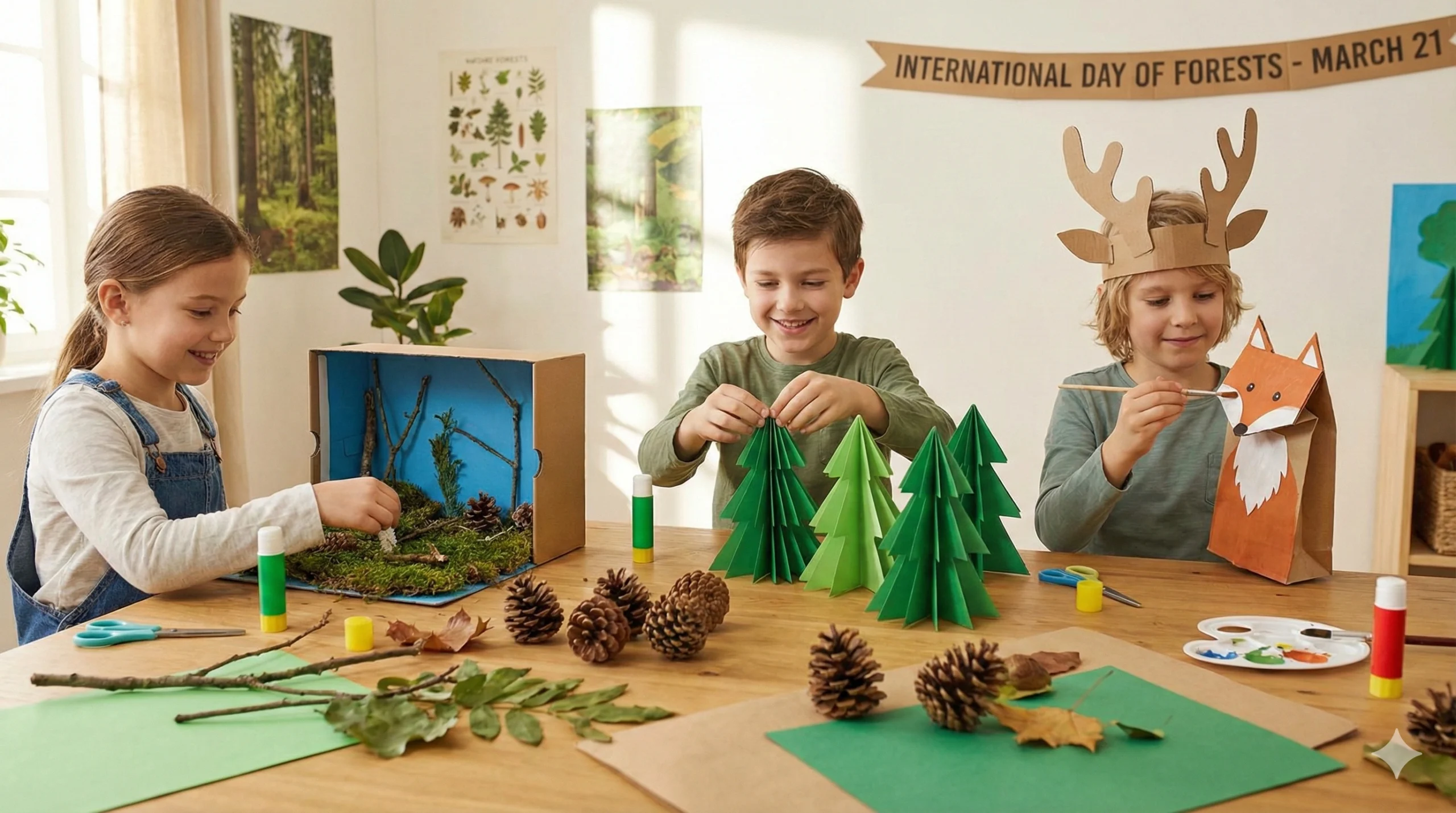
The forests are calling! It’s the International Day of Forests on March 21st, and we are celebrating with a collection of fascinating forest crafts for kids that inspire creativity and a love for nature.
I often feel that with every passing generation, children are losing touch with nature. While the kids of our grandparents’ generation spent nearly all day outdoors—climbing trees, collecting bugs, and scraping knees—the kids of today often spend just a couple of hours outside, and only if the WiFi is down.
Maintaining a relationship with nature is essential for a child’s development. It gives them a sense of the wonders of the natural world, of which they are a vital part. It teaches them the art of peaceful co-existence, showing them that every creature has its place, and that every plant blooms in its own time.
Beyond the spiritual connection, the natural world teaches us practical lessons about survival. Forests play a massive role in sustaining life on Earth. With International Day of Forests approaching on March 21st, it is the perfect opportunity to learn about how vital these ecosystems are.
Let’s go on a virtual forest adventure! Below, we explore why forests matter and dive into 10 hands-on crafts that bring the magic of the woods into your home or classroom.
Why Forests Matter: A Lesson for Little Ones
Before we get the glue sticks out, it is important to set the stage. Why are we making trees and bears today? Here is a simple way to explain the importance of forests to children:
- The Earth’s Lungs: Just like we breathe in and out, forests “breathe” for the planet. They take in carbon dioxide (which can be harmful in large amounts) and release oxygen (which we need to survive).
- Animal Homes: 70% of the world’s land animals depend on forests for their homes. Without forests, tigers, monkeys, and owls would have nowhere to sleep.
- Nature’s Pharmacy: Did you know that more than 25% of the medicines we use today originated from rainforest plants? The cure for a future illness might be hidden in a leaf right now!
5 Fun Forest Facts to Share While Crafting
- The Amazon Powerhouse: 20% of the Earth’s oxygen is produced by the Amazon Rainforest alone.
- Tree Neighbors: Trees can actually “talk” to each other underground using a network of fungi to share nutrients.
- A Crowded House: Over 300 million people live in forests worldwide.
- The Loss: We are losing nearly 6.6 million hectares of forest area per year, mostly due to human activity.
- Old Giants: Some trees, like the Great Basin Bristlecone Pine, are over 4,000 years old!
10 Creative & Educational Forest Crafts for Kids
These crafts are designed to use simple materials—often things you can recycle—to teach kids about the diversity and beauty of the woodlands.
1. The 3D Accordion Paper Forest
What is the main component of a forest? The trees, of course!
- The Concept: Celebrate the diversity of foliage by creating a standing paper forest.
- How to Make It: Use green construction paper in various shades (lime, emerald, olive). Cut out triangle tree shapes. Fold them accordion-style (back and forth). Punch a hole through the center and insert a wooden skewer or a straw as the trunk. Stick the base into a ball of playdough or a piece of cardboard so it stands upright.
- Educational Angle: Discuss how different trees have different shades of leaves depending on the season and climate.
2. The Shoebox Forest Diorama
We thoroughly enjoyed making this 3D diorama. It is a classic school project for a reason—it allows for endless creativity.
- The Concept: Create a miniature ecosystem inside an old shoebox.
- How to Make It: Paint the inside of a shoebox: blue for the sky on top, green for the background. Collect real twigs, moss, and pebbles from your garden. Glue the moss to the bottom for grass and stand the twigs up to represent trees. You can print out small pictures of animals or use plastic figurines to inhabit your tiny world. Don’t forget a vine for a monkey!
- Tip: Add a blue paper “river” running through the middle.
3. Geometric Felt Forest (Sensory Play)
Here is a simple, easy craft project perfect for toddlers and preschoolers who are learning shapes and textures.
- The Concept: An open-ended arrangement game using soft felt.
- How to Make It: Cut green felt into various sizes of triangles. Cut brown felt into rectangles for trunks. Provide a large felt board or a piece of cardboard covered in flannel. Let the child arrange and rearrange the trees to create their own woods.
- Why it works: There is no “right or wrong” way to do this. It encourages spatial awareness and fine motor skills without the mess of glue.
4. Paper Bag Woodland Puppets
If you would like to have some fun with the animals of the forest, this is the perfect upcycling project.
- The Concept: Turn boring brown lunch bags into foxes, owls, and bears.
- How to Make It: The flap of the folded paper bag serves as the animal’s mouth.
- Fox: Paint the bag orange. Glue white triangles for ears and a bushy tail on the back.
- Owl: Paint it brown. Add large circular eyes and feathers cut from construction paper.
- Bear: Add rounded ears and a black nose.
- Activity: Once dry, put on a puppet show about how the animals help each other in the wild.
5. Woodland Theme Collage
This is a great project for primary school children who are learning about biodiversity.
- The Concept: A bright, colorful art piece that combines cutting, pasting, and layout design.
- How to Make It: Give the children a large sheet of paper. Have them cut out pictures of forest elements from old magazines (flowers, trees, birds, mushrooms). Alternatively, use printable clipart. The goal is to create a dense, layered forest scene where animals are hiding behind trees or peeking out of bushes.
6. Mixed Media “Trash to Treasure” Forest
This project is a wonderful use of mixed materials to create a lifelike forest scene, emphasizing the importance of recycling.
- The Concept: Use non-traditional materials to build textures.
- How to Make It: Use a cardboard base.
- Trunks: Toilet paper rolls or paper towel tubes.
- Leaves: Bubble wrap painted green, scrunched-up tissue paper, or even real dried leaves.
- Ground: Coffee grounds or sand glued down for soil.
- The Lesson: This teaches that “waste” can be beautiful if reused, mirroring how a forest recycles dead leaves into soil.
7. The Enchanted Magic Forest
We have all read stories about enchanted forests and often wished we could visit one. Since we can’t, let’s build one!
- The Concept: A fantasy version of nature using bright, unnatural colors.
- How to Make It: Forget the green and brown. Use metallic paints, glitter, and neon paper. Create purple trees with silver trunks. Add “fairy dust” (glitter) to the canopy. Draw imaginary creatures that might live there.
- Creativity Boost: Ask your child, “What kind of fruit grows in a magic forest? Does it glow in the dark?”
8. Forest Animal Crowns
Bring the forest inside your home by gathering your friends and pretending to be a pack of wolves or a herd of deer.
- The Concept: Wearable art for role-playing games.
- How to Make It: Cut a long strip of cardstock to fit around the child’s head.
- Deer: Glue twig-shaped antlers made of brown paper.
- Raccoon: Add a grey mask and pointed ears.
- Bird: Glue colorful feathers.
- The Game: Set a time limit (e.g., 10 minutes) where everyone must act and sound only like the animal they are wearing. No human speech allowed!
9. Upcycled Cardboard Forest
This shows us how to put together scraps of cardboard leftover from other craft projects to create a modern art sculpture.
- The Concept: A structural engineering challenge using slot-assembly.
- How to Make It: Cut tree shapes out of thick cardboard. Cut a slit in the bottom center of the tree, and a slit in the top center of a cardboard “stand.” Slide them together so the tree stands up 3D. Paint them with abstract patterns—dots, stripes, or zig-zags—rather than realistic leaves.
10. Nocturnal Forest Art (Black Paper Art)
Forests can be a scary place in the dark, but they are also full of life!
- The Concept: exploring the “night shift” of the forest ecosystem.
- How to Make It: Use a sheet of black construction paper as the base.
- The Moon: Cut a large circle from white or yellow paper.
- The Eyes: Use yellow or glow-in-the-dark paint to make pairs of eyes peeking out from the dark.
- The Details: Use white chalk to draw the outlines of tree trunks and branches.
- Discussion: Talk about nocturnal animals like bats, owls, and badgers that wake up when we go to sleep.
Bringing the Lesson Home
These forest crafts for kids are more than just a way to pass a rainy afternoon. They are a gateway to a conversation about our planet.
While you are painting paper plates or gluing felt, talk to your kids about stewardship. Explain that we are the guardians of these forests. Simple actions, like using less paper, recycling, or planting a tree in the backyard, contribute to the health of the forests we just celebrated.
International Day of Forests is just one day on the calendar, but the habits we form and the respect for nature we instill in our children will last a lifetime. So, grab your scissors, get messy, and let the forest adventure begin!