
Nelson Mandela is one of the most respected leaders in modern history—a symbol of courage, forgiveness, and unity. His influence reaches far beyond South Africa, inspiring people all across the world to stand up for justice and equality. Teaching children about Mandela’s life helps them understand fairness, kindness, leadership, and the importance of standing up for what is right.
South Africa is often lovingly called the “Rainbow Nation,” a name that reflects its cultural diversity. But the country wasn’t always united. For many years, it was deeply divided under a system called apartheid, which separated people based on race. White people had privileges and power, while people of color were denied rights, opportunities, and basic freedoms. Families were separated, neighborhoods were restricted, and even simple public places weren’t shared equally.
It was in this difficult time that Nelson Mandela stood up and said: “Enough.” His courage changed the course of history.
Mandela fought for equality and justice—even when it meant being arrested. Even when it meant spending 27 long years in prison. And even after suffering so much, he chose forgiveness instead of revenge. Today, he is remembered as a hero of peace, democracy, and human rights.
Teaching children about Mandela can be an incredibly meaningful experience. These 10 Nelson Mandela activities for kids are designed to help young learners understand his life, values, and lasting impact on the world.
A Simple Timeline of Nelson Mandela’s Life (Kid-Friendly)
Before jumping into the activities, here is a brief timeline children can understand easily:
- 1918 – Born in Mvezo, South Africa
- 1942 – Became a qualified lawyer
- 1944 – Joined the African National Congress (ANC)
- 1961 – Helped form a secret resistance group called “Spear of the Nation”
- 1962 – Arrested and sentenced to life in prison
- 1990 – Released after 27 years
- 1991 – Became President of the ANC
- 1993 – Awarded the Nobel Peace Prize
- 1994 – Became South Africa’s first Black president
- 1999 – Retired from active politics
- 2013 – Passed away at the age of 95
In 2009, the United Nations declared 18 July as Mandela Day, encouraging people to dedicate 67 minutes of service—one for each year Mandela spent fighting for justice.
10 Nelson Mandela Activities for Kids
These activities are educational, engaging, and suitable for classrooms, homeschooling, cultural celebrations, and Mandela Day programs.
1. Mandela Fact Sheet + Coloring Activity
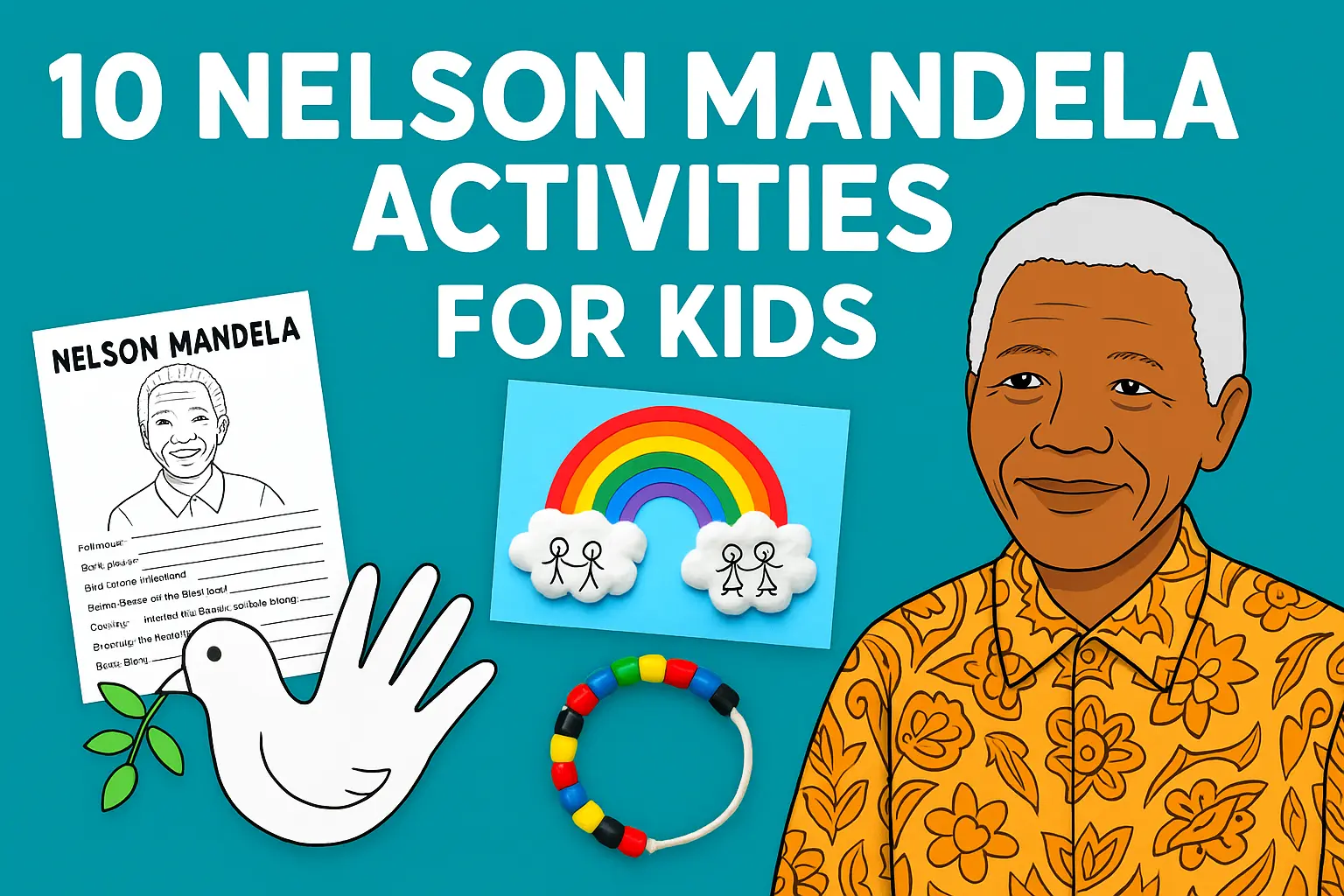
Create a simple printable fact sheet with Mandela’s portrait, a few fun facts, and key dates. Kids can color the border, add stickers, or decorate it with South African symbols. This activity combines learning with creativity.
Fun fact to include:
Mandela was originally named Rolihlahla, a Xhosa word meaning “troublemaker.” His school teacher later gave him the English name “Nelson.”
2. Make a “Rainbow Nation” Craft
Since Mandela helped unite South Africa, children can create a rainbow craft to symbolize togetherness and diversity. Use paper strips, beads, yarn, or paint to create a bright rainbow that celebrates unity among different cultures.
Ask children what “rainbow nation” means to them and have them write a small sentence under their craft.
3. Mandela Peace Dove Craft
Mandela believed strongly in peaceful solutions. Kids can create a paper peace dove using white paper, feathers, or cotton. Add a small olive branch or a banner that says “Peace,” “Hope,” or “Unity.”
This helps children connect Mandela’s message with art.
4. Mandela Quote Posters
Mandela’s speeches are full of powerful messages that even children can understand. Provide short, simple quotes such as:
- “It always seems impossible until it’s done.”
- “Education is the most powerful weapon you can use to change the world.”
- “Courage is not the absence of fear.”
Kids can design their own mini posters with markers, paint, or collage materials. These posters make great classroom displays for Mandela Day.
5. Storytime: The Life of MandelaFor younger children, read a simplified story about Mandela’s life. After reading, ask:
- What made Mandela brave?
- Why did he fight for equality?
- Why is forgiveness important?
Let kids draw one scene from Mandela’s story—a prison cell, voting day, or Mandela giving a speech.
6. Make a Mandela T-Shirt or Badge
Older kids can design simple Mandela-themed T-shirts or badges using:
- Fabric markers
- Felt
- Printed outlines
- Iron-on patches
They can draw Mandela, the word “Freedom,” a peace sign, or the South African flag. This activity encourages self-expression and can be worn proudly during cultural events.
7. Kindness Challenge – 67 Minutes for Mandela
Teach kids the meaning of Mandela Day by asking them to complete small acts of kindness for 67 minutes.
Examples:
• Helping a younger sibling
• Cleaning up a shared space
• Writing thank-you notes
• Reading to a friend
• Donating an item
Kids can write down their acts in a “Kindness Log Book.”
8. South African Flag Mosaic
Use colored paper squares, buttons, or beads to create a vibrant mosaic version of the South African flag. This introduces children to the colors of the nation and their symbolic meanings—unity, hope, and diversity.
9. Mandela Paper Doll or Puppet
Kids can make a Mandela puppet using paper, popsicle sticks, felt, or fabric scraps. Add small details like:
- A suit and tie
- A patterned shirt (Mandela’s famous “Madiba shirts”)
- A small flag
Use the puppet for storytelling or role play.Freedom bracelets can be made using beads that represent different ideas:White (peace)
- Yellow (hope)
- Green (growth)
- Red (courage)
- Blue (truth)
- Black (strength)
Kids can wear these bracelets as reminders of Mandela’s values.
Teaching children about Nelson Mandela is more than a history lesson. It reinforces:
✔ Respect for diversity
Kids learn that people of all backgrounds deserve equal rights.
✔ Courage and leadership
Mandela showed that peaceful leadership can change nations.
✔ Forgiveness
His example teaches children to let go of anger and choose unity.
✔ The power of education
Mandela believed education could change the world.
✔ Service to others
Even small acts can make a big difference.
Conclusion
Nelson Mandela’s life is a powerful story of courage, resilience, and hope. These 10 Nelson Mandela activities for kids provide fun and meaningful ways for children to learn about the man who transformed South Africa and inspired the world.
Through crafts, printables, stories, and acts of kindness, kids can explore Mandela’s values—freedom, unity, peace, and equality. Whether in a classroom, at home, or during a Mandela Day event, these activities help carry forward Madiba’s legacy for the next generation.