
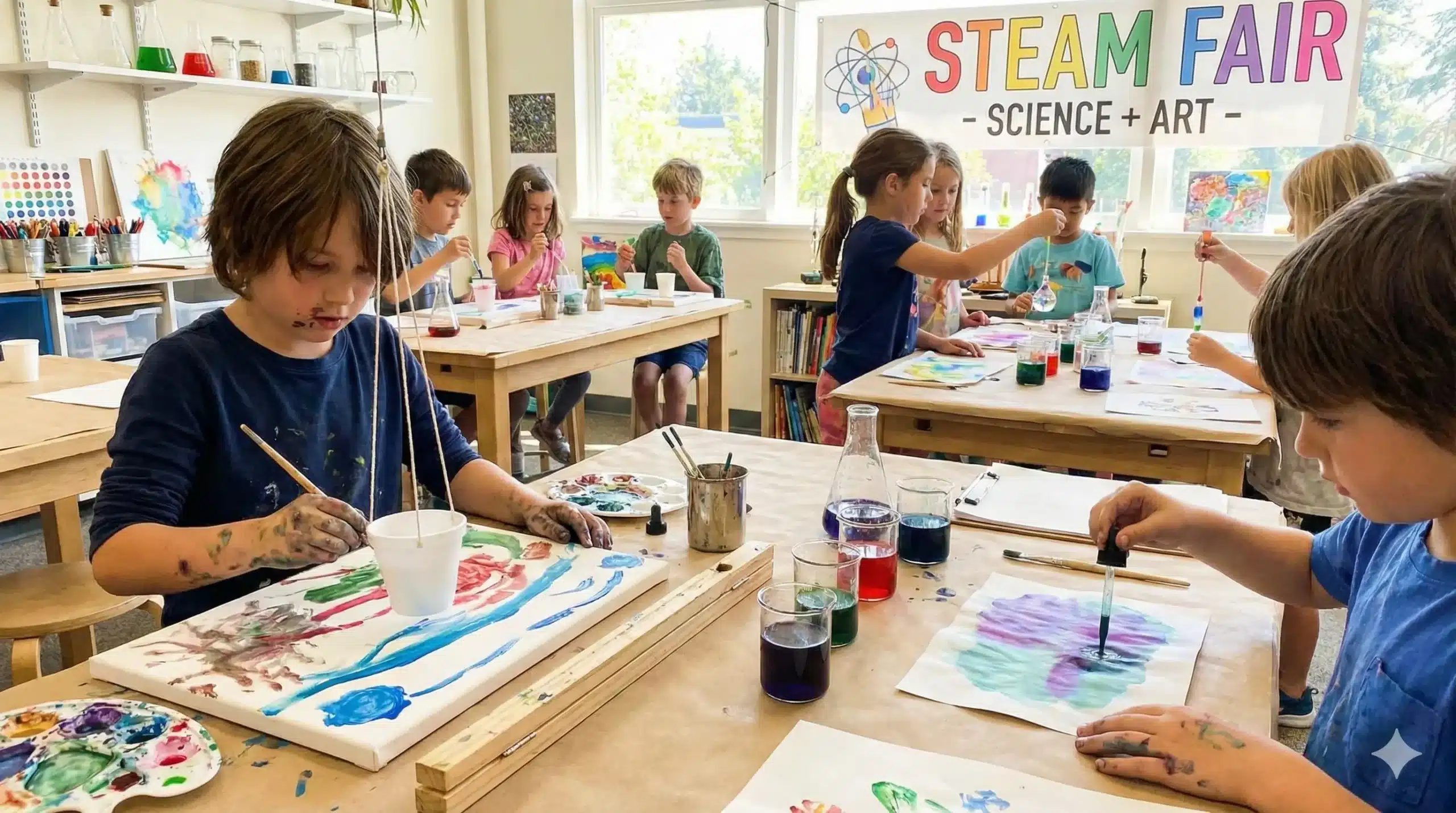
We often hear about STEM (Science, Technology, Engineering, and Math) as the gold standard for modern education. But there is a missing letter that transforms a rigorous subject into a world of creativity and wonder: “A” for Art.
When you add Art to the mix, STEM becomes STEAM. This approach acknowledges that scientists and artists are very similar; they both ask “Why?”, they both experiment, and they both observe the world in unique ways.
To celebrate the spirit of inquiry, we are diving into 15 Awesome Science Art Projects for Kids. These activities are perfect for the classroom, a rainy weekend, or celebrating National Science Day. But before we get messy with paint and experiments, let’s look at the inspiration behind our celebration of science.
The Story of the Blue Sea: A Tribute to Sir C.V. Raman
One day, way back in 1921, a young scientist was sitting on the deck of a ship sailing across the vast Mediterranean Sea. He looked out at the gorgeous, deep blue water and began to wonder—why is the sea blue?
At the time, the common belief was that the sea simply reflected the color of the sky. But this young scientist wasn’t satisfied with that answer. He was a man of deep curiosity. He began investigating this phenomenon, extending his studies all the way to the Bay of Bengal.
Eventually, he discovered that the color of water wasn’t just a reflection. It was due to the scattering of light by the water molecules themselves. Specifically, he found that the color comes from a “selective absorption of longer wavelengths of light in the red and orange regions of the spectrum,” combined with the scattering effect.
That inquisitive man was Sir C.V. Raman, one of India’s most celebrated physicists.
A Legacy of Curiosity
Sir C.V. Raman was a true child prodigy. He completed high school at age 13, college at 16, and his Masters before he turned 20! It is no surprise that he went on to win the Nobel Prize for Physics at the young age of 42. He was the first Asian to win a Nobel Prize in any field of science.
The prize was awarded for his discovery of the “scattering of light,” a phenomenon now known as the Raman Effect. This discovery was confirmed on February 28th, and since 1986, this day has been celebrated across India as National Science Day.
It is a day to encourage scientific research, ask questions, and marvel at how the world works. And what better way to do that than by making art with science?
15 Awesome Science Art Projects for Kids
Here are 15 projects that blend creativity with chemistry, physics, and biology. These activities prove that science isn’t just about textbooks—it’s about creating something beautiful.
1. Salt and Watercolor Galaxies
Creating art with watercolor is classic, but adding salt changes the game entirely.
- The Art: Have kids paint a sheet of paper with very wet watercolors. While the paint is still wet, sprinkle coarse salt (sea salt or kosher salt) over the paper. Let it dry completely and then brush the salt off.
- The Science: This demonstrates absorption and hygroscopy. Salt is hygroscopic, meaning it absorbs moisture. As it sits on the wet paper, the salt pulls the water (and the pigment) toward it, creating starburst patterns that look like distant galaxies.
2. Magic Milk Marbling
This is a mesmerizing activity that changes every second.
- The Art: Pour whole milk into a shallow dish. Add drops of food coloring. Dip a cotton swab in dish soap and touch the milk’s surface. Watch the colors explode and swirl! You can place a piece of watercolor paper on top to capture the print.
- The Science: This is a lesson in surface tension and molecular bonds. Milk contains fat. Dish soap is a “degreaser” that weakens the chemical bonds that hold the proteins and fats in the milk. The molecules race around to find new bonds, carrying the colors with them in a wild dance.
3. Chromatography Butterflies
Turn a black marker into a rainbow.
- The Art: Draw a thick circle with a non-permanent black marker on a coffee filter. Fold the filter into a cone and dip the tip in water. Watch the colors climb! Once dry, scrunch the filter in the middle and wrap with a pipe cleaner to make a butterfly.
- The Science: This is chromatography. It separates mixtures. The black ink is actually made of many different colors. As the water travels up the paper (capillary action), it carries the ink pigments with it. Different pigments travel at different speeds, separating into bands of color.
4. Pendulum Painting
Physics meets Jackson Pollock in this messy, fun project.
- The Art: Create a tripod using bamboo sticks or use a camera tripod. Hang a cup with a hole in the bottom from the center. Fill the cup with watered-down paint. Swing the cup over a canvas and watch the geometric patterns form.
- The Science: This demonstrates the forces of gravity and motion. The pendulum wants to return to its center point due to gravity, but its momentum keeps it swinging. The resulting pattern is a visual representation of these physical forces losing energy over time.
5. Oil and Water Droplet Painting
- The Art: Mix food coloring with water in a tray. Use a dropper to add drops of vegetable oil. Place a piece of paper on top of the liquid to make a print.
- The Science: Immiscibility. We all know oil and water don’t mix. The oil is less dense and hydrophobic (water-fearing), so it floats on top and creates barriers that the colored water cannot penetrate, leaving white negative space on your paper.
6. Invisible Ink with Lemon Juice
Secret spy messages are the ultimate science art.
- The Art: Paint a picture or write a message using lemon juice. Let it dry (it will disappear). To reveal the art, carefully heat the paper (near a lightbulb or iron it).
- The Science: This is an oxidation reaction. Lemon juice is acidic and contains carbon compounds. When you heat the dried juice, the carbon compounds break down and oxidize (react with oxygen), turning brown before the rest of the paper burns.
7. Shadow Art Tracing
- The Art: Set up toy animals or shapes on the edge of a paper in the sunlight. Have the child trace the long shadows cast by the objects.
- The Science: This teaches light paths and perspective. It’s a great way to explain how light travels in straight lines and how an opaque object blocks that light to create a shadow. You can do this at different times of the day to see how the angle of the sun changes the shadow’s length.
8. Baking Soda & Vinegar Erupting Colors
- The Art: Sprinkle baking soda all over a tray. Drip food coloring in various spots. Use a dropper to squirt vinegar onto the colors. It will fizz and bubble, mixing the colors into abstract art.
- The Science: A classic acid-base reaction. The acetic acid (vinegar) reacts with sodium bicarbonate (baking soda) to create carbon dioxide gas. The gas bubbles are what create the fizzing and movement in the art.
9. Nature Sun Prints (Cyanotype)
- The Art: Use special solar paper (Sunprint paper). Place leaves, flowers, or feathers on the paper and leave it in the bright sun. Rinse the paper in water to reveal a deep blue print with white silhouettes.
- The Science: This is a photochemical reaction. The paper is treated with light-sensitive chemicals. Ultraviolet (UV) rays from the sun react with the chemicals to turn the paper blue, while the areas blocked by the leaves remain white.
10. Thaumatropes (Optical Illusions)
- The Art: Cut out a cardboard circle. Draw a bird on one side and a cage on the other. Punch holes on the sides and use rubber bands to spin the circle rapidly. It will look like the bird is inside the cage.
- The Science: Persistence of vision. Our eyes (and brain) retain an image for a fraction of a second after it disappears. When the images spin fast enough, the brain blends the two images into one. This is the basis of how animation works!
11. Cabbage Juice Chemistry Art
- The Art: Boil red cabbage to make a purple liquid. Paint a piece of watercolor paper with this juice. Now, paint over it with lemon juice (turns pink) or baking soda water (turns blue/green).
- The Science: Red cabbage contains a pigment called anthocyanin, which acts as a natural pH indicator. It changes color depending on whether it is exposed to an acid or a base.
12. Spinning Top Art
- The Art: Place a piece of paper inside a salad spinner. Drop blobs of paint inside. Spin it as fast as you can!
- The Science: Centrifugal force. As the spinner rotates, the paint is pushed outward away from the center. It illustrates the laws of motion and inertia.
13. Oobleck Sculptures
- The Art: Mix cornstarch and water (2:1 ratio) and add food coloring. Try to mold it or let it drip through your fingers to make temporary sculptures.
- The Science: Oobleck is a Non-Newtonian fluid. It acts like a liquid when poured but acts like a solid when you apply force (pressure). It’s a fascinating exploration of the states of matter.
14. Crystal Suncatchers
- The Art: Bend pipe cleaners into shapes (hearts, stars). Suspend them in a jar filled with a supersaturated solution of Borax and hot water. Leave overnight. By morning, the pipe cleaners will be covered in sparkling crystals.
- The Science: Crystallization and supersaturation. Hot water can hold more dissolved solid (solute) than cold water. As the water cools, it can no longer hold the Borax particles, so they settle on the pipe cleaner and bond together to form crystals.
15. Magnetic Painting
- The Art: Put a piece of paper inside a cardboard box. Squirt some paint on it. Drop in a few metal objects (nuts, bolts, paperclips). Hold a strong magnet underneath the box and move it around to drag the metal pieces through the paint.
- The Science: Magnetism. The magnet’s force passes through the cardboard box to attract the metal objects. This project helps kids “see” the invisible magnetic field in action.
Why STEAM Matters
Why should we bother combining these subjects?
- It encourages risk-taking: In art, there are no “wrong” answers, just different outcomes. This helps kids feel safe to experiment in science.
- It aids visualization: Many scientific concepts (like atoms or forces) are invisible. Art helps children visualize and model these concepts.
- It makes learning memorable: A child might forget a definition of surface tension read from a book, but they will never forget the explosion of color in the Magic Milk experiment.
Conclusion
Sir C.V. Raman looked at the sea and saw a question waiting to be answered. That is the spirit we want to cultivate in our children. By using these science art projects, we aren’t just making pretty pictures to hang on the fridge. We are building neural pathways, sparking curiosity, and perhaps inspiring the next Nobel Prize winner.