
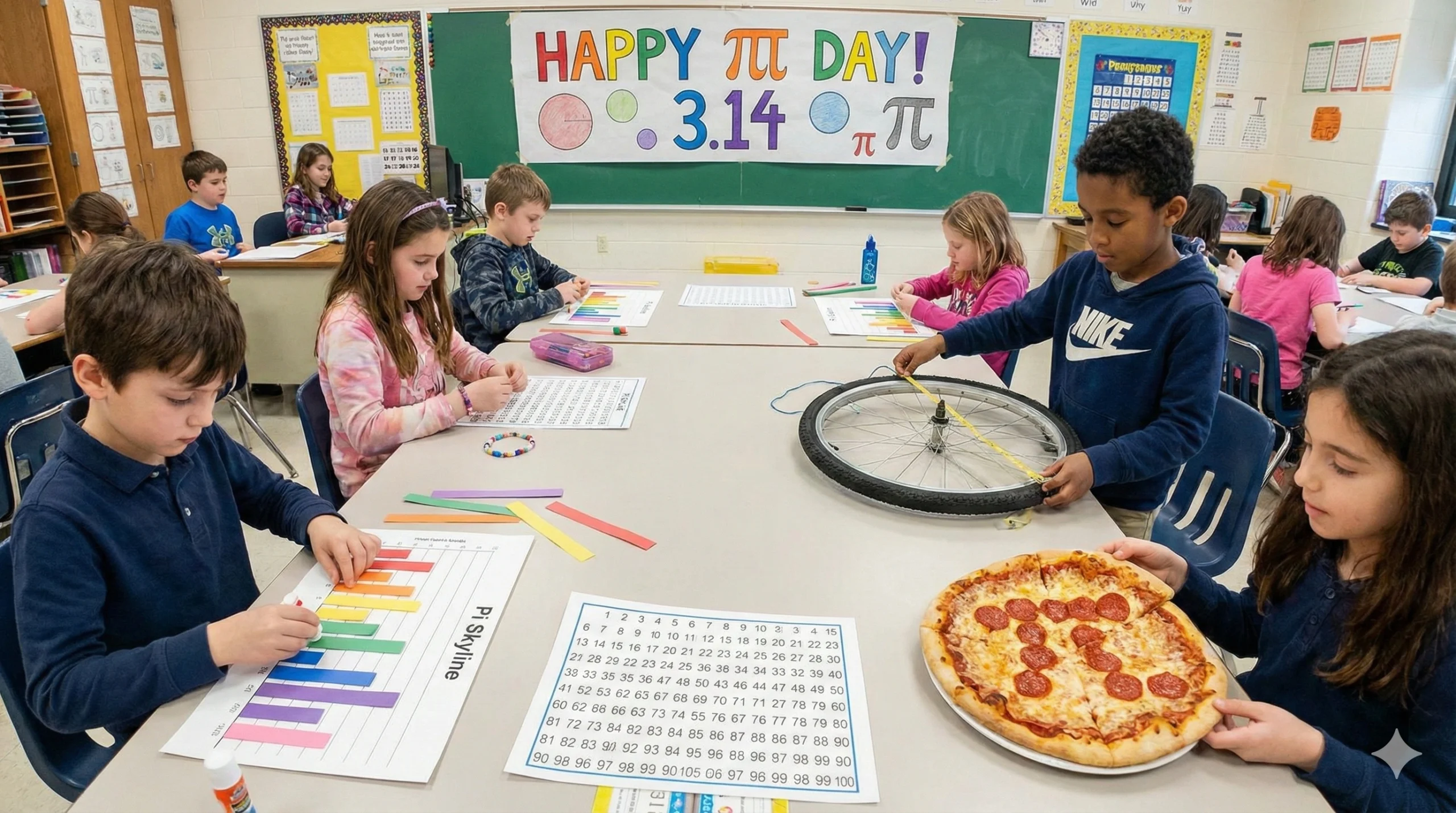
It’s Pi Day, and we’re all set to celebrate with these fun Pi Day activities for kids! From art projects and crafts to STEM challenges, here is everything you need to make math magical.
Did you know that 3.14% of all sailors are Pi-rates?
If you got that math joke instantly, you represent a special slice of the population! With Pi Day coming up on March 14th, you need to be prepared for puns, pie, and a whole lot of problem-solving fun.
While math can sometimes feel intimidating to children, Pi Day is the perfect opportunity to show them the creative, mysterious, and delicious side of numbers. Whether you are a teacher looking for classroom ideas or a parent wanting to do some educational crafting at home, this guide covers it all.
What Exactly is Pi Day?
Before we dive into the glue and glitter, let’s cover the basics. Pi, symbolized by the Greek letter $\pi$, is an irrational number. This means its digits go on forever without repeating a pattern.
Pi is crucial for mathematics because it represents the ratio of a circle’s circumference (the distance around the circle) to its diameter (the distance across the circle). No matter how big or small the circle is—from a dinner plate to a planet—that ratio is always Pi.
We usually round Pi to 3.14. Since March 14th is written as 3/14 in the month/day date format, it has officially become the day we celebrate this mathematical constant!
5 Fun Facts About Pi to Share with Kids
Kick off your celebration with some trivia. Kids love knowing “weird” facts!
- Ancient Origins: The Ancient Egyptians were the first people to find a ratio between the radius and circumference of a circle, though their calculation wasn’t quite as precise as ours today.
- Double 16s: Pi is the 16th letter of the Greek alphabet, and P is the 16th letter of the English alphabet. Coincidence? Maybe!
- The Fraction: While we use 3.14, some calculations use the fraction 22/7 as an approximation for Pi.
- Genius Birthday: Albert Einstein, perhaps the most famous physicist in history, was born on March 14th, 1879. It’s a double celebration of science!
- Space Math: NASA states that to calculate the circumference of the visible universe to the precision of the size of a hydrogen atom, you only need about 39 or 40 decimal places of Pi.
15 Creative Pi Day Activities for Kids
We have curated a list of activities that range from simple arts and crafts to active movement games. These are designed to be low-prep but high-engagement.
1. Create a “Pi Skyline” Cityscape
This is a fantastic way to visualize the digits of Pi.
- What you need: Graph paper, black markers, and watercolors or colored pencils.
- How to do it: Write the digits of Pi across the bottom of the graph paper (3, 1, 4, 1, 5, 9…). Have the kids color in a column of squares corresponding to each number. For example, the first column is 3 squares high, the next is 1 square high, the next is 4. When finished, it looks like a city skyline! You can paint the background like a sunset for a beautiful piece of math art.
2. The Pi Paper Chain
This is a great collaborative project for a classroom or siblings.
- The Activity: Assign a specific color of construction paper to each digit from 0 to 9 (e.g., 0=White, 1=Red, 2=Blue, 3=Yellow, etc.). Cut the paper into strips.
- The Goal: Start linking the strips in the order of Pi’s digits. See how long you can make the chain! Since Pi is infinite, the chain can go on forever—or at least until you run out of paper.
3. Pi Bead Bracelets
Turn math into fashion with this fine-motor activity.
- The Activity: Similar to the paper chain, assign a colored bead to each number. String the beads onto a pipe cleaner or elastic cord in the order of Pi (3.14159…).
- Why it works: It helps kids memorize the first few digits of Pi while creating a wearable reminder of the day.
4. The “String Theory” Experiment
Prove that Pi is real!
- The Activity: Gather various circular objects (cans, lids, cups). Have the kids measure the diameter of the object with a string, then cut the string.
- The Challenge: Ask them to guess how many “diameter strings” it will take to go around the outside of the circle (the circumference). They will find that it takes three strings plus a little tiny bit more. That “little bit more” is the .14!
5. Bake a Pi Pie
You cannot celebrate March 14th without the food that sounds just like it.
- The Activity: Bake a classic apple or pumpkin pie.
- The Twist: Use extra dough to cut out the symbol $\pi$ or the numbers 3.14 and place them on top of the crust before baking. If you aren’t a baker, buying a round pizza works just as well—it’s a “Pizza Pi”!
6. Albert Einstein Craft
Since it is Einstein’s birthday, pay homage to the genius.
- The Activity: Use a paper plate as the face. Glue on crazy white yarn or cotton balls for his famous wild hair and a bushy white mustache. Add googly eyes. You can even stick out a pink paper tongue to mimic his famous photograph!
7. Circle Art (Kandinsky Style)
Wassily Kandinsky was a famous artist known for his “Concentric Circles.”
- The Activity: Divide a paper into squares. Inside each square, have the kids paint or color circles inside of circles using different contrasting colors. It’s a beautiful way to celebrate the shape that makes Pi possible.
8. Pi Day Scavenger Hunt
Get the kids moving!
- The Activity: Give the kids a ruler and a list of circular items to find around the house or classroom (e.g., a clock, a wheel, a coin, a coaster).
- The Math: They must measure the diameter of each item and record it. For older kids, have them calculate the circumference using the formula $C = \pi \times d$.
9. Write a “Pi-Ku”
Move over, Haiku!
- The Activity: A Haiku is a poem with a 5-7-5 syllable structure. A Pi-Ku follows the digits of Pi: 3 syllables, 1 syllable, 4 syllables.
- Example:
- Math is great (3)
- Pi (1)
- Day is the best (4)
10. The Buffon’s Needle Toss (Simplified)
This is a famous probability experiment that results in Pi.
- The Activity: On a large sheet of paper, draw parallel lines that are exactly one toothpick’s length apart.
- The Game: Have kids drop a handful of toothpicks onto the paper from a height.
- The Math: Count the total toothpicks dropped versus the number of toothpicks that cross a line. If you do this enough times, the ratio approaches Pi! (This is great for older elementary or middle school students).
11. Dot Art Circles
This promotes patience and artistic focus.
- The Activity: Give kids a template of the Pi symbol or a large circle. Instead of coloring it in normally, use Q-tips dipped in paint to fill the shape with dots. This technique is called pointillism.
12. “Pi”ñata Party
If you want to go big, this is the ultimate crowd-pleaser.
- The Activity: Create (or buy and modify) a round piñata. Decorate it with the $\pi$ symbol.
- The Fun: Fill it with circular treats like lollipops, peppermint patties, or chocolate coins.
13. Memorization Challenge
This is a classic Pi Day tradition.
- The Activity: Print out the first 50 or 100 digits of Pi. Give the kids 10 minutes to study it.
- The Contest: See who can recite the most digits from memory. Offer a prize (maybe a mini pie?) to the winner.
14. Playdough Math Mats
Perfect for preschoolers.
- The Activity: Print out large outlines of the numbers 3, 1, and 4, and the symbol $\pi$.
- The Fun: Have the little ones roll “snakes” out of playdough to trace the shapes. It helps with number recognition and sensory play.
15. The “Cut the Pi” Puzzle
A DIY logic puzzle.
- The Activity: Take a large paper plate and write the digits of Pi all over it in random places. Paint the background.
- The Game: Cut the plate into puzzle pieces. Have the child try to reassemble the circle. It teaches them that Pi is essential to the “whole” circle!
Why Celebrating Pi Day Matters
You might wonder, why go through all this trouble for a math constant?
In a world that is increasingly driven by STEM (Science, Technology, Engineering, and Math), fostering a love for numbers early on is vital. Many children develop “math anxiety” because they see numbers as cold facts on a worksheet.
By turning March 14th into a celebration, you are changing the narrative. You are showing them that math is found in art (the skyline), in nature (the circles), in history (the pyramids), and even in their lunch (the pie!).
Conclusion
Whether you choose to build a city out of graph paper, memorize 50 digits, or simply enjoy a slice of cherry pie while talking about Einstein, the goal is to have fun.