
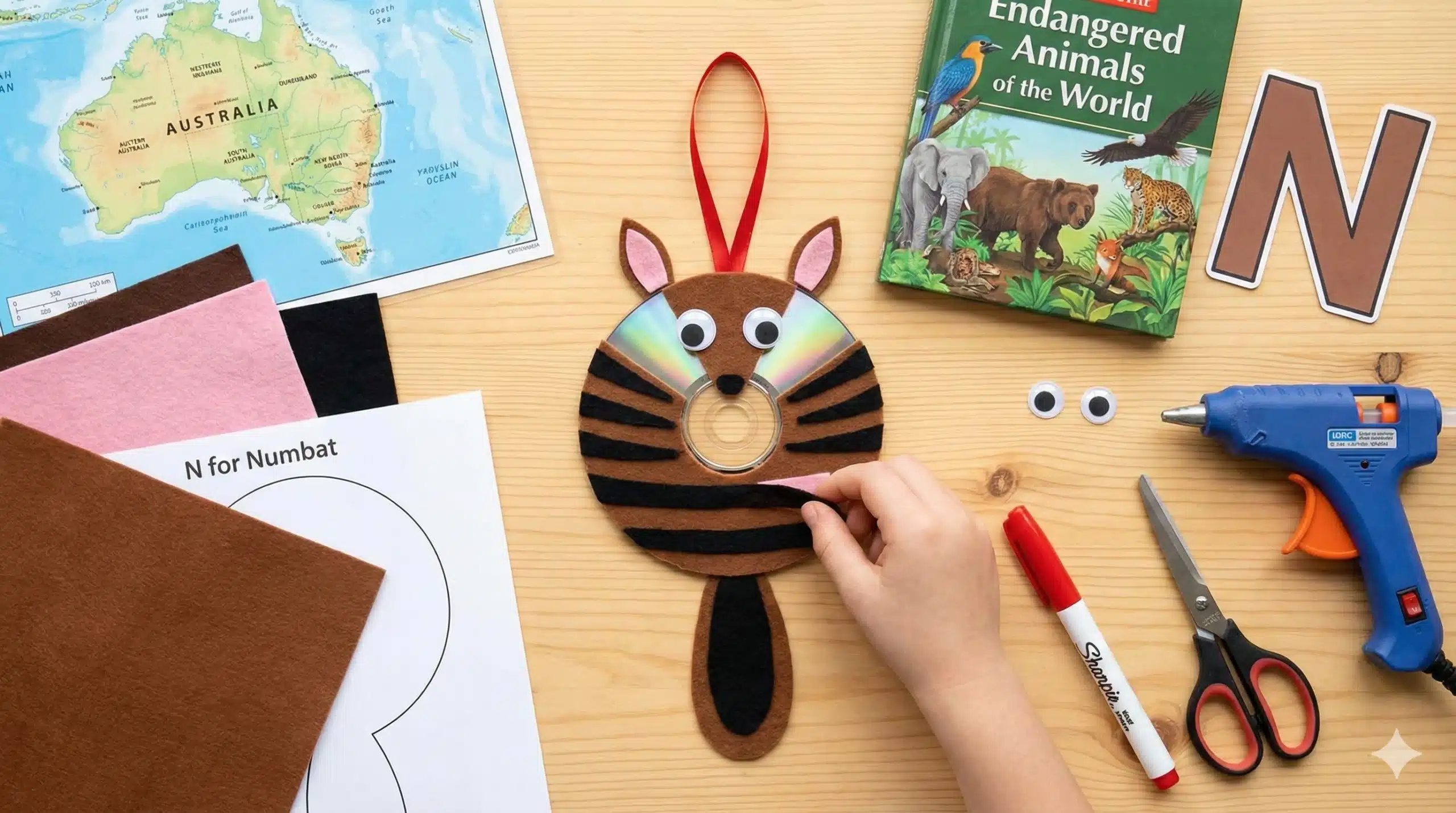
When exploring the alphabet with young children, the letter N can sometimes be a bit of a challenge. We often default to “Nest,” “Newt,” or “Narwhal.” While those are wonderful, today we are taking a trip down under to Western Australia to discover a truly unique and adorable creature: the Numbat!
This N for Numbat Craft is the perfect addition to your “Letter of the Week” curriculum, a unit on Australian wildlife, or a lesson about endangered species. Using simple materials like an old CD and some felt or paper, we will transform recycled items into a cute “Banded Anteater.”
Not only is this craft fun, but it also provides a fantastic opportunity to teach children about a mammal they have likely never heard of before. Let’s grab our scissors and glue and jump into the world of the Numbat!
What in the World is a Numbat?
Before we dive into the glue and glitter, let’s set the stage. If you ask a room full of kindergarteners what a Numbat is, you will likely get blank stares. This is what makes this craft so special—it is a journey of discovery.
The Numbat is a small, colorful creature native to Australia. Unlike kangaroos or koalas, the Numbat doesn’t get as much fame, but it is just as fascinating. It is a marsupial (like a kangaroo), but here is the twist: it doesn’t have a pouch!
They are famous for their beautiful stripes, bushy tails, and long, sticky tongues used for slurping up termites. By introducing this animal during your Letter N activities, you are expanding your child’s vocabulary and knowledge of global biodiversity.
Educational Benefits of This Craft
Crafting is about more than just making something pretty. This specific project focuses on several developmental areas for kids aged 5 and up:
- Fine Motor Skills: Cutting out the specific shapes for the ears, nose, and stripes requires hand-eye coordination and scissor control.
- Visual Perception: Arranging the stripes on the Numbat’s back (the CD) helps children understand patterns and spatial relationships.
- Phonics & Letter Recognition: Associating the sound /n/ with a tangible character helps solidify the letter in a child’s memory.
- Environmental Awareness: Since the Numbat is an endangered species, this craft opens the door to conversations about conservation and protecting nature.
Supplies You Will Need
We love this craft because it utilizes upcycling. In an era of digital streaming, we all have old CDs or DVDs gathering dust. This project gives them a second life!
Main Materials:
- An Old CD or DVD: This acts as the body of the Numbat.
- Printable Template: (You can draw your own shapes based on the description below if you don’t have a printer).
- Felt Sheets: We recommend Stiff Felt (2mm) because it holds its shape well. You will need:
- Light Brown/Tan (for the face and body bands).
- Black (for the stripes and nose).
- Pink (for the inner ears).
- White (for the eye backdrop or stripes).
- Alternative: If you don’t have felt, Construction Paper or Craft Foam works perfectly.
Tools & Embellishments:
- Scissors: Sharp enough to cut felt (adult supervision required for thick felt).
- Glue: A Hot Glue Gun works best for felt and CDs (adults only). Use Tacky Glue or a strong Glue Stick if working with paper.
- Googly Eyes: The bigger, the cuter!
- Red Satin Ribbon: For a hanging loop if you want to display it.
- Marker/Chalk: To trace the template onto the felt.
Step-by-Step Instructions: Making Your Numbat
Follow these simple steps to bring your Numbat to life.
Step 1: Prepare the “Body”
Take your old CD. You have two choices here:
- The Shiny Look: Leave the CD as is. The iridescent reflection makes the Numbat look magical and catches the light.
- The Realistic Look: Cover the CD with a circle of light brown felt or paper to match the animal’s actual fur color. Teacher Tip: If you leave it shiny, tell the kids it represents the Numbat basking in the Australian sun!
Step 2: Prepare the Template Pieces
Download a Numbat template or draw your own parts. You will need to draw and cut out:
- A pear-shaped piece for the Head (Light Brown).
- Two triangular Ears (Light Brown).
- Two smaller triangles for Inner Ears (Pink).
- A small oval for the Nose (Black).
- 3 to 4 long, thin strips for the Stripes (Black and White).
Step 3: Trace and Cut
Place your paper templates onto the felt sheets. Use a piece of chalk (on black felt) or a marker (on light felt) to trace the shapes.
- Fine Motor Challenge: Encourage older children to cut along the lines themselves. For younger toddlers, pre-cut the pieces to avoid frustration.
Step 4: Assemble the Face
Let’s give our Numbat some personality!
- Glue the Pink Inner Ears onto the larger Light Brown Ears.
- Glue the completed ears to the top of the Head shape.
- Glue the Black Nose to the pointy bottom of the face.
- Stick on two large Googly Eyes.
- Optional: Use a black marker to draw a little mouth or whiskers!
Step 5: The Famous Stripes
The defining feature of a Numbat is its stripes.
- Take your CD (the body).
- Glue the Black and White strips horizontally across the CD.
- Design Tip: You can alternate colors or make them different lengths. Let the child decide how their unique Numbat should look.
Step 6: Putting It All Together
- Glue the completed Head onto the top edge of the CD (body).
- If you want to create a tail, you can cut a fluffy shape from the brown felt and attach it to the side, though the face and round body are often enough for this stylized craft.
Step 7: Ready to Hang
Cut a length of red satin ribbon (about 6 inches). Loop it and glue the ends to the back of the CD. Now your Numbat is ready to hang on the classroom wall, the Christmas tree, or a doorknob!
5 Fun Numbat Facts for Kids
While the kids are busy gluing and pasting, engage their minds with these fascinating facts. This turns “arts and crafts time” into a science lesson!
- The Termite Hunter: Numbats are insectivores. They eat almost exclusively termites. They don’t eat ants, just termites!
- A Big Appetite: A single Numbat can eat up to 20,000 termites in just one day. That is like eating 20,000 grains of rice!
- Super Tongue: They have a very long, thin, sticky tongue that they stick down into termite tunnels to fish out their dinner.
- Daytime Sleepers? No way!: Unlike many Australian animals that are nocturnal (awake at night), Numbats are diurnal. This means they are awake during the day, just like us, because that is when termites are active.
- No Pouch: Even though they are marsupials (related to Koalas), mother Numbats don’t have a pouch. The babies cling to their mommy’s belly fur instead.
Extension Activities for the Letter N
Don’t let the learning stop when the glue dries. Here are a few ways to extend the theme:
1. N is for Nocturnal vs. Diurnal Discuss the difference between animals that sleep at night (like us and the Numbat) and animals that sleep during the day (like Owls). Sort plastic animals into two piles: Day and Night.
2. Sensory Bin: Termite Dig Fill a bin with sand or rice. Hide small black beans (representing termites) inside. Give the children tweezers or clothespins (representing the Numbat’s beak/tongue) and see how many “termites” they can catch in one minute.
3. Geography Lesson Pull out a map or globe. Ask the child to find where they live, and then help them find Australia. Trace a line to show how far away the Numbat lives. Discuss the weather there (hot and dry) compared to where you are.
4. Endangered Species Talk Explain that there are fewer than 1,000 Numbats left in the wild. Discuss simple ways we can help animals, like picking up trash, recycling (like we did with the CD!), and planting trees.
Conclusion
The N for Numbat Craft is more than just a cute project; it’s a bridge to understanding a unique part of our natural world. By moving away from the standard “N is for Nurse” or “N is for Nest,” we spark curiosity in children. We teach them that the animal kingdom is vast, weird, and wonderful.
Whether you are a homeschool parent looking to spice up your alphabet curriculum, or a teacher needing a prop for a unit on Australia, this crafty Numbat is sure to steal your heart.