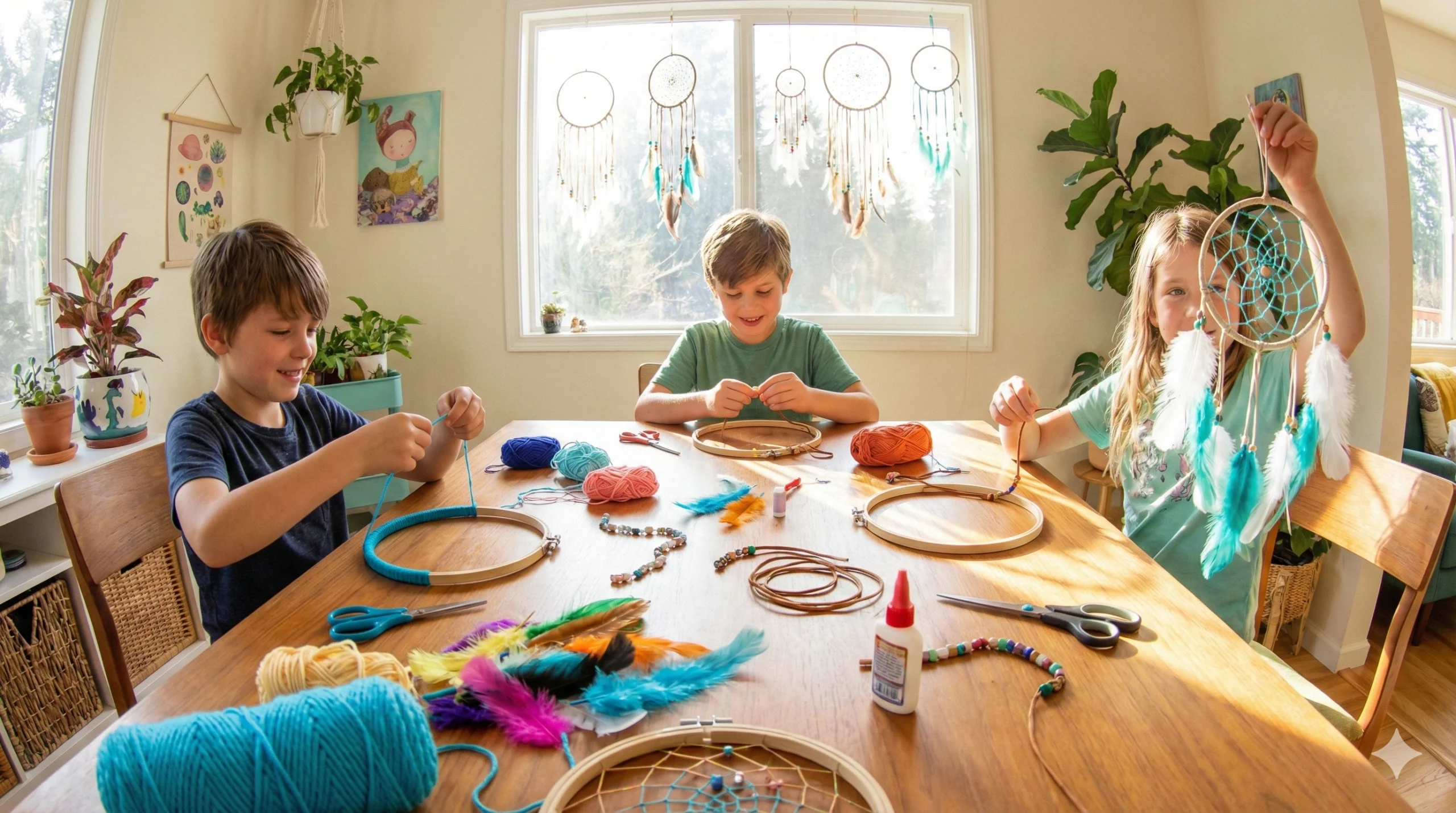
Do you remember your dreams when you wake up? Most of the time, even if the details are fuzzy, we remember the feeling—whether it was a sweet adventure or a scary nightmare. If your little ones are struggling with the latter, it might be time to introduce a little bit of magic into their bedtime routine.
With World Dream Day coming up on September 25th, there is no better time to get creative and banish those bad dreams for good.
While you can buy dream catchers in stores, making one by hand adds a layer of personal intention and love that makes the “magic” feel even stronger. Plus, it is a fantastic way to improve fine motor skills and unleash creativity.
Here is everything you need to know about the history of this fascinating talisman, followed by 10 fun and easy DIY Dream Catcher ideas for kids of all ages.
What is a Dream Catcher? (The History & Legend)
Before we dive into the glue and glitter, it is important to teach children the cultural significance of what they are making.
The dream catcher is a protective talisman rooted in Native American culture, specifically originating from the Ojibwe (Chippewa) people and later adopted by the Lakota and other nations. It was traditionally used for young children and hung above their cradles or beds.
The Legend of the Spider Woman
The most popular legend tells the story of Asibikaashi (Spider Woman). She was the spiritual protector of the Ojibwe people, taking care of the children. As the tribe grew and spread across the land, it became difficult for Asibikaashi to reach every child before bedtime.
So, the mothers and grandmothers began weaving magical webs for the children, using willow hoops and sinew (cord). The legend says that these webs filter the night air.
Bad Dreams: Get caught in the sticky web and perish when the morning sun hits them.
Good Dreams: Pass through the center hole and slide down the feathers to the sleeping child below.
Do They Really Work?
This is a question kids often ask! From a scientific perspective, there is no proof that a hoop and string can alter brain waves. However, from a psychological perspective, they work wonders.
Having a tangible object that represents safety can help alleviate a child’s anxiety about bedtime. It acts as a “worry stone” or a security blanket, giving the child the confidence to sleep soundly.
Where to Hang Your Dream Catcher
Tradition and function suggest three main spots:
Above the Bed: The most traditional spot to “catch” dreams before they reach the sleeper.
The Window: Since windows are entry points for energy and light, hanging one here allows the morning sun to “cleanse” the bad dreams caught in the web.
The Porch: To bring good energy into the home.
The Ultimate Dream Catcher Supply List
You don’t need expensive materials. In fact, upcycling household items encourages more creativity!
The Base (Hoop):
Wooden or metal embroidery hoops
Paper plates (with the center cut out)
Cardboard cut into rings
Flexible willow branches (traditional)
Mason jar lid rings
The Webbing:
Yarn or wool
Embroidery floss
Ribbon
Artificial sinew or hemp cord
The Decorations:
Feathers (essential for the good dreams to slide down!)
Beads (wooden, plastic, or glass)
Pom-poms
Fabric scraps
Nature items (pinecones, shells)
10 DIY Dream Catchers for Kids to Make
Here are ten unique ways to make a dream catcher, ranging from toddler-friendly paper crafts to intricate designs for pre-teens.
1. The Classic Paper Plate Dream Catcher
Best for: Preschoolers and Toddlers
This is the perfect introduction to the craft because it requires minimal dexterity.
How to make it: Take a standard paper plate and cut out the center circle, leaving just the rim. Let the child color the rim with markers or paint. Use a hole punch to make holes around the inner edge. Give the child a piece of yarn (with a taped end to act as a needle) and let them “sew” randomly across the center to create a web. Hang beads and feathers from the bottom.
2. The Nature-Lover’s Twig Catcher
Best for: Ages 6+
Take a nature walk before crafting!
How to make it: Find a long, flexible branch (willow or vine works best). Bend it carefully into a circle and secure the ends with twine or floral wire. Instead of a perfect geometric web, wrap yarn randomly to create a rustic look. Decorate with found items like dried leaves, acorns, and shells instead of plastic beads.
3. The “No-Weave” Tassel Dream Catcher
Best for: Kids who struggle with knots
If weaving the web is too frustrating, skip it!
How to make it: Use an embroidery hoop or a cardboard ring. Wrap the ring entirely in yarn so the cardboard doesn’t show. Instead of a web in the middle, tie long strips of colorful fabric, lace, and ribbon to the bottom of the hoop. It looks like a beautiful boho wall hanging and creates a calming “sensory” experience.
4. The Hula Hoop Giant Catcher
Best for: Room Decor / Sleepover Parties
Go big or go home! This makes a stunning statement piece for a bedroom wall.
How to make it: Use an old hula hoop as the base. Wrap it in thick fabric strips or chunky wool. Because the hoop is so big, use T-shirt yarn (cut up old t-shirts) to weave the web. Use large decorations like giant pom-poms or fabric flowers to balance the size.
5. The Mason Jar Ring Mini
Best for: Backpack Charms or Car Hangers
How to make it: Use the metal ring from a mason jar lid. Wrap it in suede lace or embroidery floss. Because the area is small, a simple star pattern web works best. These are small enough to be hung on a school backpack or the rearview mirror of the family car for protection on the go.
6. The Beaded Web Catcher
Best for: Improving Fine Motor Skills
How to make it: Follow the standard weaving method using a wooden hoop. However, instruct the child to slide a bead onto the string every time they loop the string around the hoop or the previous layer of webbing. This creates a “dewdrop” effect that looks like a spiderweb glistening in the morning sun.
7. The Heart-Shaped Catcher
Best for: Gifts
How to make it: You can buy metal heart frames, or simply bend a wire coat hanger into a heart shape (wrap the hook with tape so it isn’t sharp). Wrap the wire in pink or red yarn. Weave the web as usual. These make lovely gifts for friends or family members to show you care about their well-being.
8. The CD Upcycle Catcher
Best for: Adding Sparkle
Do you have scratched CDs or DVDs lying around?
How to make it: Drill a small hole in the top and bottom of an old CD (adult help required). The shiny side of the CD acts as the center “web” (it catches the light!). Kids can glue gems or sequins directly onto the CD. Hang feathers from the bottom hole and a loop from the top. When the light hits the CD, it reflects rainbows around the room.
9. The Doily Vintage Catcher
Best for: An elegant look without weaving
How to make it: Find an old lace doily (you can get these at thrift stores or dollar stores). Stretch the doily inside an embroidery hoop. That’s it! The doily is the web. The kids can focus entirely on decorating the bottom with ribbons, beads, and feathers. It creates a very intricate look with very little effort.
10. The Yarn-Wrapped Cardboard Initial
Best for: Personalization
While not a traditional circle, this variation is very popular.
How to make it: Cut the first letter of the child’s name out of cardboard. Wrap it entirely in multi-colored yarn. Hang the feathers and beads from the bottom of the letter. It serves the same purpose—protection and comfort—but feels personalized to the child.
Tips for Success with Kids
Prep the Materials: If working with younger kids, pre-cut the yarn and punch the holes in advance.
Use Tape: Wrapping yarn around the end of a string works like a shoelace aglet, making it easier for kids to thread beads.
Let Go of Perfection: The web doesn’t have to be perfectly symmetrical to catch bad dreams. A “messy” web catches them just as well!
The Activation Ceremony: Once the craft is done, hang it up together. Have the child whisper a wish or a happy thought into the center of the web to “activate” it.
Conclusion
Making a dream catcher is more than just a craft project; it is an opportunity to talk to your children about their fears, their dreams, and the history of other cultures.
Whether you choose a simple paper plate version or an intricate beaded design, the result is the same: a feeling of safety and a beautiful piece of art. So, this World Dream Day, gather your supplies, clear the kitchen table, and get ready to catch some good dreams!