
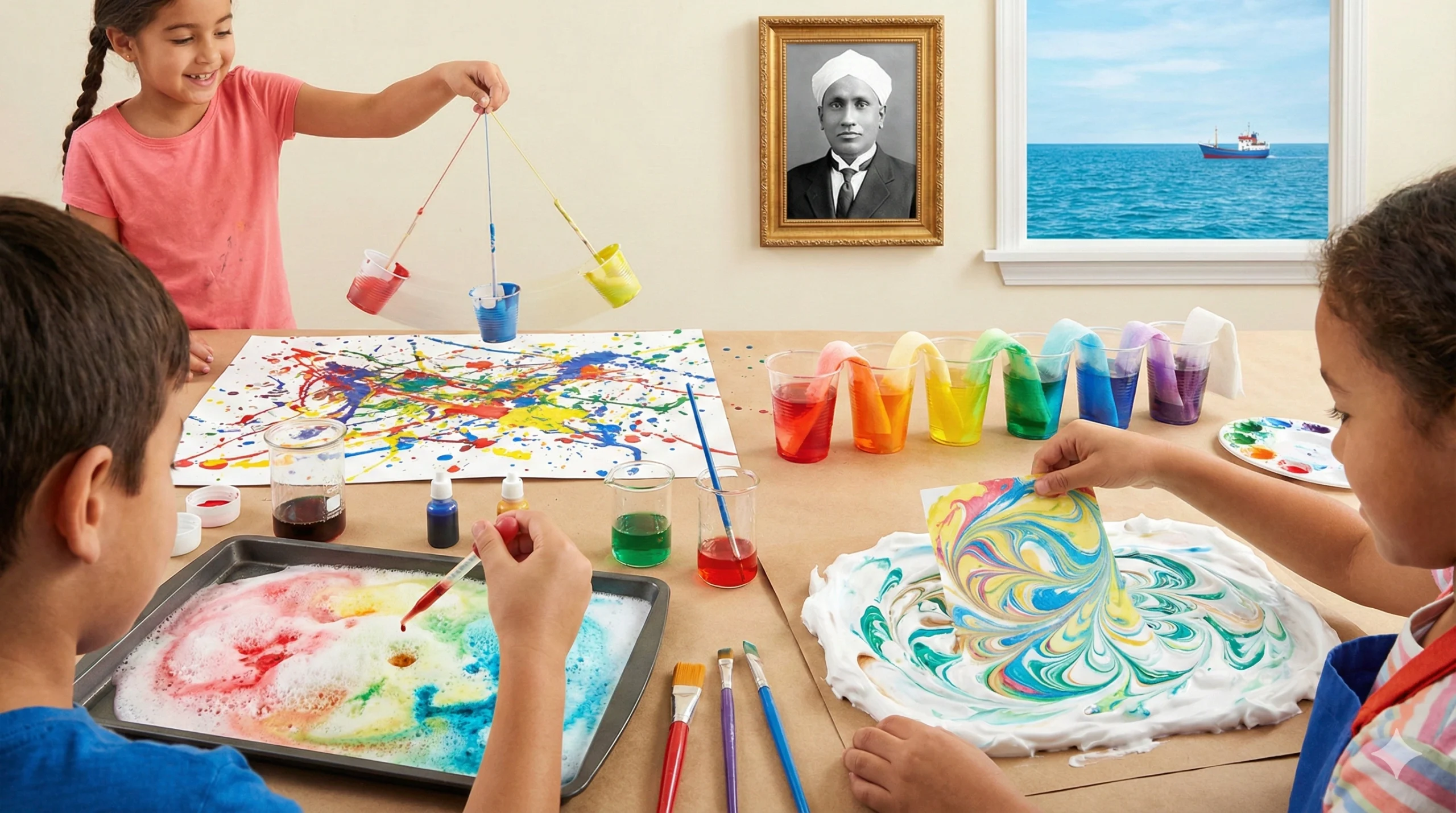
One day, way back in 1921, a young scientist was sitting on a ship sailing across the Mediterranean Sea. He looked out at the gorgeous, endless blue water and began to wonder—why is the sea blue?
At the time, the common belief was that the sea reflected the color of the sky. But being a true scientist, he wasn’t satisfied with a simple answer. He began investigating this phenomenon, extending his studies all the way to the Bay of Bengal. Eventually, he discovered that the color of water is due to the scattering of light by water molecules.
And that, my friends, is the story of Sir C.V. Raman, the famous Indian physicist whose curiosity changed the world of science forever!
Who Was Sir C.V. Raman?
Before we dive into our art projects, it is essential to understand the inspiration behind them. C.V. Raman was a true child prodigy. He completed high school at age 13, college at 16, and his Master’s degree before he even turned 20!
It is not surprising that he won the Nobel Prize for Physics at the young age of 42. This was a monumental achievement, as it was the first Nobel Prize won by an Asian in any field of science.
This Nobel Prize was for his work on the “scattering of light,” a phenomenon now known as the Raman Effect. Since 1986, the day of this discovery, February 28th, has been celebrated as National Science Day all over India.
National Science Day is an opportunity to encourage scientific curiosity. But science isn’t just about textbooks and formulas; it’s about observation, experimentation, and creativity. When we mix Science, Technology, Engineering, and Math (STEM) with Art, we get STEAM.
To celebrate the spirit of Sir C.V. Raman and the joy of discovery, here are 15 Awesome Science Art Projects for Kids that will blow your mind!
1. The Magic Salt & Watercolor Galaxy
Creating art with watercolor isn’t new, but what happens when you add a common kitchen ingredient into the mix?
- The Activity: Have your kids paint a wet, colorful background using watercolors on heavy paper. While the paint is still wet, sprinkle coarse salt over the paper. Let it dry completely and then brush the salt off.
- The Science: This demonstrates absorption. Salt is hygroscopic, meaning it attracts and holds water molecules. As the salt crystals soak up the water from the paint, they pull the pigment along with it, creating beautiful, starburst-like patterns that look like a galaxy.
2. Fizzy Baking Soda Art
Anyone who has mixed baking soda and vinegar knows the immense potential of that reaction. Let’s take it to the next level and bring it into the realm of art.
- The Activity: Sprinkle a tray with baking soda. In a muffin tin, mix vinegar with different food colorings. Use a dropper or spoon to drop the colored vinegar onto the baking soda.
- The Science: This is a classic Acid-Base Reaction. Baking soda (sodium bicarbonate) is a base, and vinegar (acetic acid) is an acid. When they mix, they create carbon dioxide gas, which causes the bubbling and fizzing, resulting in a chaotic, colorful masterpiece.
3. Chromatographic Butterflies
Have you ever wondered what colors hide inside a black marker?
- The Activity: Draw a circle on a coffee filter using a non-permanent black marker. Fold the filter into a cone and dip the very tip into a cup of water. Watch the water travel up! Once dry, scrunch the filter in the middle to make a butterfly.
- The Science: This is Chromatography. As the water moves through the paper (via capillary action), it dissolves the ink. Different pigments in the ink travel at different speeds depending on their molecular size and solubility, separating the black ink into rainbows of purple, blue, and red.
4. Oil and Water Droplet Painting
We all know oil and water don’t mix, but they sure do make pretty art.
- The Activity: Mix watercolors or food coloring with a little water in a shallow dish. Pour a thin layer of cooking oil into a separate clear tray. Use a dropper to drop the colored water into the oil. Place a piece of paper on top to capture the print.
- The Science: This teaches Density and Polarity. Water molecules are polar (they stick together), while oil molecules are non-polar. Because water is denser than oil, the colored droplets sink, but because of the polarity difference, they stay as perfect spheres rather than mixing, creating unique bubbly art.
5. Pendulum Painting
Let’s use physics to paint without touching the paper!
- The Activity: Poke a hole in the bottom of a plastic cup and cover it with tape. Tie string to the cup and hang it from a tripod (or two chairs and a broomstick). Fill the cup with watered-down paint. Place paper underneath, remove the tape, and swing the cup!
- The Science: This demonstrates the forces of Gravity and Motion. The pendulum moves in an elliptical pattern due to the physics of the swing, creating perfect geometric spirals known as Lissajous curves.
6. Invisible Ink with Lemon Juice
Write secret messages like a spy!
- The Activity: Dip a cotton bud in lemon juice and write a message on white paper. Let it dry invisibly. To reveal it, hold the paper near a light bulb or iron it (with adult supervision).
- The Science: This is Oxidation. Lemon juice is an organic substance that oxidizes and turns brown when heated. It basically burns faster than the paper, revealing your secret art.
7. Shaving Cream Marbling
This is one of the most sensory-satisfying projects on the list.
- The Activity: Spray shaving cream into a tray and smooth it out. Drop food coloring on top and swirl it with a toothpick. Press a piece of paper onto the cream, lift, and scrape off the foam. The color stays on the paper!
- The Science: This explores Surface Tension and Hydrophobic properties. The food coloring (mostly water) sits on top of the shaving cream (which contains oil/soap) without sinking immediately, allowing you to transfer the pattern.
8. Magnetic Abstract Art
Painting without getting your hands dirty!
- The Activity: Put a piece of paper inside a cardboard box. Drop a few blobs of paint on the paper. Throw in some metal items like paperclips or washers. Hold a strong magnet underneath the box and move it around to drag the metal pieces through the paint.
- The Science: This demonstrates Magnetism. The magnetic force passes through the cardboard, pulling the metal objects and creating movement and friction that spreads the paint.
9. Red Cabbage pH Indicators
Turn your kitchen into a chemistry lab with color-changing paint.
- The Activity: Boil red cabbage to make a purple liquid. Paint this onto watercolor paper. Once dry, paint over it with lemon juice (it turns pink!) or baking soda water (it turns blue/green!).
- The Science: Red cabbage contains a pigment called anthocyanin, which is a natural pH Indicator. It changes color depending on whether it touches an acid (lemon) or a base (baking soda).
10. Sun Prints (Cyanotype or Construction Paper)
Harness the power of the sun to create silhouettes.
- The Activity: Place dark construction paper in direct sunlight. Arrange flat objects (leaves, toys, keys) on the paper. Leave it for a few hours. Remove the objects to see the print.
- The Science: This demonstrates the power of Ultraviolet (UV) Rays. The sun’s UV rays break down the dyes in the paper (photodegradation), fading the exposed areas. The areas covered by the objects remain the original color.
11. Milk Plastic Sculptures
Did you know you can turn milk into a stone-like material?
- The Activity: Heat a cup of milk and add 4 tablespoons of vinegar. Stir until it separates into curds and whey. Strain the curds, knead them into a dough, and sculpt shapes. Let them dry for 2 days to harden.
- The Science: This is Polymer Chemistry. The acid in the vinegar causes the Casein protein in the milk to unfold and reorganize into long chains (polymers), creating a hard, plastic-like substance.
12. Spinning Optical Illusions (Thaumatropes)
Trick your eyes with this Victorian-era toy.
- The Activity: Cut out a cardboard circle. Draw a bird on one side and a cage on the other. Punch holes on the sides and use rubber bands to spin the circle rapidly. It will look like the bird is inside the cage.
- The Science: This explains Persistence of Vision. Your eyes retain an image for roughly 1/30th of a second. When images switch faster than that, your brain blends them into a single image.
13. Bubble Blower Painting
Geometric art made with breath.
- The Activity: Mix paint, water, and dish soap in a cup. Use a straw to blow bubbles until they rise above the rim. Press a piece of paper onto the bubbles.
- The Science: This highlights Geometry and Surface Tension. Bubbles always form spheres because that is the most efficient shape for surface tension (minimum surface area). When they stack, they form hexagons!
14. Walking Water Rainbow
A slow-motion art project that is mesmerizing to watch.
- The Activity: Place 7 cups in a row. Fill every other cup with water and food coloring (Red, Yellow, Blue). Place folded paper towels bridging the cups. Watch the water “walk” into the empty cups and mix colors.
- The Science: This is Capillary Action, the same process plants use to pull water from roots to leaves. The water moves through the tiny gaps in the paper towel fibers against gravity!
15. Ice Painting
A cool activity for a hot day.
- The Activity: Freeze water mixed with food coloring in an ice cube tray (add popsicle sticks for handles). Let kids paint on paper with the melting ice.
- The Science: This explores States of Matter and Phase Changes. As the ice absorbs heat from the room and the friction of the paper, it changes from a solid to a liquid, leaving the pigment behind.
Why STEAM is Important
Sir C.V. Raman didn’t discover the Raman Effect by sitting in a dark room; he observed the world, asked questions, and appreciated the beauty of nature.
Integrating Art into STEM (making it STEAM) helps children who might be intimidated by “hard sciences” engage with the material. It encourages:
- Critical Thinking: figuring out why the paint moved that way.
- Problem Solving: Adjusting the pendulum to swing correctly.
- Creativity: Seeing the beauty in chemical reactions.
So, this National Science Day, don’t just read about science—create it! Whether you are making fizzing volcanoes or magnetic masterpieces, you are following in the footsteps of great scientists like Dr. Raman.