
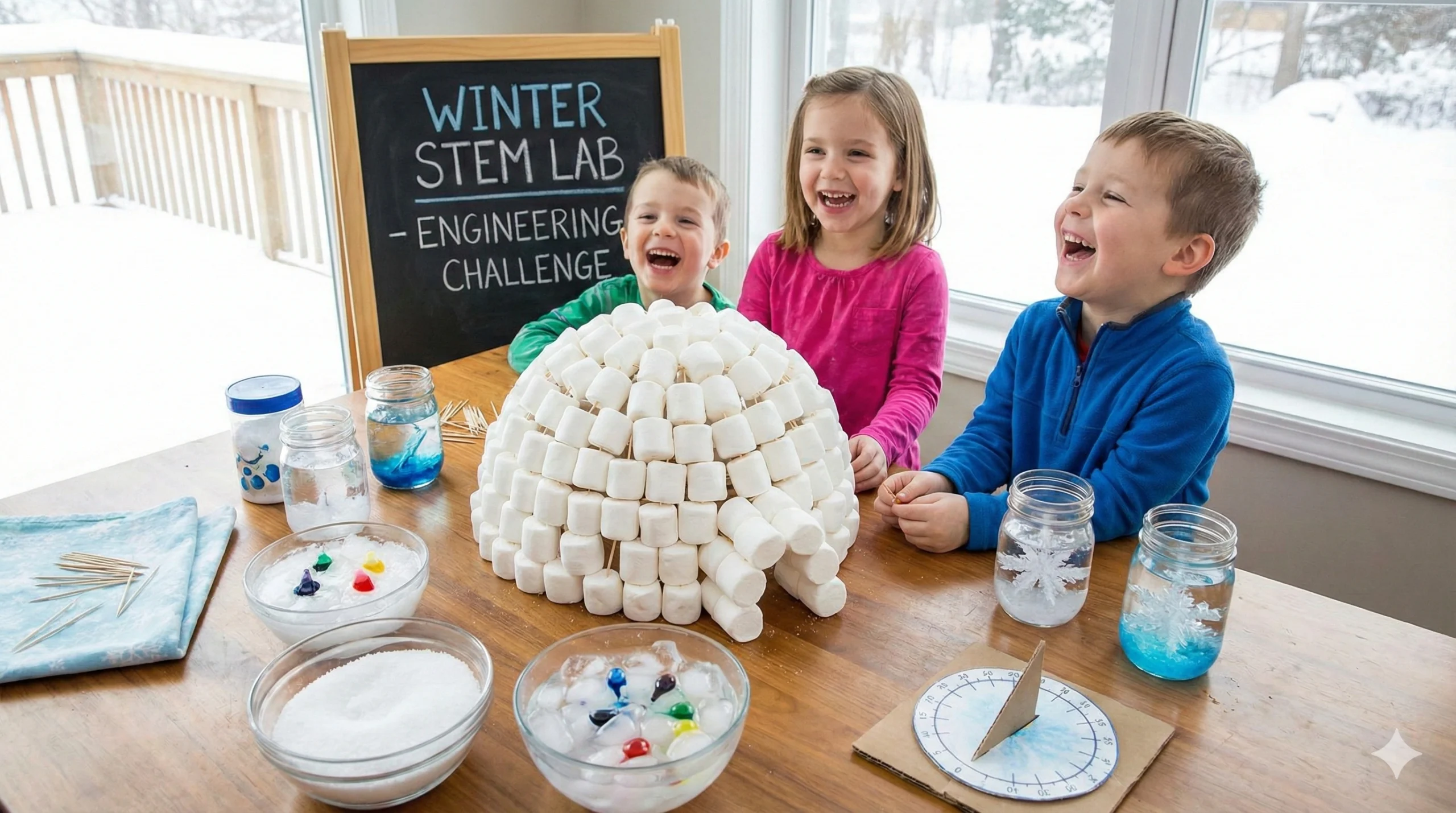
Winter is a magical season. From the crisp air to the possibility of snow, it offers a unique backdrop for curiosity and learning. It is also the perfect time to bring education indoors with hands-on activities that keep young minds active.
One reason we love doing crafts is simply because it is plain good fun—fun that doesn’t involve a screen! But another reason is that it is a powerful way for kids to learn. School lessons become much more effective when accompanied by tangible projects, especially those dealing with STEM.
So, what is STEM? It stands for Science, Technology, Engineering, and Math. When we add Art to the equation, it becomes STEAM. This holistic approach to learning encourages innovation, problem-solving, and critical thinking.
With National STEM Day celebrated on November 8th, and the long winter months stretching ahead, now is the perfect time to dive into these 15 wonderful Winter STEM projects. All you need are regular household materials and a sense of adventure!
What is National STEM Day?
Before we get our hands dirty (or snowy!), let’s look at the origin of STEM Day. It was created by MGA Entertainment, a major toy company, to encourage more children—especially girls—to explore the world of science and engineering.
They launched a franchise called Project Mc2, featuring spy dolls who used science to save the day. The spies belonged to an organization called NOV8 (pronounced “Innovate”). This clever play on words is why November 8th was chosen as the day to celebrate all things STEM. It is a day dedicated to inspiring the next generation of innovators, thinkers, and creators.
The Science of Winter: 15 Hands-On Projects
We have rounded up the best winter-themed activities that combine festive fun with educational value.
1. Salt and Ice Experiment: The Melting Point
Have you ever wondered why we salt the roads in winter? This experiment visually demonstrates how salt affects the freezing point of water.
- The Activity: Freeze a block of ice or use ice cubes. Let kids sprinkle coarse salt over the ice. Add drops of food coloring to highlight the cracks and tunnels forming.
- The Science: Salt lowers the freezing point of water (freezing point depression), causing the ice to melt even when the surrounding air is freezing.
2. Crystal Snowflakes
Snowflakes are nature’s most beautiful geometry lesson.
- The Activity: Twist pipe cleaners (chenille stems) into snowflake shapes. Suspend them in a jar filled with a supersaturated solution of Borax and hot water. Leave it overnight.
- The Science: As the water cools, the Borax particles settle and cling to the pipe cleaners, forming cubic crystals that sparkle just like real snow.
3. DIY Snowstorm in a Jar
Create a blizzard without the cold! This is a fantastic density lesson.
- The Activity: Fill a jar 1/4 full with water and white paint/glitter. Fill the rest with baby oil. Drop in an Alka-Seltzer tablet.
- The Science: The water and oil don’t mix because they have different densities. The tablet creates carbon dioxide gas bubbles, which carry the white water up through the oil, creating a “snowstorm” effect.
4. Build a Marshmallow Igloo
This is an engineering challenge that doubles as a snack.
- The Activity: Provide mini marshmallows and toothpicks (or icing as “mortar”). Challenge kids to build a dome-shaped structure that won’t collapse.
- The Engineering: Kids learn about structural integrity and why the dome shape is so strong (it distributes weight evenly).
5. Frozen Bubbles
If the temperature drops below freezing (32°F / 0°C), this is a must-do outdoor activity.
- The Activity: Blow soap bubbles onto a cold surface or into the air. Watch as ice crystals form on the surface of the bubble.
- The Science: The thin film of water in the bubble freezes into intricate geometric patterns before the bubble pops.
6. “Hot” Chocolate Science
Explore solubility and temperature with a delicious treat.
- The Activity: Test how fast hot chocolate powder dissolves in water of different temperatures: cold, warm, and hot.
- The Science: Heat adds energy to the water molecules, making them move faster and dissolve the solute (powder) more quickly.
7. Pinecone Weather Station
Did you know pinecones can predict the weather?
- The Activity: Collect pinecones and place them on a windowsill. Observe them daily.
- The Science: In dry weather, pinecone scales open up to release seeds. In damp, humid weather (predicting snow or rain), the scales close up to protect the seeds. It is a natural hygrometer!
8. The Gingerbread Man Trap
Inspired by the classic fairy tale, this project focuses on simple machines.
- The Activity: Challenge kids to build a trap to catch the Gingerbread Man using household items. They must incorporate a lever, a pulley, or an inclined plane.
- The Engineering: This encourages creative problem-solving and introduces basic physics concepts related to force and motion.
9. Static Electricity Snowmen
Make paper dance with the power of electrons.
- The Activity: Cut out tiny tissue paper snowmen. Rub a balloon against your hair to build a static charge. Hold the balloon over the paper snowmen.
- The Science: The static electricity attracts the lightweight paper, making the snowmen “jump” and stick to the balloon.
10. Arctic Animal Blubber Glove
How do polar bears stay warm in freezing water?
- The Activity: Fill a ziplock bag with vegetable shortening (shortening represents blubber). Place a smaller bag inside it so your hand doesn’t get messy. Have kids dip their bare hand in ice water, then their “blubber glove” hand.
- The Science: The fat acts as an insulator, trapping body heat and keeping the cold out.
11. Balance the Sleigh
A lesson in weight distribution and physics.
- The Activity: Create a simple sleigh using a cardboard box. Provide “presents” (blocks) of different weights. Ask kids to load the sleigh so it slides down a ramp without tipping over.
- The Math/Physics: Kids explore concepts of center of gravity and friction.
12. Exploding Snowman
A winter twist on the classic baking soda volcano.
- The Activity: Put baking soda inside a baggie. Decorate the bag to look like a snowman. Add vinegar and quickly zip the bag shut.
- The Science: The acid-base reaction creates carbon dioxide gas. The gas expands until the bag pops!
13. Winter Solstice Sundial
Learn about the shortest day of the year.
- The Activity: On a sunny winter day, use a paper plate and a pencil to create a sundial. Mark the shadow’s position every hour.
- The Science: This demonstrates the earth’s rotation and the angle of the sun during the winter season compared to summer.
14. Gumdrop Bridge Construction
Can you build a bridge strong enough to hold a toy car?
- The Activity: Use gumdrops and toothpicks to build a bridge across two stacks of books. Test its strength by adding weights (pennies).
- The Engineering: This teaches triangulation—using triangles to make a structure rigid and strong.
15. Ice Fishing Experiment
Can you catch an ice cube with a string?
- The Activity: Place an ice cube in water. Lay a string across it. Sprinkle salt over the string. Wait a minute and lift.
- The Science: Similar to the first experiment, the salt melts the ice slightly. As it dilutes and refreezes, it traps the string inside the ice, allowing you to lift it.
Why STEM Matters in Early Education
Incorporating these activities into your winter routine does more than just pass the time. It builds resilience. In science, things don’t always work the first time. A bridge might collapse, or a crystal might not form. This teaches children that “failure” is just data—a step toward finding the solution.
Moreover, these projects require active engagement. Instead of passively consuming entertainment, children are creating, observing, and questioning. This winter, turn your home or classroom into a laboratory of wonder.
So, grab your salt, your glue, and your curiosity. Let’s make this winter a season of discovery!
Frequently Asked Questions (FAQ)
1. Are these projects safe for toddlers? Most activities (like the blubber glove or marshmallows) are safe with supervision. However, activities involving Borax or small parts (choking hazards) are better suited for elementary-aged children.
2. Do I need expensive kits? No! The beauty of these projects is that they use everyday items like salt, ice, baking soda, and cardboard.
3. How can I explain the science to my child? Keep it simple. Use analogies (like the “blubber is like a warm coat”). Focus on observation: “What do you see happening?” rather than just lecturing on the facts.