
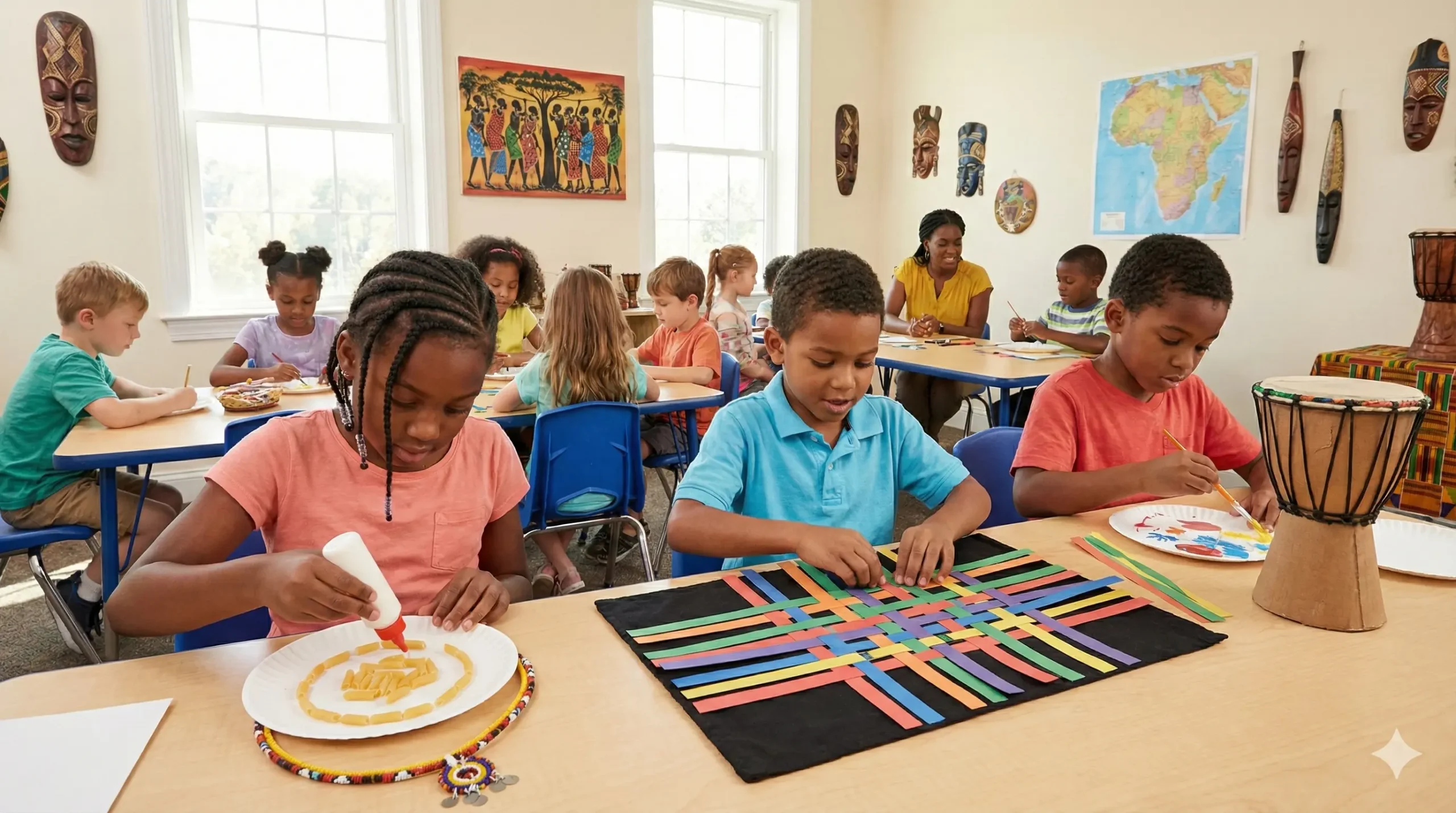
These traditional African crafts for kids teach us about the rich and colorful heritage of the African continent! Play games, create art, and have fun while exploring new cultures.
I was 10 years old when The Lion King was first released, and I was instantly hooked! I don’t remember how many times I watched it after that; I just remember that I could sing “The Circle of Life” continuously without missing a beat.
Another bonus of watching The Lion King was that it introduced me to the gorgeous African landscape, so beautifully recreated by Disney in the movie. Not to mention the coolest ever ‘bros’ – Timon and Pumbaa – and their iconic catchphrase: Hakuna Matata!
While my Swahili might still be limited to those two words, my interest in Africa has only grown. The more I learn, the more I realize that Africa is not just a single place, but a massive continent comprised of 54 distinct countries, thousands of languages, and incredibly diverse cultures.
Before we dive into the crafts, reading is the best way to set the stage. Here are some wonderful books to pair with your crafting session:
Books about Africa for Kids:
- Too Small Tola by Atinuke
- Africa, Amazing Africa: Country by Country by Atinuke
- The Water Princess by Susan Verde
- Deep in the Sahara by Kelly Cunnane
- Ayo’s Adventure: Across the African Diaspora by Ain Heath Drew and Erin K. Robinson
As the love for African stories continues to grow, let’s take this opportunity to learn more about the continent through creativity. Here are 15 Traditional African Crafts for Kids that combine history, art, and fun.
1. Paper Plate Maasai Necklaces
The Maasai people of Kenya and Tanzania are world-renowned for their intricate and vibrant beadwork. In their culture, jewelry is more than just decoration; it represents beauty, strength, and marital status.
- The Craft: You can recreate the look of these stunning collar necklaces using a large paper plate. Cut out the center of the plate so it fits around the child’s neck.
- The Technique: Instead of tiny glass beads, use painted pasta shapes, buttons, or colored paper squares glued in concentric circles.
- Cultural Note: Teach kids the meaning of Maasai colors: Red stands for bravery, white for peace, and blue for energy and the sky.
2. Kente Cloth Paper Weaving
Originating from the Ashanti people of Ghana, Kente cloth is a royal and sacred fabric. Legend has it that two brothers learned to weave by watching a spider spin its web.
- The Craft: This is a fantastic fine motor activity. Take a sheet of black construction paper and cut slits across it (leaving the edges intact). Cut strips of red, yellow, green, and blue paper.
- The Technique: Have the children weave the colored strips in and out of the black paper.
- Cultural Note: Gold represents status and serenity, while green represents renewal. This craft is perfect for discussing how clothes can tell a story.
3. African Village Roundhouses (Rondavels)
In many parts of Southern and East Africa, traditional homes are round with thatched roofs. This architectural style is aerodynamic and keeps the house cool in the heat.
- The Craft: Use paper cups or cardboard rolls as the base. Decorate the “walls” with geometric patterns using markers.
- The Technique: Create a cone shape out of brown cardstock or textured paper to serve as the thatched roof. Group several together to create a village scene.
- Why it works: It’s an open-ended project where kids can design their own Ndebele-style geometric wall paintings, famous in South Africa.
4. West African Djembe Drums
Music is the heartbeat of daily life in many African cultures. The Djembe drum, which originated in West Africa (Mali and Guinea), is meant to gather people together in peace.
- The Craft: Recycle two sturdy paper cups or a plastic container. Tape them bottom-to-bottom to create an hourglass shape.
- The Technique: Stretch a balloon over the top opening to act as the drum skin. Secure it with rubber bands or tape. Let the kids decorate the body of the drum with tribal patterns.
- Activity: Once made, form a drum circle and teach a simple rhythm (call and response).
5. Adinkra Potato Stamping
The Akan people of Ghana use Adinkra symbols to represent concepts or aphorisms. You have likely seen these symbols on pottery and fabric.
- The Craft: This is a printmaking activity. Cut potatoes in half and carve simple Adinkra symbols into them (like the “Gye Nyame” which signifies the supremacy of God, or a simple spiral for resilience).
- The Technique: Dip the potato stamps in fabric paint and stamp onto a plain tote bag or t-shirt.
- Learning Moment: Choose a symbol that represents the child’s personality and explain why they chose it.
6. Wire Toy Cars (Galimoto)
“Galimoto” means “motorcar” in the Chichewa language of Malawi. Children in many African countries are incredibly resourceful, creating intricate toy vehicles out of scrap wire and found materials.
- The Craft: For a kid-safe version, use colorful pipe cleaners (chenille stems).
- The Technique: Bend the pipe cleaners to form the chassis, wheels, and steering wheel of a car. You can use bottle caps with holes punched in the center for the wheels if you want them to roll.
- The Lesson: This teaches engineering, recycling, and resourcefulness.
7. African Tribal Masks
Masks play a vital role in rituals and ceremonies across the continent, particularly in West and Central Africa. They are often used to honor ancestors or spirits.
- The Craft: Use cardboard or stiff paper plates as a base. The key is symmetry and bold features.
- The Technique: Cut out eye holes and use raffia or yarn for hair. Paint using earth tones (browns, creams, blacks, and reds). Add dimension by gluing on cardboard noses and lips before painting.
- Cultural Note: Explain that these masks are rarely used as wall decor in their original context; they are part of a full costume used in dance.
8. Egyptian Collar (Usekh)
Moving to North Africa, we look at Ancient Egypt. The Usekh collar was a broad collar worn by the wealthy and nobility.
- The Craft: Cut a large “C” shape out of gold cardstock or a paper plate painted gold.
- The Technique: Decorate with “jewels” made from sequins, glitter glue, or colored pasta. Focus on patterns of turquoise and lapis lazuli (dark blue).
- History: Discuss how jewelry was used for protection and to show power in the time of the Pharaohs.
9. Handprint Lion Keepsake
Celebrating the wildlife of the African Savannah is a great entry point for younger children.
- The Craft: Paint the child’s palm yellow and their fingers orange. Press it onto paper.
- The Result: The palm becomes the lion’s face, and the fingers are the majestic mane. Add googly eyes and a drawn mouth once the paint dries.
- Connection: This is the perfect time to talk about the “Big Five” game animals found in Africa.
10. Ndebele Doll Art
The Ndebele people of South Africa are famous for their colorful homes and beadwork, as well as their ceremonial dolls which are often associated with courtship and marriage customs.
- The Craft: Use empty toilet paper rolls or wooden pegs as the body.
- The Technique: Wrap the cylinder in colorful fabric scraps or yarn. Use black rings (pipe cleaners or wool) around the neck and ankles to simulate the traditional copper rings worn by Ndebele women.
- Artistic Element: Focus on the use of very bright, contrasting colors.
11. Sunset Safari Silhouette Art
The African sunset is legendary for its massive, red sun and silhouetted acacia trees.
- The Craft: Paint a background blending red, orange, and yellow watercolors to look like a hot sky.
- The Technique: Cut shapes out of black paper—acacia trees, giraffes, or elephants—and glue them onto the dried background.
- Visual Art: This teaches children about positive and negative space and the concept of a silhouette.
12. Bogolanfini (Mud Cloth) Painting
Originating from Mali, Mud Cloth is a traditional cotton fabric dyed with fermented mud. It is famous for its geometric black and white (or earth tone) patterns.
- The Craft: Use brown construction paper or a piece of brown cotton fabric.
- The Technique: Use white and black paint to create geometric patterns—triangles, zig-zags, and lines.
- The Lesson: Discuss how natural resources (like river mud and plant dyes) have been used for centuries to create art.
13. Recycled Shekere (Shaker)
The Shekere is a West African percussion instrument consisting of a dried gourd with beads woven into a net covering it.
- The Craft: Use a clean, empty plastic milk jug (with the handle).
- The Technique: String pony beads onto yarn. Wrap the beaded yarn around the belly of the milk jug and secure it. When you shake the jug, the beads slap against the plastic, mimicking the sound of the gourd.
- Music: Use this to teach rhythm and keeping a beat.
14. Tinga Tinga Art
Named after Edward Saidi Tingatinga, this painting style originated in Tanzania. It is known for its bright, surrealistic colors and cartoon-like animals.
- The Craft: Ask children to draw an African animal (like a leopard or bird) but use “unrealistic” colors.
- The Technique: Use high-gloss paint or bright acrylics. A leopard could be blue with pink spots!
- Creativity: This encourages children to break the rules of reality and paint with their imagination.
15. Paper Rainstick
While often associated with South America, rainsticks are also found in African traditions, used to invoke rain during droughts.
- The Craft: Use a long cardboard mailing tube or tape several paper towel rolls together.
- The Technique: Poke nails or toothpicks through the sides of the tube (secure with tape on the outside). Fill with rice or beans. Seal both ends.
- Decoration: Decorate the outside with tribal markings. When tipped, the beans hit the internal obstacles, sounding like falling rain.
Final Thoughts
Engaging in these crafts is about more than just glue and paper; it is a way to raise global citizens who appreciate the diversity of the world. By making a Maasai necklace or a Ghanaian Kente weave, children learn that art is a universal language that connects us all.