
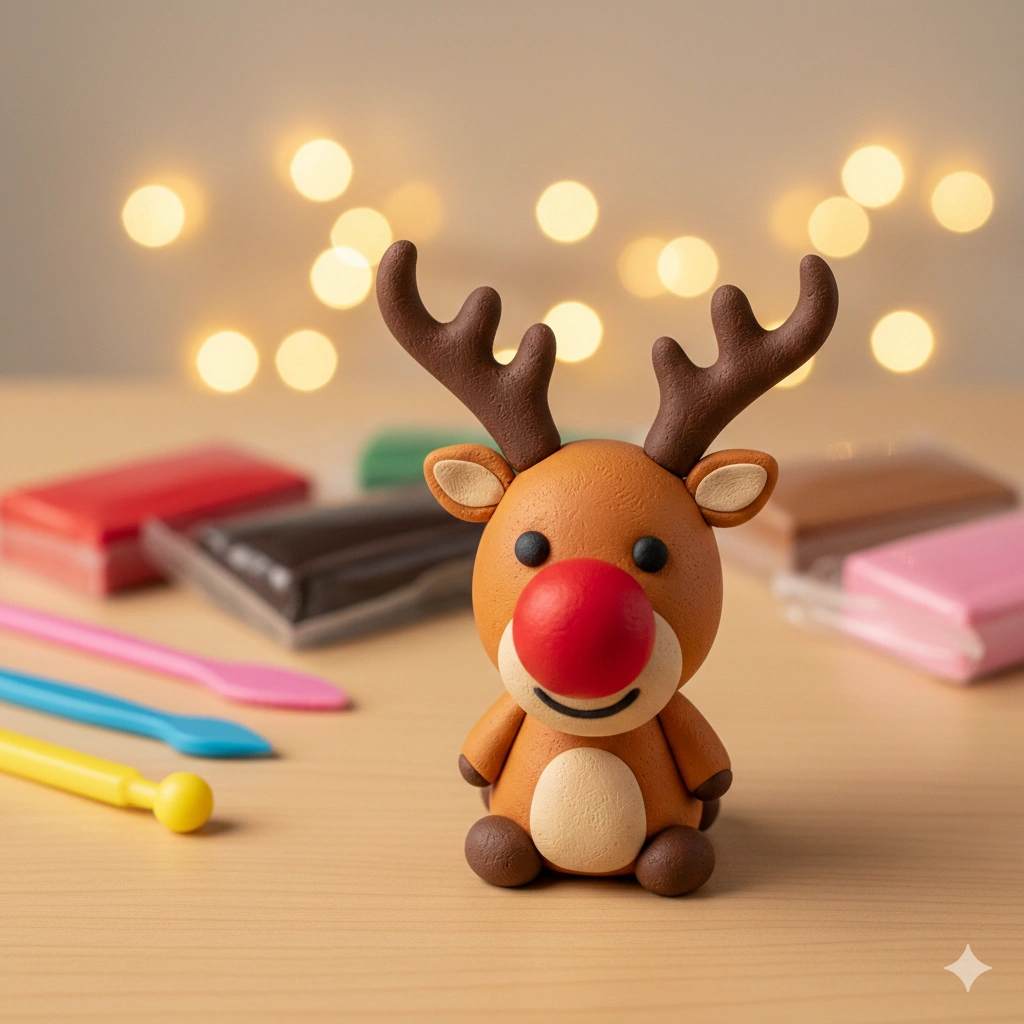
Celebrate the red-nosed hero of the holiday season with a cute DIY Clay Rudolph Craft for Kids! If you’ve ever felt a little different or out of place, you’ll know that Rudolph is the ultimate symbol of how our “flaws” can actually be our greatest strengths. This hands-on project is the perfect way to bring the magic of Christmas into your home while teaching children a valuable lesson about self-love and individuality.
Do you know anyone who was ever teased because they had big ears, a prominent nose, or maybe crooked teeth? If you do, please tell them the story of Rudolph the Red-Nosed Reindeer. He was mocked by all the other reindeer because of his large, glowing red nose. But when a thick fog threatened to cancel Christmas, it was that very nose that guided Santa’s sleigh and saved the day!
Today, we celebrate individuality and uniqueness—just like Rudolph—with this adorable clay craft. As kids mold and shape their reindeer, they’ll realize that anything made with love is beautiful, regardless of “imperfections.”
Why Choose Clay Crafting for Kids?
Clay is one of the most versatile and beneficial mediums for children’s art. Unlike paper, clay is three-dimensional, which helps kids understand volume, scale, and structure.
- Sensory Development: The squishy, tactile nature of clay provides excellent sensory input, which can be very calming for children.
- Fine Motor Strength: Rolling, pinching, and pressing clay builds the intrinsic muscles in the hands, which are essential for handwriting and using scissors.
- Patience and Focus: Building a character step-by-step encourages children to slow down and follow a sequence to reach a rewarding end goal.
Supplies Required for Your Rudolph Craft
Before you begin, gather your materials. We recommend using air-dry clay or foam clay because it is lightweight, doesn’t require baking, and is much easier for small hands to manipulate than traditional ceramic clay.
- Air-dry clay/Foam clay: You will need colors in light brown (body), dark brown (antlers), beige (snout/belly), bright red (the nose!), and a tiny bit of pink (inner ears).
- Clay crafting tools: A plastic needle tool, a ball pin tool, and a small knife tool.
- Clay rolling board: Or a smooth acrylic board to prevent sticking.
- Clay rolling pin: To flatten sections for ears or details.
Step-by-Step Tutorial: How to Make Your Clay Rudolph
Follow these instructions to create your very own red-nosed companion. Remember, if your Rudolph’s legs are a little wobbly or his nose is extra large, that just makes him more special!
Step 1: Form the Main Body Base
Start with a generous piece of light brown clay. Roll it into a smooth, crack-free ball between your palms. Once you have a perfect sphere, roll it gently on your flat surface to transform it into a thick cylinder.
Press one end of the cylinder firmly against your table so it flattens and becomes slightly wider than the top end. Using your ball pin tool, poke a small indentation or hole in the bottom center. This creates a sturdy base that allows your reindeer to stand upright without toppling over.
Step 2: Sculpting the Hindlegs
Pinch out two equal pieces of light brown clay. Roll these into smooth balls. To give them a “leg” shape, use your finger to roll one side of the ball more than the other, creating an oval or teardrop shape. Now, each leg should have one narrow end (the hip) and one wide end (the hoof).
Step 3: Attaching the Limbs
Attach the narrow ends of the legs to the lower sides of your cylinder body. Press firmly so the clay bonds together. If your air-dry clay has started to skin over, you can use a tiny drop of water as “glue” to help the pieces stick. Repeat this process for the front legs, making them slightly thinner than the back ones.
Step 4: The Head and Snout
Roll another light brown ball for the head—aim for it to be about two-thirds the size of the body. Take a small amount of beige clay, flatten it into a small oval, and press it onto the lower half of the head. This is Rudolph’s snout area.
Step 5: The Famous Red Nose
This is the most important part! Take a vibrant piece of red clay and roll it into a small, shiny ball. Place it right in the center of the beige snout. Give it a little press to make sure it’s secure. Now Rudolph is officially ready to lead the sleigh!
Step 6: Antlers and Ears
Using the dark brown clay, roll two thin “snakes.” Bend them slightly and use your tool to create small notches, making them look like real antlers. For the ears, use light brown clay with a tiny dot of pink in the center. Attach these to the top of the head, just behind the antlers.
Step 7: Final Details
Use your black marker or tiny dots of black clay to create the eyes. If you want Rudolph to look extra festive, you can even add a tiny clay “collar” around his neck with a small yellow bell!
Tips for Working with Air-Dry Clay
| Tip | Description |
| Keep it Covered | Air-dry clay dries quickly. Keep unused portions in a zip-top bag while you work on specific parts. |
| Smooth the Cracks | If you see a crack forming, dip your finger in a tiny bit of water and “massage” the surface until it’s smooth again. |
| Drying Time | Let your Rudolph sit undisturbed for at least 24 hours. Depending on the humidity, it might take up to 48 hours to fully harden. |
| Avoid Heavy Topping | If the head is too heavy, the neck might sag. You can use a toothpick inside the body and head to act as a “skeleton” for support. |
Individualism: The Core Message of Rudolph
While your child is busy sculpting, this is a wonderful time to have a conversation about what makes them unique. Ask them:
- “What is one thing about you that is different from everyone else?”
- “How can we use our special talents to help others, just like Rudolph used his nose?”
This craft serves as a physical reminder that being “different” isn’t just okay—it’s often what makes us a hero in our own story.
Conclusion
This DIY Clay Rudolph Craft is more than just a holiday decoration; it’s a lesson in character and creativity. When the holiday season is over, your child will have a handmade keepsake that reminds them that they are worthy of love and respect exactly as they are.
Whether he’s sitting on your mantelpiece or acting as a centerpiece for your Christmas dinner, this little clay reindeer is sure to bring a smile to everyone who sees him.
Would you like me to help you create a “Christmas Clay Checklist” for other characters like Santa or Frosty, or would you like some tips on how to turn these clay figures into hanging ornaments?