
The very word “Math” evokes mixed feelings in most people. For some, it is a language of logic and beauty. For others, it brings back memories of confusing equations and test anxiety. However, opinions on math are often shaped by how we were introduced to it.
If math is presented only as a series of drills and worksheets, it can become a chore. But if we introduce it through creativity, colors, and hands-on play, it becomes a game.
This World Maths Day, let’s flip the script. Let’s put aside the textbooks and pick up the glue sticks. Whether you are a homeschooling parent or a teacher looking for classroom inspiration, these 20 Enjoyable Math Crafts and Activities are designed to help kids visualize concepts, understand logic, and—dare we say it—have fun with numbers!
Why Math Crafts Matter for Child Development
Before we dive into the activities, it is important to understand why we are doing this. Research shows that multisensory learning helps children retain information better. When a child touches a shape or builds a fraction, the concept moves from abstract theory to concrete reality.
- Visual Learning: Seeing how 1/2 is physically bigger than 1/4 helps overcome confusion.
- Fine Motor Skills: Cutting, pasting, and drawing improve dexterity while learning.
- Positive Association: Associating math with art reduces “math anxiety” early on.
The Ultimate List: 20 Math Crafts & Activities
We have categorized these activities to help you find the perfect fit for your child’s age and skill level.
Section 1: Number Sense and Counting (Preschool & Kindergarten)
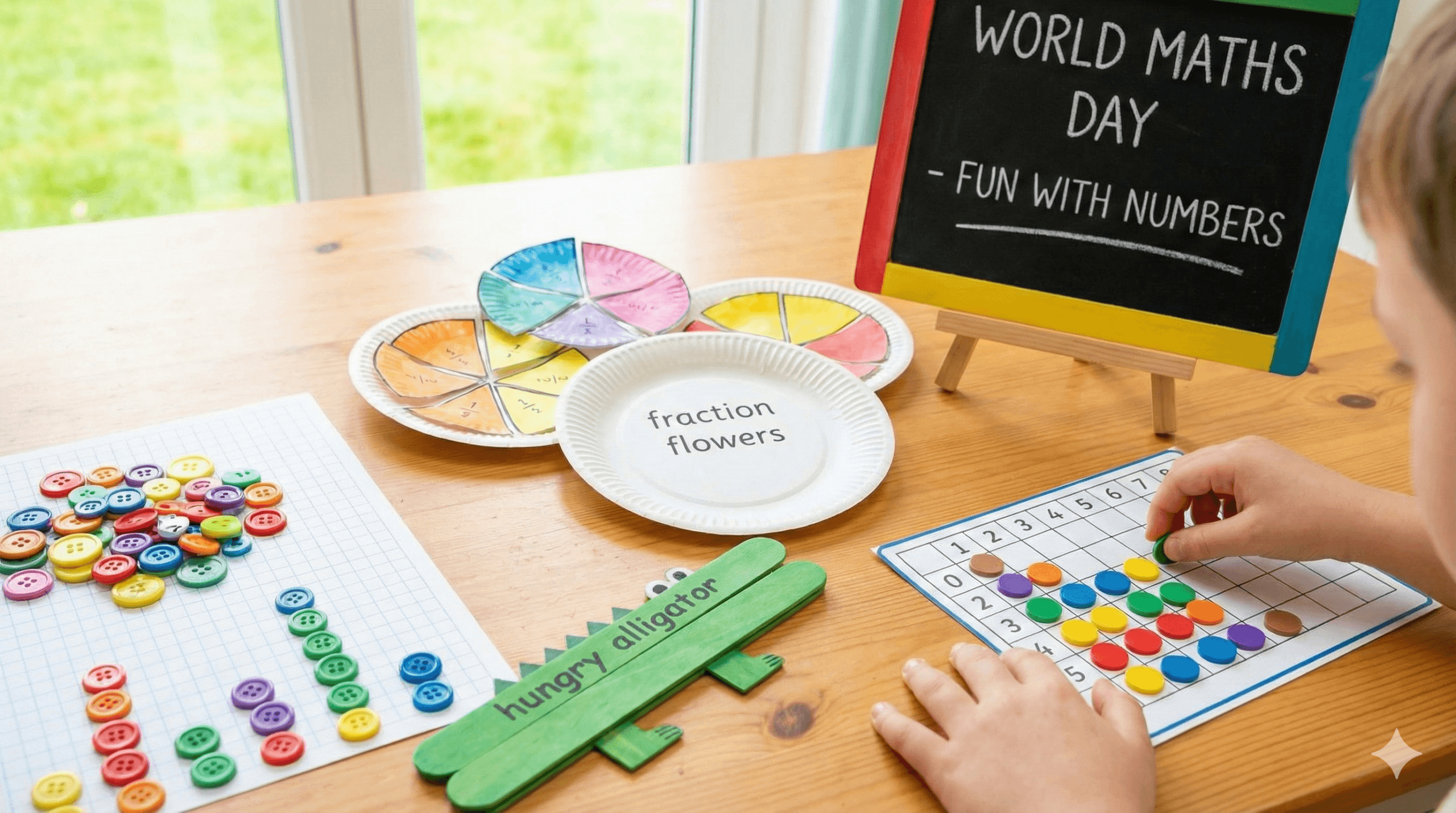
1. The “Hungry Alligator” Inequalities Comparing numbers can be tricky, but not when you have a hungry friend!
- The Concept: An alligator always wants to eat the bigger number.
- The Craft: Use two green popsicle sticks glued in a “V” shape. Add jagged teeth with white paper and a googly eye.
- The Activity: Place two piles of treats (or number cards) on the table. Ask the child to position the alligator to “eat” the larger pile. This teaches the Greater Than (>), Less Than (<), and Equal To (=) symbols instantly.
2. Skip Counting Caterpillars
- The Craft: Cut out colorful paper circles. Glue them together in a long line to make a caterpillar body.
- The Math: Write numbers on the body segments to teach skip counting (2, 4, 6, 8…). It’s a colorful reference tool they can hang on their wall.
3. Button Graphing Art
- The Activity: Give your child a jar of mixed buttons. Have them sort the buttons by color or size and glue them onto a chart.
- The Lesson: This introduces data visualization and bar graphs in a tactile way.
4. Number Bond Rainbows
- The Craft: Draw a cloud with a number in the center (e.g., 10). Draw rainbow stripes coming out of it.
- The Math: At the end of each stripe, write pairs of numbers that add up to the cloud number (e.g., 5+5, 8+2, 9+1). It visually represents number bonds.
5. Place Value “Cup” Towers
- The Craft: Take three Styrofoam cups. Write digits 0-9 around the rim of each. Stack them.
- The Activity: Label the cups “Ones,” “Tens,” and “Hundreds.” Twist the cups to create different numbers. It’s a kinetic way to understand how position changes value (e.g., 123 vs 321).
6. Addition “Sunshine” Fact Families Many kids struggle to see the relationship between addition and subtraction.
- The Craft: Cut a yellow circle (the sun) and yellow strips (the rays). Write a central number on the sun (e.g., 12).
- The Math: On the rays, write the equations that equal that number (6+6, 10+2, 15-3). It shows that one number can be reached in many ways.
7. LEGO Multiplication Arrays
- The Activity: Don’t just build castles; build arrays! Give your child a multiplication problem like 4×3.
- The Task: Have them snap LEGO bricks onto a baseplate to physically show 4 rows of 3 studs. This bridges the gap between memorization and understanding area.
8. Math Twister
- The Game: Tape numbers to the floor (or use a Twister mat with numbers taped on).
- The Rules: Call out an equation: “Left hand on 5 + 2!” The child has to solve it (7) and place their hand on that number. Great for active learners!
9. Place Value Robots
- The Craft: Cut squares, rectangles, and lines out of grid paper.
- The Math: Assign values to the shapes (Small square = 1, Strip = 10, Big square = 100). Have the child build a robot and then calculate the total “value” of their robot based on the pieces used.
10. “Uno” Flip Math
- The Game: Use a deck of Uno cards (remove special cards). Flip two cards. The first person to add/multiply them correctly keeps the pair.
Section 3: Fractions and Geometry (Upper Elementary)
11. Fraction Flowers Fractions are often the first major hurdle in math.
- The Craft: Cut several paper plates. Leave one whole. Cut the second into halves, the third into quarters, etc.
- The Assembly: Stack them or arrange them as flower petals. Label each “petal” (1/4, 1/8). This visually demonstrates that the larger the denominator, the smaller the piece.
12. Geometry Scavenger Hunt
- The Activity: Give the child a checklist of geometric terms (Right Angle, Acute Angle, Cylinder, Sphere, Parallel Lines).
- The Task: They must find these items in the house or nature and photograph them. Create a collage of their findings.
13. Marshmallow and Toothpick Geometry
- The Craft: Use marshmallows (vertices) and toothpicks (edges) to build 3D shapes like cubes, pyramids, and prisms.
- The Lesson: It teaches structural integrity and the difference between 2D and 3D shapes.
14. Symmetry Butterfly Paintings
- The Art: Fold a piece of paper in half. Place blobs of paint on one side. Fold and press. Open it up.
- The Math: Discuss the “Line of Symmetry.” Measure the distance of paint blobs from the center line to prove they are mirrored.
15. Tessellation Art (Escher Style)
- The Craft: Cut a shape from a sticky note (like a puzzle piece). Trace it repeatedly on a piece of paper so the shapes fit together with no gaps.
- The Lesson: This introduces advanced geometric concepts like tiling and planes while creating beautiful art.
16. Paper Plate Clocks
- The Craft: Use a paper plate and a brad pin (split pin). Cut two arrows for hands.
- The Math: Write the hours on the inner edge and the minutes (5, 10, 15…) on the outer edge. Lift flaps to quiz them on “Quarter past” or “Half past.”
Section 4: Advanced & Fun Challenges
17. Möbius Strips
- The Experiment: Cut a strip of paper. Twist it once and tape the ends together.
- The Mind-Bender: Draw a line along the center. You will end up back where you started without lifting the pen, proving it has only one side. It’s a mind-blowing introduction to topology.
18. Fibonacci Spiral Art
- The Art: Use grid paper to draw squares based on the Fibonacci sequence (1, 1, 2, 3, 5, 8…). Draw a curve through the corners to create the famous spiral.
- The Context: Show them how this spiral appears in nature (seashells, sunflowers).
19. Coordinate Plane “Battleship”
- The Game: Print two grid sheets. Each player draws ships on their grid.
- The Math: Players guess locations using coordinates (X, Y axis). “Is there a hit at (3, 4)?” It makes plotting points exciting.
20. Measurement “Me” Monster
- The Craft: Have the child trace their body outline on butcher paper.
- The Math: Measure different parts. How many inches is the arm? How many centimeters is the leg? Calculate the perimeter of their body.
Tips for Success on World Maths Day
- Keep it Low Pressure: The goal is enjoyment, not testing. If a craft doesn’t work out perfectly, focus on the process.
- Join In: Kids love it when parents or teachers participate. Make your own alligator or fraction flower alongside them.
- Real-World Connection: While doing these crafts, talk about how math is used in cooking, building, and shopping.
Conclusion
Math is not just about numbers on a page; it is the language of the universe. It is in the symmetry of a butterfly’s wings, the spiral of a snail shell, and the rhythm of music. By integrating these 20 Math Crafts and Activities into your routine, you help children see the subject in a new light.