
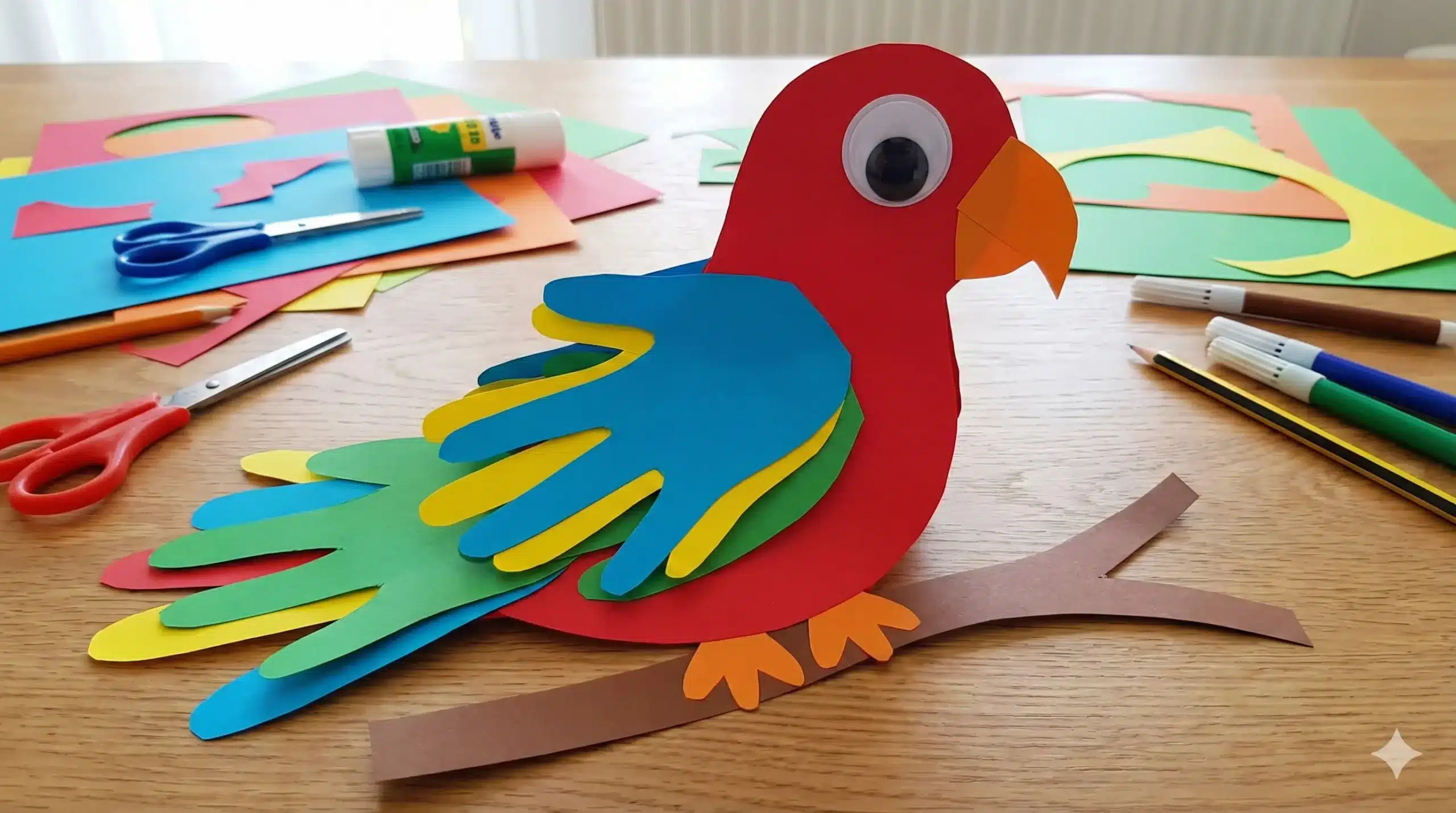
Here’s a colorful handprint parrot craft to brighten up your day! Perfect for young kids to use their hands, get creative, and learn about different colors in nature’s palette.
Have you ever looked at the talking animals and birds in cartoons and wished they could do the same in real life? Imagine having a conversation with your dog or debating with your cat! While most animals communicate in their own unique ways, there is one creature that bridges the gap between animal sounds and human speech IRL – the parrot!
Parrots are among the most intelligent creatures on the planet. Scientists have studied African Grey parrots and discovered that their cognitive reasoning ability rivals that of a 3-year-old human child. That is amazing! It is no wonder, then, that parrots are incredibly popular in various cultures, folklore, and even national symbols.
+1
In this article, we will explore the fascinating world of these colorful birds and guide you through a fun, educational, and easy-to-make handprint parrot craft.
The Cultural Significance of Parrots
Before we dive into the glue and paper, let’s take a moment to appreciate why this bird is such a superstar. Teaching children the backstory of the animal they are crafting adds a rich layer of educational value to the activity.
- Ancient Stories: Parrots have appeared in literature for centuries. In Aesop’s Fables, stories like “The Parrot and the Cat” teach moral lessons. In Eastern literature, Rumi wrote “The Merchant and the Parrot,” a beautiful tale about freedom and wisdom.
+1 - Mythology: In Hindu mythology, Kamadeva, the god of love, is often depicted riding a parrot. The parrot symbolizes speech, love, and the arrival of spring.
- National Symbols: The Dominican Republic features the Sisserou parrot on its national flag and coat of arms, highlighting the bird’s importance to the island’s natural heritage.
- Global Celebrations: Conservation is key! Every year, a Parrot Festival is held in Venezuela to raise awareness about the endangered Yellow-Shouldered Parrot. Additionally, the World Parrot Trust has declared May 31st as World Parrot Day to highlight the threats these birds face in the wild.
Why Choose a Handprint Craft?
You might be wondering, “Why use handprints?” Apart from being adorable keepsakes that freeze a moment in time (those hands grow so fast!), handprint crafts offer specific developmental benefits:
- Fine Motor Skills: Tracing fingers involves precision and control, helping children develop the muscles needed for writing.
- Self-Expression: It gives children a sense of ownership. “That’s my hand that made the wing!”
- Color Recognition: Parrots are the perfect subject for teaching colors. You aren’t limited to brown or black; you can use Scarlet, Turquoise, Gold, and Lime Green. It’s a lesson in color theory disguised as play.
Supplies Required
To make this Bright and Colorful Handprint Parrot, you will need standard craft supplies found in most homes or classrooms.
- Colored Cardstock or Construction Paper: You need a variety of bright colors (Red, Blue, Green, Yellow) for the feathers/handprints, and a neutral color for the branch.
- Pencil: For tracing the hand.
- Scissors: Child-safe scissors are best for little ones.
- Glue Stick: Or liquid school glue.
- Googly Eyes: Large ones look funnier!
- Markers: Black marker for details (beak smile, feet).
- Orange Paper: For the beak and feet.
- Optional: Real craft feathers for extra texture.
Step-by-Step Instructions: How to Make a Handprint Parrot
This craft uses paper handprints to create the layered look of the parrot’s wings and tail. It is less messy than paint and allows for more detailed layering.
Step 1: Trace and Cut the Handprints
This is the most fun part! Have your child place their hand on three or four different colors of paper (e.g., Red, Yellow, Blue). Trace around the hand with a pencil.
- Tip: Trace the hand about 3 to 4 times on different colors. These handprints will act as the parrot’s wings and tail feathers.
- Action: Cut out the handprint shapes carefully. If your child is very young, an adult can help with the cutting, especially around the tricky finger areas.
Step 2: Create the Parrot Body
Draw a large, simple pear shape or a bowling pin shape on a piece of red (or green) paper. This will be the main body of the parrot. Cut it out.
- Note: The top of the pear is the head, and the bottom is where the tail will go.
Step 3: Layer the Wings
Take your cutout handprints. You want to glue them onto the side of the body to look like folded wings.
- Start with one handprint near the shoulder area. Fingers should be pointing down and slightly back.
- Layer a second handprint (in a different color) slightly over the first one, but moved down a bit. This creates a beautiful, multi-colored wing effect, mimicking the plumage of a Macaw.
Step 4: The Tail Feathers
Take two more handprints and glue them to the back of the parrot body, at the very bottom.
- Position them so the fingers fan out. This creates a glorious, bushy tail that balances the bird.
Step 5: Add the Face Details
Now, let’s give our parrot some personality!
- Beak: Cut a curved triangle or a cashew-nut shape out of orange or black paper. Glue it to the center of the head area.
- Eyes: Stick a large googly eye right above the beak.
- Cheeks: Cut a small white circle and place it behind the eye if you want to make it look like an African Grey or Macaw, which often have white patches on their faces.
Step 6: The Perch
A parrot needs somewhere to sit! Cut a long, thin rectangle from brown paper to act as a branch. Glue the parrot’s body so it looks like it is sitting on top of the branch.
- Feet: Cut small claw shapes out of orange or black paper and glue them over the branch, tucked under the parrot’s body, so it looks like the bird is gripping the wood.
Step 7: Embellish!
Use a black marker to draw a smile on the beak or add texture lines to the branch. You can also glue a few real craft feathers to the top of the head for a funky crest!
Fun Facts About Parrots for Kids
While the glue dries, keep the engagement going by sharing these cool facts:
- Zygodactyl Feet: That’s a big word! It means parrots have four toes on each foot—two pointing forward and two pointing backward. This helps them grip branches (and their food) very tightly.
- Long Lives: Parrots live a very long time. While dogs might live to be 15, some large parrots can live to be over 80 years old! They are a lifelong commitment.
- Taste Buds: Parrots have taste buds on the roof of their mouths, not just on their tongues!
- Omnivores: While they love seeds and nuts, many parrots also eat fruit, flowers, and even insects in the wild.
Educational Extensions: Turning Craft into Learning
You can easily expand this handprint parrot craft into a full lesson plan:
- Geography: Show the kids a map. Where do parrots live? (The Amazon Rainforest, Australia, Africa). Point out how colorful the birds are in tropical regions compared to birds in colder climates.
- Biology: Discuss why parrots are colorful. Is it for camouflage in bright flowers and fruits? Is it to attract friends?
- Writing: Ask the child, “If you were a parrot, what would be the first sentence you would learn to say?” Have them write it in a speech bubble and attach it to their craft.
Conclusion
Crafting with kids is about more than just the final product; it is about the conversations you have while the scissors are snipping and the glue is sticking. This Bright and Colorful Handprint Parrot Craft is a fantastic way to celebrate nature, explore colors, and learn about one of the world’s most fascinating animals.
Whether you are celebrating World Parrot Day on May 31st or just looking for a rainy day activity, this project is sure to bring a smile to your child’s face. So, spread your wings, grab your paper, and have a squawking good time!