
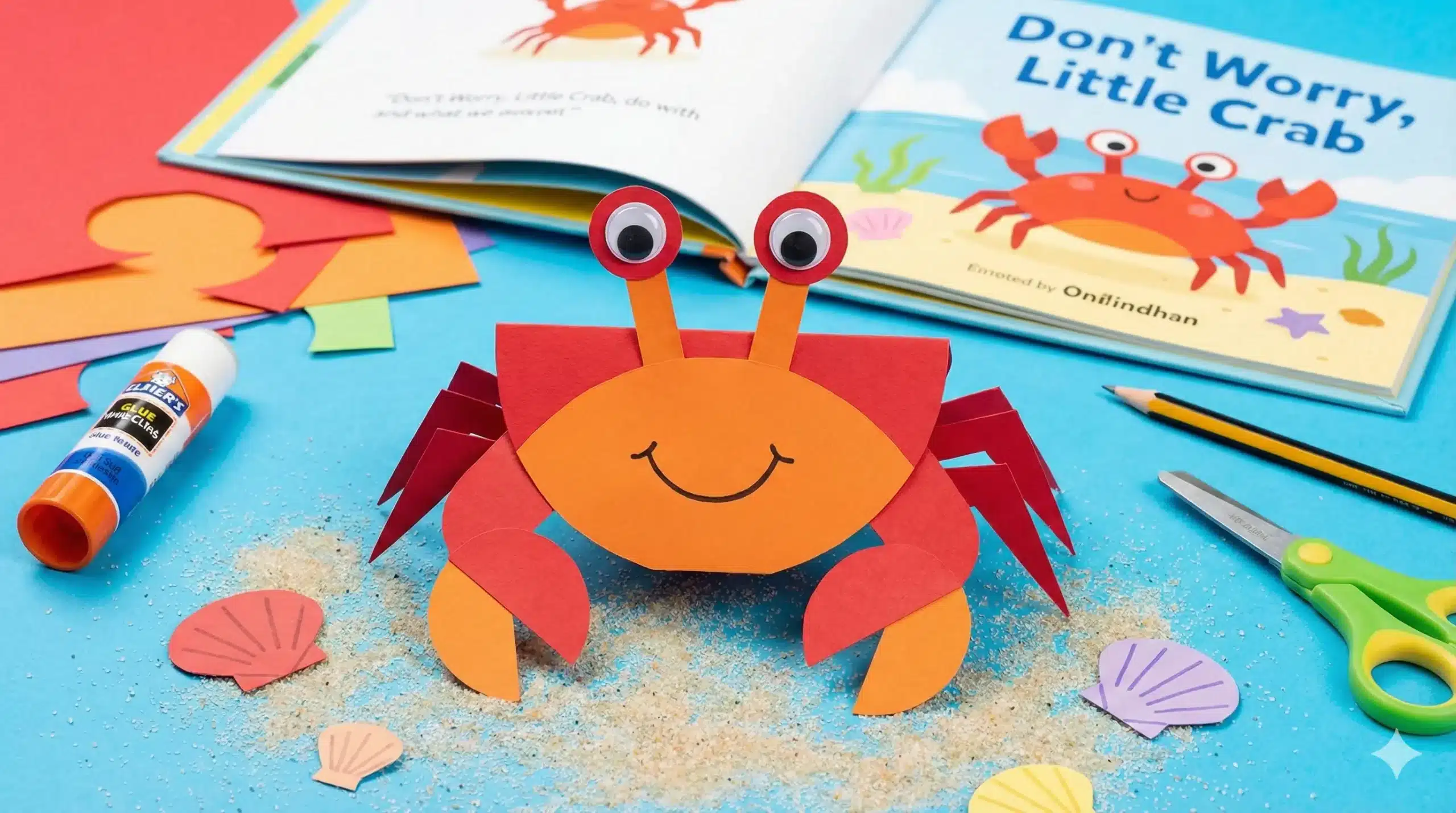
There is something undeniably charming about the ocean’s cheekiest residents: crabs. You know the type—the quiet folks who prefer to stay in the background, diligently doing their work without much fuss or flashiness. They scuttle along the sand, carrying their homes on their backs or digging little burrows, minding their own business.
But what happens when these shy creatures are suddenly thrust into the limelight? That is the central theme of Carter Goodrich’s wonderful book, The Hermit Crab. It is a story about stepping out of your shell (quite literally!) and finding the courage to be seen.
With International Crab Day observed annually on April 26th, there is no better time to dive deep into the blue and celebrate these ten-legged crustaceans. Whether you are looking for a summer activity, a classroom project for an ocean unit, or just a way to keep little hands busy on a rainy afternoon, this Super Cute Crab Papercraft is the perfect solution.
In this guide, we will explore some fantastic books to spark your child’s interest, share some fun facts about crabs, and provide a detailed, step-by-step tutorial on how to make your very own paper crab friend.
Fun Books about Crabs for Kids
Before we break out the glue and scissors, it is always a great idea to set the stage with a story. Reading together not only builds vocabulary but also helps children connect emotionally with the subject of their art project. Here are five highly recommended titles that celebrate our clawed friends:
1. A House for Hermit Crab by Eric Carle
A classic that belongs on every bookshelf. Join Hermit Crab as he moves out of his small shell and looks for a bigger home, meeting various sea creatures along the way who help him decorate his new abode. It is a gentle lesson on growing up and moving forward.
2. Don’t Worry, Little Crab by Chris Haughton
This visually stunning book captures the feeling of anxiety perfectly. Little Crab and Very Big Crab leave their rock pool for the ocean. The waves look scary and huge to Little Crab, but with a bit of encouragement, he learns that taking a plunge can lead to beautiful discoveries.
3. Clem and Crab by Fiona Lumbers
Clem is a little girl who loves collecting treasures from the beach. When she finds a crab stuck in a plastic bag, she learns an important lesson about protecting our oceans and the creatures that live there. It is a sweet story with an eco-friendly message.
4. The Hermit Crab by Carter Goodrich
As mentioned earlier, this story follows a crab who is perfectly happy being unnoticed inside his plain shell. But when he uses his shell as a canvas for something flashy, everything changes. It is a humorous look at fame and staying true to oneself.
5. Get Well, Crabby! by Jonathan Fenske
For early readers who love a good laugh, this graphic novel-style book is perfect. Crabby is, well, crabby! His friend Plankton tries to cheer him up with varying degrees of success. It is silly, fun, and great for reading aloud.
Why Crafting is Important for Child Development
You might think you are just making a paper toy, but crafts like this play a vital role in a child’s development.
- Fine Motor Skills: Cutting along curved lines, folding paper, and gluing small eyes all require dexterity and hand-eye coordination.
- Following Instructions: Moving step-by-step through a process helps children learn patience and sequencing.
- Creativity: While we provide a template, the choice of colors and expressions allows children to make the art their own.
- Emotional Expression: Making a “happy” crab or a “grumpy” crab allows kids to explore different emotions through play.
Supplies Required
To get started, you don’t need a trip to an expensive art store. Most of these supplies are likely already in your drawer.
- Colored Craft Papers or Cardstock: You will need a main color for the crab (Red is classic, but Orange, Pink, or even Blue work great!) and White for the eyes. Thicker paper (cardstock) is recommended so the crab stands up well.
- A Pencil: For tracing the template onto your colored paper.
- Scissors: Child-safe scissors for the little ones, and sharper ones for adults to help with tricky corners.
- Craft Glue: A glue stick works best for paper-to-paper connections to avoid wrinkling, but liquid school glue works too.
- Sharpies or Markers: A black marker for the pupils and mouth. You can also use colored markers to decorate the shell.
- The Template: You can draw your own shapes (a large circle for the body, smaller ovals for claws) or find a simple crab outline online to trace.
How to Make the Super Cute Crab Papercraft
Ready to get scuttling? Follow these easy steps to create your own crustacean companion.
Step 1: Prepare Your Shapes
First, you need to create the parts of the crab. If you are using a printable template, download and print it out. If you are drawing freehand, here is what you need:
- Body: One large circle (about the size of a saucer).
- Claws: Two large oval shapes with a “V” cut out of the top to look like pincers.
- Legs: Six smaller, thin rectangles or oval strips.
- Eyes: Two small white circles for the eyeballs and two thin strips to act as the eye stalks.
Trace these shapes onto your chosen colored craft paper. Remember, nature is colorful! Your crab can be a realistic muddy brown or a fantastical neon purple.
Step 2: Cut Out the Pieces
Carefully cut out all the traced shapes. This is excellent scissor practice for kindergarteners. Encourage them to turn the paper as they cut, rather than twisting their arm.
Tip: If you want to make the eyes pop, use a black Sharpie to color in a pupil on the white circles before you glue them. You can make them look left, right, or cross-eyed for a funny expression!
Step 3: Create the Body Base
Now for the engineering part! Take your large circle (the body) and fold it exactly in half.
- Crease the fold sharply.
- When you set it down with the folded edge at the top and the curved edge at the bottom, it should rock back and forth like a rocking chair.
- Note: For this specific craft style, the curved edge acts as the bottom, allowing the crab to rock. Alternatively, you can place the flat side down for a stable crab, but the rocking motion adds to the fun!
Step 4: Assemble the Eyes
Glue the white eye circles onto the top of the thin eye stalk strips. Open your folded body circle slightly. Apply a dab of glue to the bottom of the eye stalks and paste them inside the fold, sticking out of the top (the folded edge) of the crab. They should be poking up like periscopes!
Step 5: Attach the Claws and Legs
Crabs are decapods, meaning they technically have ten limbs (including claws), but for a cute papercraft, we usually simplify!
- The Claws: Glue the two large claws to the sides of the body. You can glue them to the back of the paper so they look like they are reaching out.
- The Legs: Glue three smaller legs on the left side and three on the right side. Again, attach them to the back of the body shape so the connections are hidden. Angle them downwards so it looks like the crab is walking.
Step 6: Add Personality
Close the body fold back up. Now, take your black marker and draw a smile on the face. You can make it a zigzag smile for a confused crab or a big wide U for a happy crab.
- Optional: Use glitter glue to add sparkles to the shell, or use a hole punch to make colored dots and glue them on for a textured “bumpy” shell look.
Fun Facts About Crabs to Share While Crafting
While the glue dries, keep the kids engaged with these cool crab facts:
- They Walk Sideways: Most crabs have legs that bend outwards, which makes it much faster and easier for them to scuttle sideways than forward.
- They Have Armor: A crab’s shell is actually its skeleton! It’s called an exoskeleton. Since it’s on the outside, it protects them like a suit of armor.
- They grow by molting: Since their shell is hard and doesn’t stretch, crabs have to crack open their old shell and wiggle out of it to grow larger. They then grow a new, soft shell that eventually hardens.
- They are ancient: Crabs have been around since the Jurassic period—that means they lived alongside dinosaurs!
Creative Ways to Use Your Paper Crab
You’ve made the craft, but the fun doesn’t have to stop there. Here are a few ways to utilize your new paper creation:
- Ocean Diorama: Use a shoe box painted blue to create an underwater scene. Your paper crab can live on the sandy bottom made of crushed cereal or real sand.
- Greeting Cards: Since the body folds, this crab makes an adorable pop-up card. Write a message like “I’m Crabby without you!” or “Have a Snappy Birthday!” inside the fold.
- Storytelling Props: Glue a popsicle stick to the bottom of the crab (if you didn’t make it a rocker) and use it as a puppet while reading A House for Hermit Crab.
- Summer Party Decor: Make a dozen of these in different colors and string them together to make a festive garland for a pool party or beach-themed birthday.
Conclusion
We hope you enjoyed this deep dive into the world of crustaceans! This Super Cute Crab Papercraft is more than just a way to pass the time; it is an opportunity to spark curiosity about marine life, practice essential motor skills, and bond over a shared creative activity.
There is something undeniably charming about the ocean’s cheekiest residents: crabs. You know the type—the quiet folks who prefer to stay in the background, diligently doing their work without much fuss or flashiness. They scuttle along the sand, carrying their homes on their backs or digging little burrows, minding their own business.
But what happens when these shy creatures are suddenly thrust into the limelight? That is the central theme of Carter Goodrich’s wonderful book, The Hermit Crab. It is a story about stepping out of your shell (quite literally!) and finding the courage to be seen.
With International Crab Day observed annually on April 26th, there is no better time to dive deep into the blue and celebrate these ten-legged crustaceans. Whether you are looking for a summer activity, a classroom project for an ocean unit, or just a way to keep little hands busy on a rainy afternoon, this Super Cute Crab Papercraft is the perfect solution.
In this guide, we will explore some fantastic books to spark your child’s interest, share some fun facts about crabs, and provide a detailed, step-by-step tutorial on how to make your very own paper crab friend.