
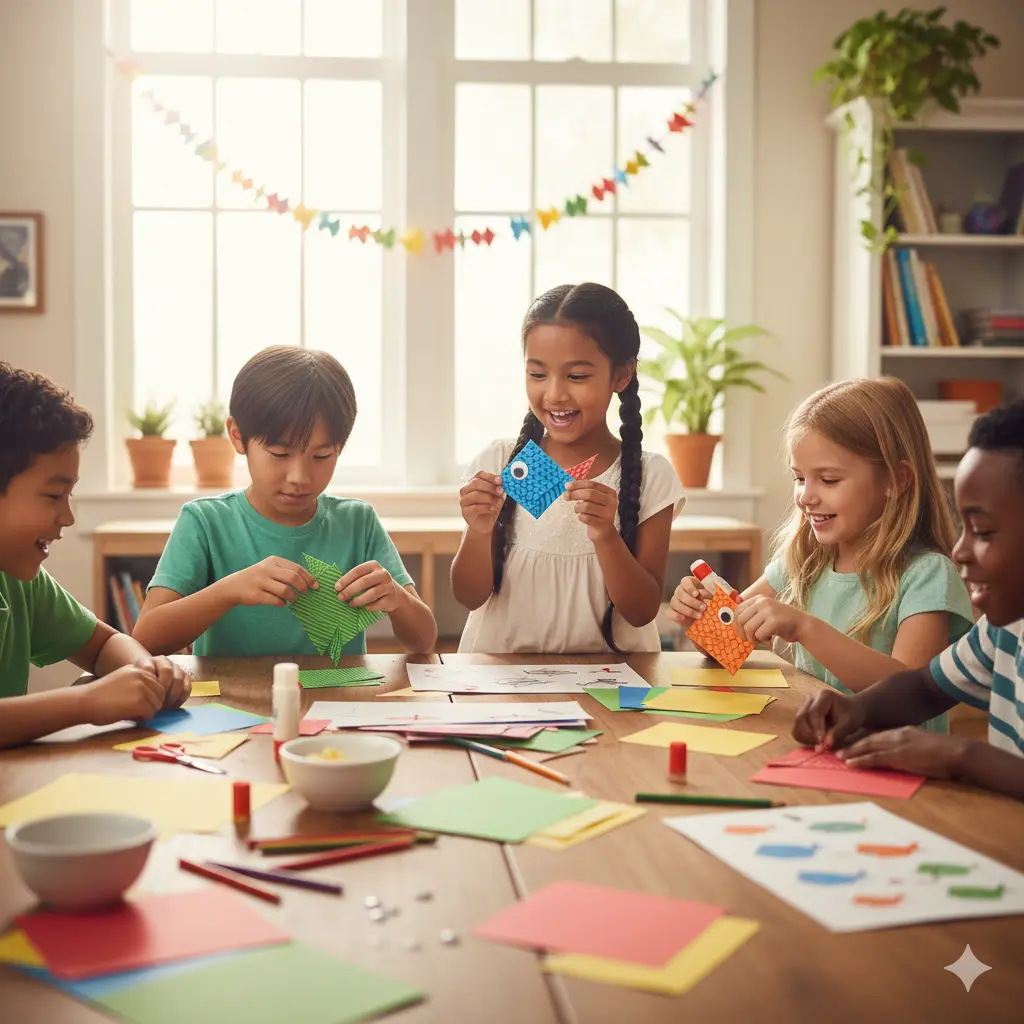
While you can use almost any paper for Origami, for this specific fish craft, the choice of paper can change the “vibe” of your project:
- Standard Origami Paper: This is usually colored on one side and white on the other, which helps beginners keep track of which side they are working on.
- Patterned Paper: Using paper with dots, stripes, or floral patterns can make your fish look like a tropical species found in a coral reef.
- Recycled Paper: Old magazine pages or colorful gift wrap can be cut into squares for an eco-friendly crafting session.
Step-by-Step Guide: The Easy Origami Fish
This fish is a “beginner” level fold, making it ideal for preschoolers and elementary-aged kids.
Materials Required:
- One square piece of paper (any size, but 6×6 inches is easiest to handle).
- Googly eyes or a black marker.
- A flat surface to press your creases.
The Folding Process:
Step 1: The Initial Triangle
Place your square paper on the table so it looks like a diamond. Fold the top corner down to meet the bottom corner. Crease it well with your fingernail. You should now have a large triangle.
Step 2: Creating the Center Line
Fold the left corner over to the right corner, then unfold it. This creates a vertical crease down the center of your triangle, which will act as a guide for the next steps.
Step 3: Folding the Fins
Take the right corner and fold it toward the center line, but instead of aligning it perfectly with the middle, fold it at a slight downward angle so the tip extends past the bottom edge. This will become one side of the tail fin. Repeat this with the left corner, overlapping it slightly over the right fold.
Step 4: The Big Reveal
Flip the paper over. You should now see the smooth body of a fish with a forked tail at the back!
Step 5: Final Touches
A fish isn’t complete without its personality. Glue on a googly eye near the front point or use a marker to draw a large, friendly eye and a small mouth. You can even draw scales or colorful stripes along the body.
Fun Ways to Play with Your Origami Fish
Once you’ve mastered the fold, don’t stop at just one! Here are some creative ways to use your paper school of fish:
- The Desktop Aquarium: Glue your fish onto a blue piece of cardstock. Draw some green seaweed and bubbles to create a 3D underwater scene.
- Fishy Garland: Use a needle and thread to string several fish together. Hang them across a window or a doorway for a “swimming” room decoration.
- Matching Game: Fold pairs of fish in identical colors and patterns. Turn them over and let kids try to find the matching “twins.”
Quick Reference: Origami Basics
| Term | Meaning | Tip for Kids |
| Valley Fold | A fold that creates a “V” shape or a valley. | Fold “toward” you like a book. |
| Mountain Fold | A fold where the crease points up like a peak. | Fold “away” from you like a tent. |
| Base | A starting shape for many models. | Most start with a square or a triangle. |
| Crease | The line left after folding and unfolding. | Use your thumb or a spoon for a sharp line! |
Best Practices for SEO and AdSense Compliance
When sharing this craft on your platform, it is important to ensure the content meets the highest quality standards for Google AdSense and AdX.
- Avoid Scraped Content: Do not simply copy-paste instructions from other sites. This guide provides unique context on the linguistic roots of Origami and specific developmental benefits, which adds “thickness” to the content.
- Readability: Use clear headers and bullet points. Google’s crawlers prioritize content that is easy for users to navigate and understand.
- Original Photography: If you are posting this as a blog, use your own step-by-step photos. Original imagery is a significant factor in site authority and ad revenue potential.
- Internal Linking: Link this to other Japanese-themed projects (like Kokeshi dolls) or other paper crafts to create a “topic cluster,” which helps search engines understand your expertise.