
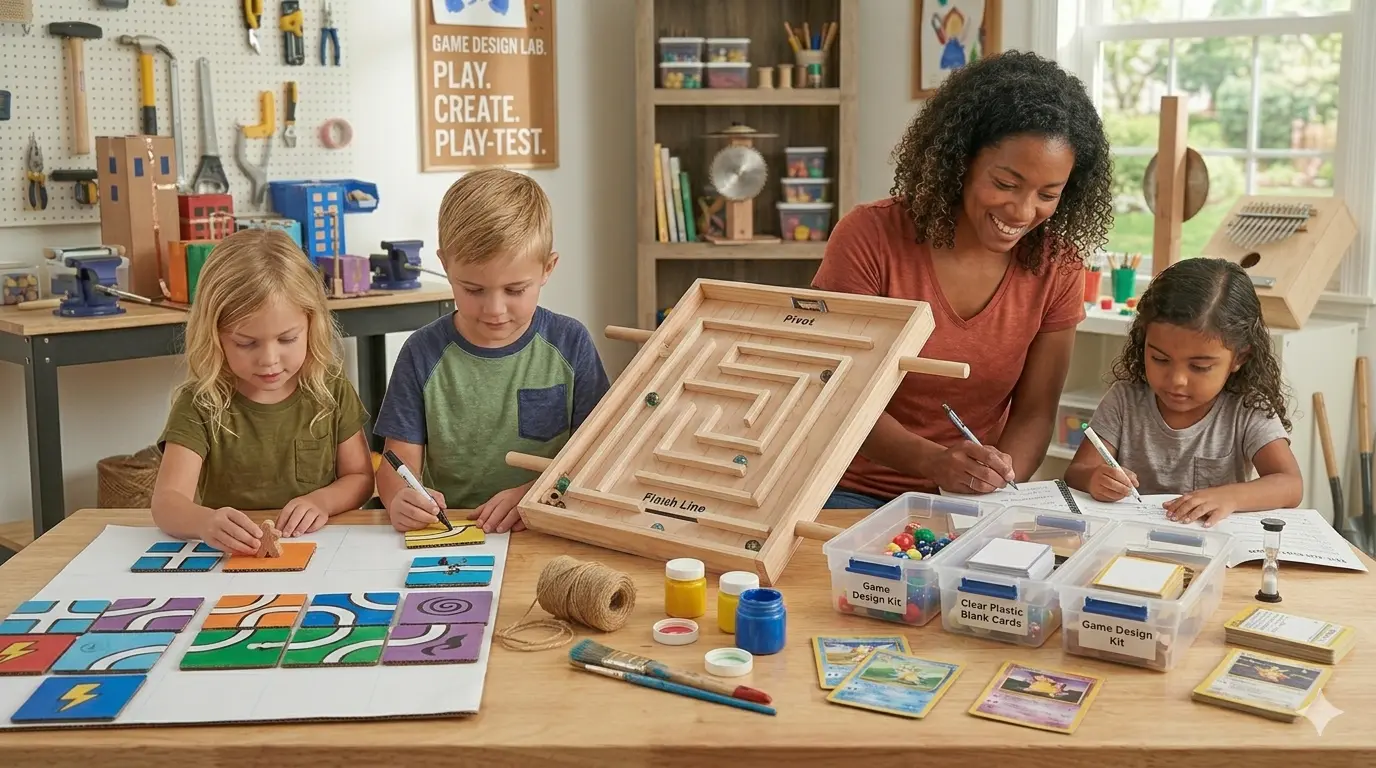
We have spent this series mastering the physical world—wood, electronics, physics, and acoustics. Now, we move into the realm of systemic thinking. Creating a DIY board game is perhaps the most intellectually complex “toy” a child can make because it requires them to build a set of laws (rules), a physical environment (the board), and a narrative (the theme).
When a child designs a game, they transition from a player to a Game Designer. They must grapple with balance, probability, and social dynamics. Is the game too hard? Is it fair? Does the “endgame” feel rewarding? This is high-level logic disguised as pure, tabletop fun.
1. Project: The “Infinite Journey” Modular Board
Target Skills: Logical sequencing, spatial planning, and probability.
Unlike a static board (like Monopoly), a modular board is made of separate tiles. This means the map is different every time you play, which is a hallmark of high-quality modern game design.
Materials You’ll Need:
- The Tiles: 4×4 inch squares cut from heavy-duty cardboard or thin plywood.
- The Surface: Chalkboard paint or white contact paper (for erasable paths).
- Markers: Wet-erase markers or chalk.
- The “Meeple”: DIY characters made from wine corks or wooden spools.
The Build:
- The Grid: Create 12 to 20 tiles. On each tile, the child draws a segment of a path. Some paths are straight, some are “T” junctions, and some are “Dead Ends.”
- The Symbols: Introduce “Action Icons.” A lightning bolt might mean “Move again,” while a swirl might mean “Go back to the start.”
- The Mechanic: Instead of a standard die, create a DIY Spinner or a “Chance Bag” filled with different colored stones.
- The Probability Lesson: If there are 10 green stones and only 1 gold stone, what are the odds ($P$) of drawing the gold?
$$P(gold) = \frac{1}{11} \approx 9\%$$
(This teaches children that “luck” is actually math in disguise!)
- The Probability Lesson: If there are 10 green stones and only 1 gold stone, what are the odds ($P$) of drawing the gold?
2. Project: The “Gravity-Defying” Labyrinth
Target Skills: Hand-eye coordination, equilibrium, and architectural design.
The classic wooden labyrinth is a test of patience. Building one from scratch allows the child to determine the difficulty level and “trap” placement.
Materials You’ll Need:
- The Tray: A shallow wooden box or a sturdy pizza box lid.
- The Walls: Balsa wood strips or thick cardboard strips.
- The Ball: A standard glass marble or a steel ball bearing.
- The “Traps”: A hole-saw (for wood) or a utility knife (for cardboard) to cut “drop-zones.”
The Build:
- The Maze Design: The child must draw the path first. If the path is too narrow, the marble gets stuck (friction). If it’s too wide, it’s too easy.
- The “Pivot” Handles: Attach two wooden dowels to the sides of the box. This allows the player to tilt the board with precision rather than just shaking it.
- The Goal: Create a “Finish Line” that triggers a sound—perhaps the marble hits a small DIY bell (from our Acoustic article!) when it wins.
3. Project: The Cardboard “Trading Card” Game (TCG)
Target Skills: Categorization, arithmetic, and graphic design.
Creating a card game like Pokémon or Magic: The Gathering is a masterclass in balance. Every card must have a “cost” and a “power.”
Materials You’ll Need:
- Card Stock: Heavyweight white paper cut into 2.5 x 3.5 inch rectangles.
- Protection: Clear plastic card sleeves.
- The Catalog: A notebook to record the “Master Rules.”
The Build:
- The Three Pillars: Every card needs an Illustration, a Statistic (Attack/Defense), and a Special Ability.
- The Resource System: How do you play a card? Does it cost “Energy” or “Gold”? This prevents players from just playing their strongest cards immediately.
- Play-Testing: This is the most important part of DIY game design. Two children play a round, and if one card is “too powerful,” they must “nerf” it (reduce its stats) for the next round.
A DIY game is only as good as its instructions. Writing the manual is where the “educational” value peaks.
- Clarity: The child must explain how a player wins. Is it by reaching the end, or by collecting the most points?
- Turn Order: Does play move clockwise? What happens during a “tie”?
- Conflict Resolution: If two players disagree on a rule, what is the “House Rule”?
5. Curating a DIY Tabletop Library
To keep the game-making process high-quality, create a “Game Design Kit” that lives in your workshop:
- Assorted Dice: 4-sided, 10-sided, and 20-sided dice to introduce different probability scales.
- Blank Cards: Always have a stack ready for when inspiration strikes.
- Sand Timers: For adding a “speed” element to games.
- The “Graveyard” Box: For game versions that didn’t work. These become “scraps” for the next project.
6. Conclusion: The Board as a Mirror
Building a board game is the ultimate act of social play. When a child creates a game, they are creating a world where they set the rules. They learn to be a fair leader and a creative problem-solver.
Over this series, we have moved from the kitchen table to the backyard, from the electronics lab to the symphony hall, and finally to the tabletop. We have shown that with a few “loose parts” and a willing adult, a child can build a universe.