
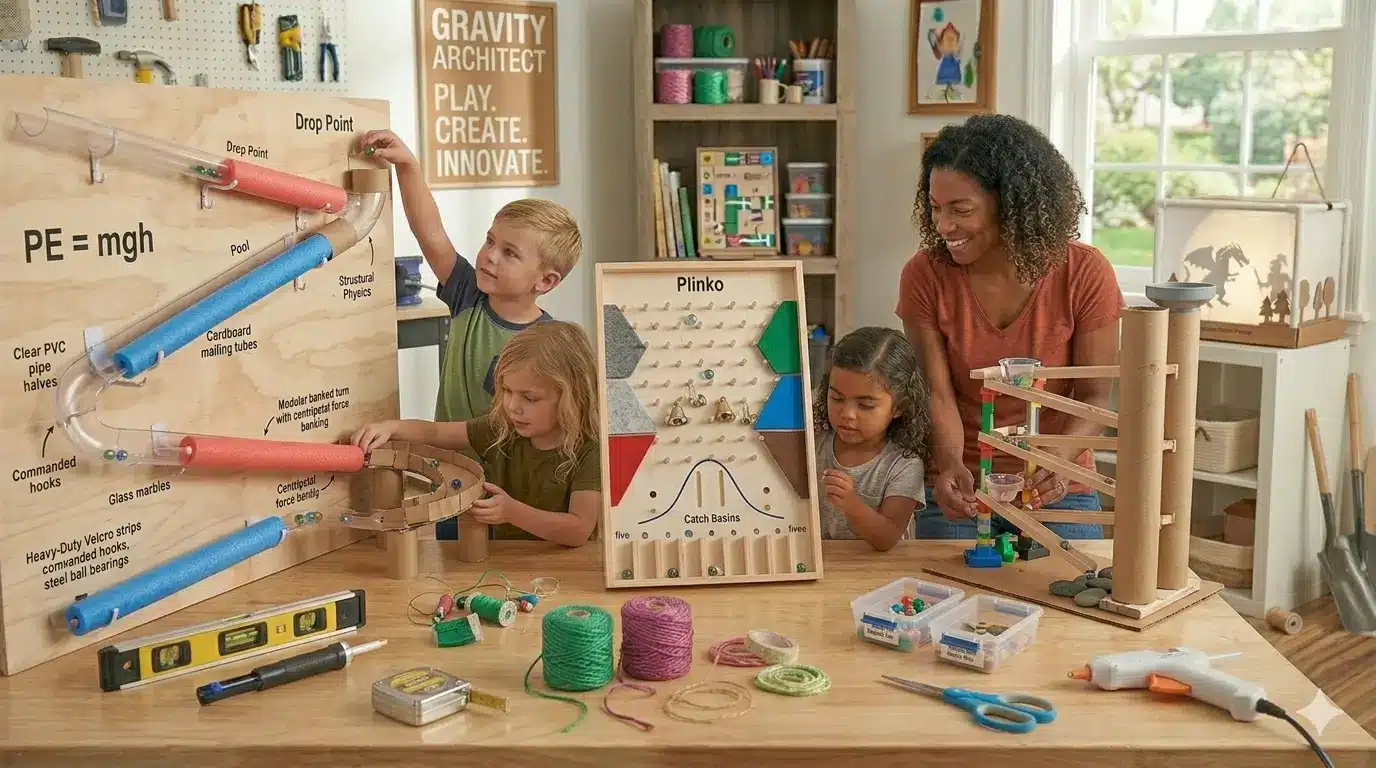
We have hacked circuits and sewn topological shapes, but now we return to the pure, unadulterated joy of dynamic motion. A high-quality DIY marble run is more than just a series of ramps; it is a complex system of potential energy, momentum, and structural stability.
When a child builds a vertical track, they are essentially practicing civil engineering. They must ensure the base can support the height (center of gravity), the angles are steep enough to overcome friction, and the joints are secure enough to withstand the “g-force” of a moving sphere.
1. Project: The “Zero-G” Wall-Mounted Track
Target Skills: Vertical alignment, kinetic energy transfer, and modular design.
Using the vertical space of a wall or a large piece of plywood allows for much longer runs and clearer observations of acceleration.
Materials You’ll Need:
- The Tracks: PVC pipe halves (sliced lengthwise), pool noodles cut in half, or cardboard mailing tubes.
- The Mounts: Self-adhesive “Command” hooks or heavy-duty velcro strips.
- The Catalyst: Glass marbles, steel ball bearings, or even ping-pong balls (for a slower, “low-gravity” look).
The Build:
- The Drop Point: Start at the highest reachable point. This is the reservoir of Potential Energy ($PE$):
$$PE = mgh$$
(Where $m$ is mass, $g$ is gravity, and $h$ is height. The higher the start, the more “fuel” the marble has!) - The Banked Turn: When the track turns, the marble wants to fly off. Angle the track inward (banking) to harness Centripetal Force.
- The Loop-the-Loop: To successfully complete a vertical loop, the marble must enter with enough velocity to maintain contact with the track at the apex.
2. Project: The “Plinko” Peg-Board Randomizer
Target Skills: Probability distribution, acoustics, and impact physics.
A Plinko board uses a grid of pegs to create a “Galton Board” effect, demonstrating how individual random events create a predictable pattern (the Bell Curve).
Materials You’ll Need:
- The Board: A sheet of pegboard or a thick wooden plank.
- The Pegs: Wooden dowels, long bolts, or even sturdy nails (if filed smooth).
- The Bells: Small metal washers or DIY bells (from our Acoustic article) placed at the bottom.
The Build:
- The Hexagonal Grid: Arrange the pegs in an offset “diamond” pattern. If the pegs are too close, the marble jams; too far, and it falls straight down.
- The Soundscape: Every time the marble hits a peg, it creates a “ping.” Vary the material of the pegs (plastic vs. metal) to create a rhythmic melody as the marble descends.
- The Catch Basins: Divide the bottom into five slots. Challenge the child to predict which slot will fill up first.
3. Project: The “Scissor-Lift” Marble Elevator
Target Skills: Simple machines, mechanical advantage, and manual power.
A marble run is a one-way trip—unless you build a way to get the marbles back to the top. This introduces the Scissor Linkage.
Materials You’ll Need:
- The Links: Large popsicle sticks or thin wooden slats.
- The Pivots: Small bolts and lock-nuts.
- The Basket: A small plastic cup or a 3D-printed bucket.
The Build:
- The “X” Pattern: Drill holes at the ends and the center of each slat. Pin them together in a series of “X” shapes.
- The Expansion: When the bottom of the “X” is squeezed, the entire tower grows vertically.
- The Hand-Crank: Connect a simple wooden handle to the base. This teaches the child how a small horizontal force can be converted into a large vertical lift.
4. The Structural Audit: Stability and Speed
A run that wobbles loses energy to vibration. To keep your marble run high-quality:
- Base Loading: If the tower is top-heavy, glue “weighted” stones or heavy metal washers to the base to lower the Center of Gravity.
- Friction Reduction: Smooth out the joints where two pieces of track meet. A tiny “bump” can steal enough momentum to stop the marble mid-run.
- The Slope Check: Use a spirit level (or a leveling app on your phone) to ensure your horizontal runs have at least a 2-degree decline.
5. Why Gravity is the Best Teacher
Gravity is a constant, honest critic. It doesn’t care about “good tries”—it only cares about physics.
- Persistence: If the marble falls off at the 4th turn every time, the child must iterate. They become a scientist by necessity.
- Observation: They begin to “see” the energy. They can anticipate where the marble will speed up and where it will struggle.
- Collaboration: Building a large-scale run almost always requires two sets of hands—one to hold the track, and one to test the drop.
Conclusion: The Infinite Descent
The marble run is the ultimate synthesis of the DIY workshop. It uses the woodworking of the frame, the acoustics of the pegs, the hacking of the haptic sensors, and the engineering of the lift. It is a world in motion, powered by the simplest and most reliable force in the universe.