
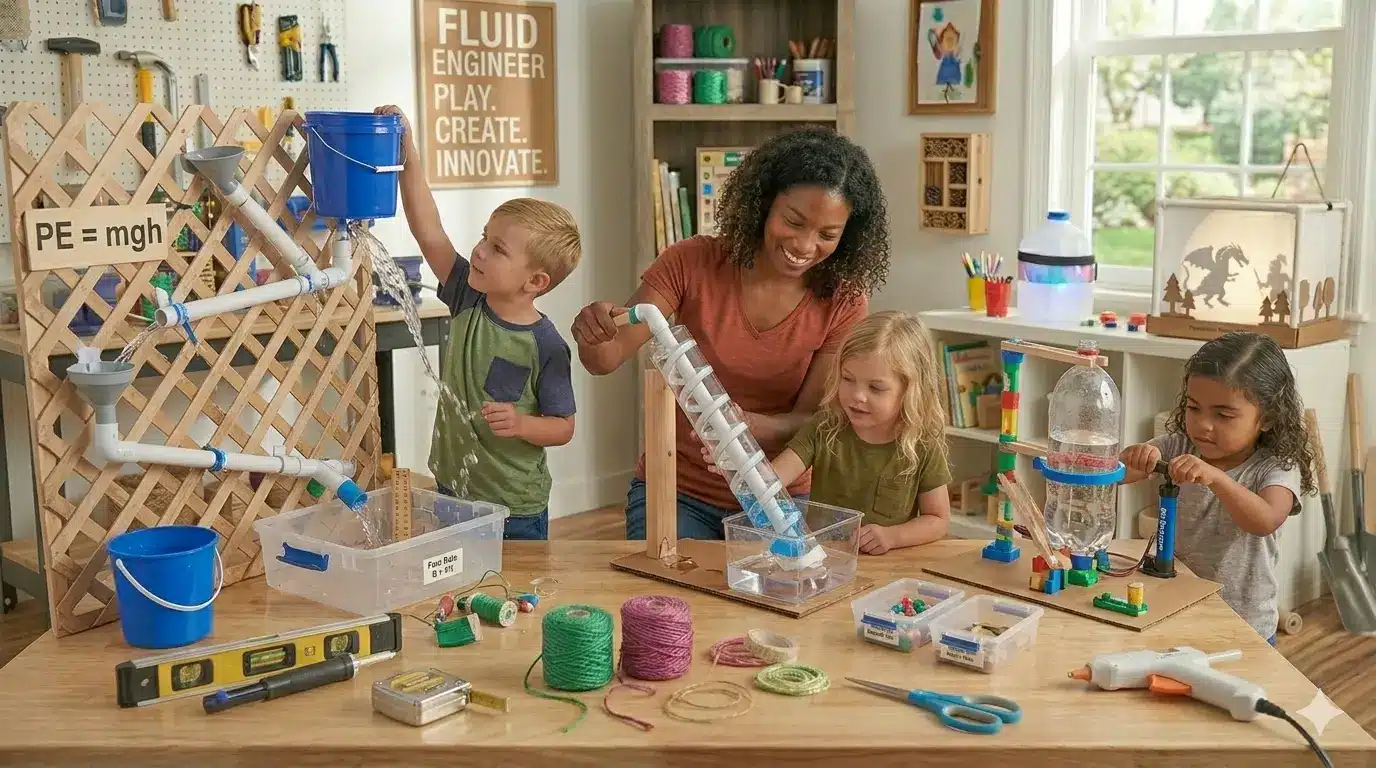
We have mastered the air with acoustics and the earth with gravity runs; now, we turn our attention to the most versatile element in the workshop: Water. A high-quality DIY water table is more than just a place to splash—it is a laboratory for fluid dynamics, siphoning, and buoyancy.
Working with water teaches a child about pressure and flow. They learn that water is both powerful enough to move a wheel and delicate enough to climb a wick. This article provides the blueprints for a modular hydraulic playground that can be built from common plumbing scraps and recycled containers.
1. Project: The “Gravity-Fed” PVC Water Wall
Target Skills: Hydrostatics, flow control, and modular assembly.
By mounting a series of movable pipes and funnels to a vertical fence or board, children can create a custom “water circuit” that demonstrates how gravity moves liquids.
Materials You’ll Need:
- The Infrastructure: A section of plastic lattice or a pegboard treated with waterproof sealant.
- The Plumbing: 1-inch and 2-inch PVC pipe off-cuts, elbows, and “T” joints.
- The Attachments: Large plastic funnels and pool noodle segments.
- Connectors: Heavy-duty rubber gear ties or waterproof Velcro.
The Build:
- The Reservoir: Mount a large bucket at the top with a small hole drilled near the bottom. This acts as the “battery” for your system, providing a steady stream of Potential Energy.
- The Diverters: Use “T” joints to split the water flow. This introduces the concept of Fluid Branching.
- The Catch: Place a clear bin at the bottom. Use a measuring stick to track how long it takes to fill, teaching the child to calculate Flow Rate ($Q$):
$$Q = \frac{V}{t}$$
(Where $V$ is volume and $t$ is time. Does narrowing the pipe change the speed?)
2. Project: The “Archimedes” Screw Lift
Target Skills: Simple machines, spiral geometry, and vertical transport.
The Archimedes screw is one of the oldest hydraulic machines in history. Building one shows how rotational motion can be converted into vertical lift.
Materials You’ll Need:
- The Shaft: A 2-foot PVC pipe or a thick wooden dowel.
- The Spiral: Flexible clear vinyl tubing (1/2-inch diameter).
- The Handle: A simple PVC elbow attached to the top.
The Build:
- The Wrap: Coil the vinyl tubing tightly around the central shaft. Secure it with waterproof adhesive or zip ties.
- The Angle: Lean the screw at a 45-degree angle into the lower water reservoir.
- The Operation: As the child turns the handle, small pockets of air and water are trapped in the coils and “climb” the screw until they pour out of the top.
3. Project: The “Pneumatic” Water Rocket
Target Skills: Propulsion, pressure seals, and Newton’s Third Law.
This project uses compressed air to force water out of a bottle at high velocity, demonstrating the power of Internal Pressure.
Materials You’ll Need:
- The Rocket: A 2-liter soda bottle (uniquely aerodynamic).
- The Launch Pad: A PVC pipe stand with a “Schrader” valve (from an old bike tire).
- The Seal: A rubber stopper that fits snugly into the bottle neck.
The Build:
- The Fuel: Fill the bottle 1/3 full with water.
- The Pressure: Use a bike pump to push air into the bottle. Explain that air is “compressible” (like a spring), but water is not.
- The Launch: When the pressure overcomes the friction of the stopper, the air expands rapidly, pushing the water out and launching the bottle skyward.
4. The “Hydraulic” Audit: Waterproofing and Safety
Water play requires a specific set of quality-control habits:
- The Leak Check: Use plumber’s tape (Teflon tape) on threaded PVC joints. For permanent joints, use PVC primer and cement (adult only).
- Surface Grip: Wet wood is slippery. Ensure any standing platforms have the same “grip tape” used on our Balance Boards.
- Stagnation Safety: Always drain your DIY water toys after use. Standing water can attract mosquitoes or grow algae, turning a lab into a hazard.
5. The Value of “Messy” Engineering
Water is unpredictable. It leaks, it sprays, and it splashes. This “mess” is actually a high-level feedback loop for a young engineer.
- Troubleshooting: Finding a leak requires the child to examine the system’s “weak points.”
- Sensory Math: Weighing a bucket of water versus a bucket of air teaches the concept of Density.
- Sustainability: Use the “waste” water from your experiments to water the DIY Hydroponic Garden from image_24.png.
Conclusion: The Flow of Innovation
Building with water bridges the gap between mechanical engineering and environmental science. It teaches a child that they can harness the world’s most vital resource to create motion and fun.