
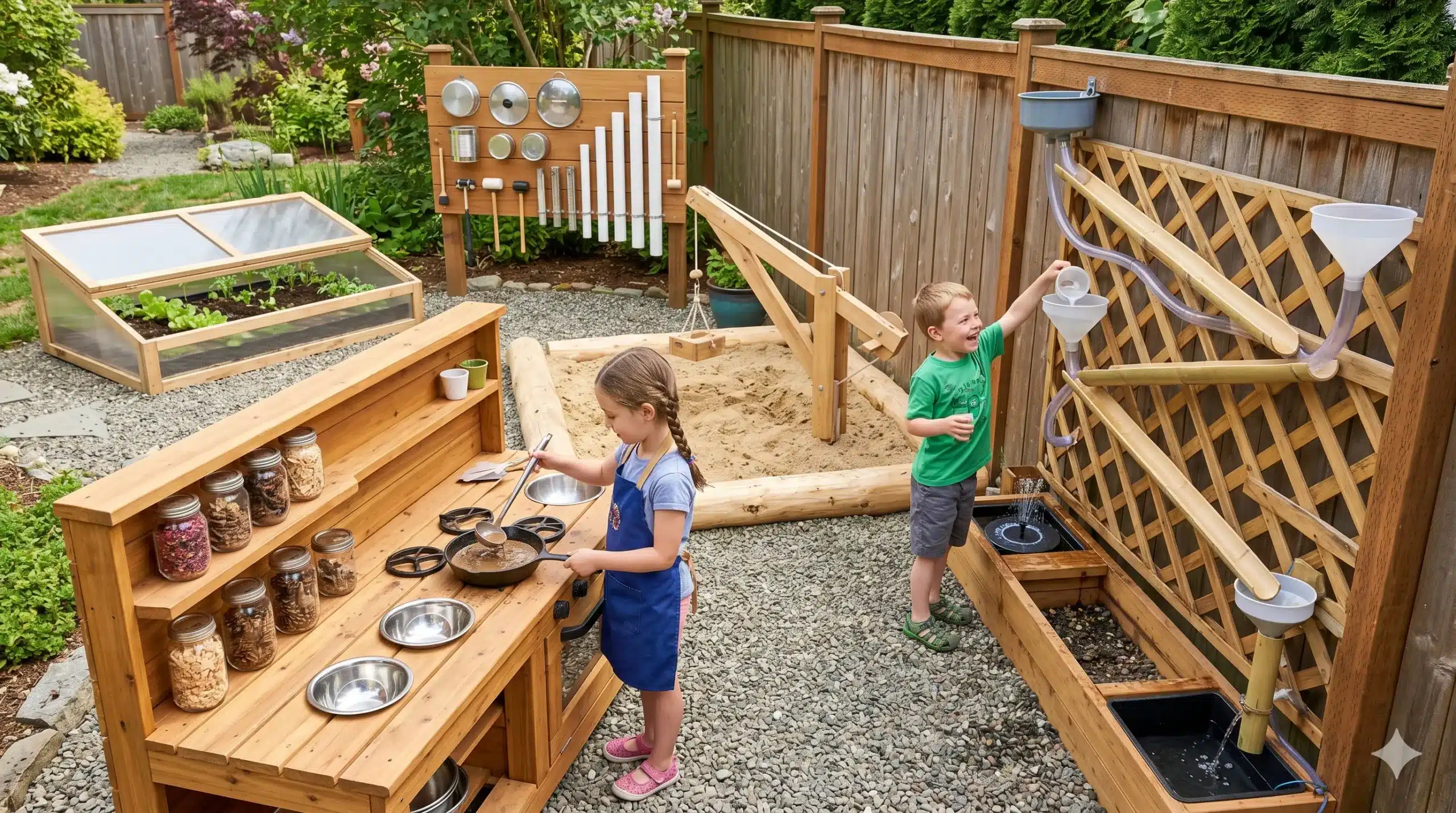
When we move play outside, the scale changes. The air is wider, the messes are larger, and the “playing things” we create can interact with the fundamental elements of our world: water, wind, mud, and light. High-quality outdoor DIY play isn’t just about building a swing set; it’s about creating interactive landscapes that invite children to become scientists and explorers in their own backyards.
In this installment, we explore how to build durable, weather-resistant outdoor play systems that turn a simple garden into a high-functioning discovery zone.
1. The “Cascading” Water Wall
Water play is a universal magnet for children, but a simple plastic water table often lacks the complexity to keep older children engaged. A DIY Water Wall uses gravity and fluid dynamics to create a repeatable experiment.
The Build: Engineering the Flow
- The Structure: Use a section of wooden lattice or a recycled shipping pallet stood upright and secured to a fence or two sturdy 4×4 posts.
- The Vessels: Instead of permanent pipes, use a variety of “loose” containers: sections of clear vinyl tubing, plastic funnels, cut-up soda bottles, and old pool noodles.
- The Mechanism: Attach industrial-strength Velcro or zip-tie mounts to the lattice. This allows the child to rearrange the vessels.
- The Goal: Can they get a cup of water poured at the top to travel through five different containers before hitting the basin at the bottom?
High-Quality Tip: Add a small solar-powered fountain pump to the bottom basin. This creates a “closed-loop” system where the water is constantly recycled, teaching children about sustainability and mechanical cycles.
2. The “Michelin-Star” Mud Kitchen
A mud kitchen is a foundational piece of outdoor play, but the “high-quality” version moves beyond a simple table. It should be a sensory laboratory that mimics the weight and feel of a real kitchen.
Essentials for a Gourmet Mud Kitchen:
- The Sink: Instead of a plastic bowl, source a cheap stainless steel “drop-in” sink from a construction habitat or scrapyard. The cold metal and the sound of water hitting it provide a premium sensory experience.
- The “Ingredients”: Don’t just provide dirt. Create a “Spice Rack” featuring dried petals, pine needles, crushed eggshells, and wood shavings.
- The Countertop: Use weather-treated cedar or redwood. These woods age beautifully and resist rot without the need for harsh chemical stains that shouldn’t touch a child’s skin.
By providing real metal whisks, ladles, and cast-iron pans, you validate the child’s play. The weight of real tools develops hand strength and coordination far more effectively than flimsy plastic alternatives
3. The Natural “Music Wall”
Outdoor play is the perfect time for loud, percussive exploration that might be too much for the indoors. A Music Wall transforms vertical space into a giant instrument.
Curating the Soundscape:
Don’t just hang “trash.” Aim for a variety of acoustic tones:
- High Pitch: Old metal cake tins or stainless steel pot lids.
- Low Pitch: Large PVC pipes cut to specific lengths (the longer the pipe, the deeper the “thwack”).
- Rattle: A wooden frame filled with various lengths of bamboo or old metal keys hanging on strings.
The Mallets: Create different strikers—one wrapped in fabric for a soft “thud” and a bare wooden dowel for a sharp “ping.” This introduces the concept of timbre and volume control.
4. The Giant “Earth-Moving” Sand Pit
Most sandboxes are too small. A high-quality sand play area should be a “construction site.”
The “Deep-Dig” Design
- The Perimeter: Use large, smooth logs (debarked) or “sleeping” railroad ties (ensure they are non-creosote) to create a border that is also a balance beam.
- The Depth: Dig down at least 12 inches before adding sand. This allows for “subterranean” building and true engineering projects.
- The Addition: Build a simple wooden crane or a pulley system on a nearby post. Being able to haul “heavy” loads of sand from one side to the other introduces basic machines (the pulley, the lever).
5. The “Sun-Trap” Greenhouse & Garden Station
For a child, watching a seed turn into a plant is the ultimate “slow-motion” play. A DIY gardening station should be at their height (approx. 20–24 inches).
Key Features:
- The Greenhouse: Use old window frames (with plexiglass replaced for safety) to create a small “cold frame” box.
- The Work Surface: A slatted top that allows soil to fall through to the ground, keeping the “lab” clean.
- Tool Storage: Use a magnetic tool strip (like those for kitchens) to hold trowels and hand rakes. This keeps the environment organized, which encourages more focused play.
Durability: Weatherproofing Your Creations
Since these items live outside, they require a different level of care to remain “high quality” over the years.
- Sealant: Use a clear, non-toxic outdoor deck sealer on all wooden components once a year.
- Hardware: Only use stainless steel or galvanized screws. Standard nails will rust and weaken the structure, creating safety hazards.
- Winterizing: Design your water and mud systems so that bins can be easily removed and stored in a garage during the coldest months.
Summary of Outdoor DIY Benefits
| System | Primary Element | Developmental Focus |
| Water Wall | Liquid / Gravity | Fluid Dynamics & Prediction |
| Mud Kitchen | Earth / Water | Sensory Integration & Roleplay |
| Music Wall | Sound / Vibration | Auditory Processing & Rhythm |
| Sand Pit | Texture / Weight | Civil Engineering & Gross Motor |
| Garden Station | Life / Sunlight | Biology & Responsibility |
Final Thoughts
High-quality outdoor play is about moving away from “fixed” structures (like a slide) toward “responsive” environments. When a child can change the flow of water, the sound of a wall, or the layout of a mud kitchen, they aren’t just playing; they are exerting influence over their world. They are learning that with the right tools and a bit of ingenuity, they can shape their environment to match the scale of their imagination.