
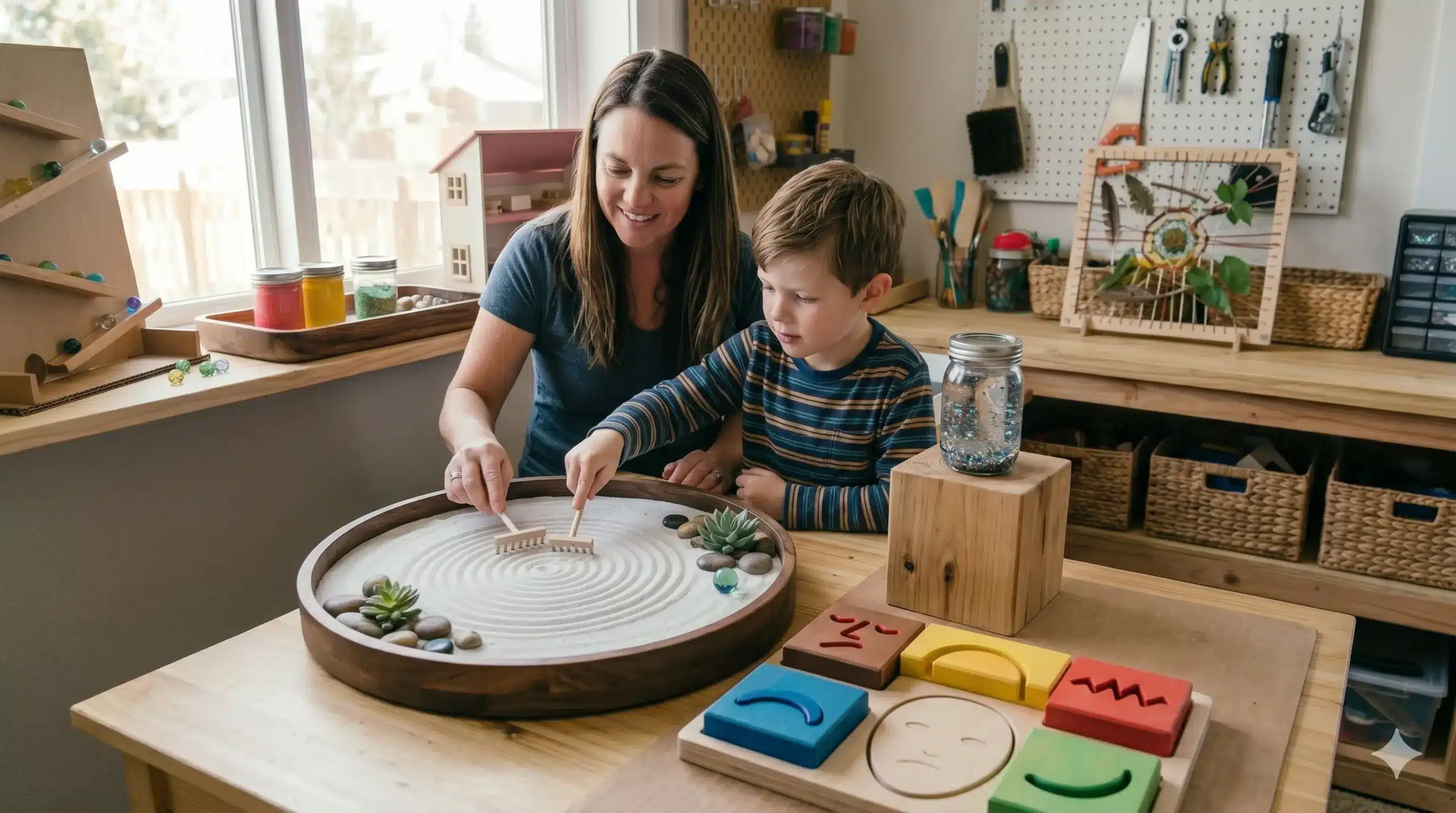
In our previous explorations, we have mastered large-scale engineering, complex electronics, and mechanical motion. For the final installment in this series, we shift our focus inward. High-quality play is not always about high energy or rapid complexity; sometimes, the most sophisticated play happens when a child is focused, quiet, and deeply attuned to their internal world.
This guide explores the engineering of “mindful making”: creating DIY playthings designed specifically to cultivate attention, emotional regulation, and deep focus (the psychological state known as “flow”).
1. The “Forever” Zen Sensory Tray (The Focus Garden)
A simple sand tray offers immediate tactile feedback, but the “Forever Zen Tray” is designed for long-term attention and complex design, moving beyond sensory exploration into artistic creation.
High-Quality Standards:
- The Tray: Source a wide, shallow wooden serving tray or a sturdy picture frame (glass removed) with a lip at least 1 inch deep. The natural wood provides a grounding aesthetic.
- The Medium: Skip standard sand, which can be dusty. Instead, use a mix of extra-fine quartz sand and a small amount of colored silica (available at craft stores). This creates a striking visual contract when raked.
- The Tools: Create “Master Rakes” using wide Popsicle sticks and different sized dowels. The focus shifts from “drawing” to raking patterns (parallel lines, curves, concentric circles).
- The Interaction: Provide a curated collection of smooth, distinct items: polished river stones, a tiny succulent (or a faux plant), and a small, perfectly round marble. The challenge is to arrange these elements and rake around them with absolute precision.
The Mindful Hook: The repetitive, delicate motion required to rake clean lines is inherently calming, encouraging the slow breathing and focused attention needed for emotional self-regulation.
2. The Emotional Anatomy Puzzle
Helping children understand and name their feelings is crucial. A DIY emotional literacy puzzle provides a physical tool for exploring abstract concepts.
Engineering Empathy:
- The Structure: A classic nested wood puzzle. We are building interchangeable emotional features: eyebrows, eyes, and mouths.
- The Parts: Create distinct shapes for key emotions. A “sad” mouth is a downturned crescent; a “joyful” mouth is a wide arc; an “angry” mouth is a jagged line. Use contrasting colors to differentiate them (blue for sad, yellow for happy, red for angry).
- The Base: A simple, featureless oval face with deep inset wells for the features.
How to Play: The game isn’t matching, but experimenting. “What does ‘frustrated’ look like?” They might put angry eyebrows above sad eyes. This physical manipulation validates complex, overlapping emotions and opens a dialogue about the nuance of feelings.
3. The “Slow-Motion” Liquid Mind Jar
Many “calm down bottles” use water and glitter, but they settle too quickly. A high-quality Mind Jar uses fluid dynamics to create a hypnotic, slow-motion effect that holds attention.
Mastering the Suspension:
- The Container: Use a smooth, sturdy plastic bottle (avoid glass for safety) or a clean jar with a reliable seal.
- The Viscosity: This is critical. We must increase the water’s thickness to slow the descent of the glitter. We use a combination of clear glue (or glycerine) and distilled water (to prevent clouding).
- The Mix: Start with 1 part glue to 3 parts water. Add different sizes of cosmetic glitter (fine dust and larger hexagons). For a “premium” effect, add a single, heavy charm (like a small glass bead or a tiny metal figure).
The Mindful Application: The child shakes the jar to symbolize busy thoughts or big emotions. Their instruction is to sit still and breathe deeply until every single piece of glitter—and the heavy charm—has settled to the bottom.
4. The Infinite Focus Maze (Labyrinth)
Unlike a standard puzzle maze with a correct exit, a labyrinth is a single, winding path designed for focused traversal. Making one teaches geometry and precision.
The Build: The Marble Labyrinth
- The Base: A square of smooth plywood or thick MDF. Sand the edges perfectly smooth.
- The Obstacles: Create “walls” using standard craft sticks or thin wood strips.
- The High-Quality Finish: This maze is navigated not by a pencil, but by tilting the board to guide a smooth glass marble. This requires immense fine motor control and concentration.
- The Layout: The path should curve gently rather than having sharp 90-degree turns. The goal isn’t solving; it’s the journey along the path without the marble leaving it.
Developmental Focus: This activity strengthens hand-eye coordination and spatial reasoning while demanding sustained concentration.
5. DIY Mandalas and Symmetrical Buildin
Mindfulness often involves pattern recognition and creation. DIY symmetry sets are low-cost ways to encourage intricate focus.
Project A: The Nature Mandala Collection
Create a “Nature Weaving Board” (cardboard with notches and yarn stretched across). Children then weave feathers, leaves, twigs, and flower petals in a circular, repeating pattern (a mandala). The temporary nature of this creation teaches non-attachment and appreciation for the moment.
Project B: Symmetrical “Block Prints”
Provide children with square pieces of paper and a variety of small, reusable “loose parts”: wooden spools, buttons, metal washers, yarn scraps, and cardboard shapes. The challenge is to make a perfectly symmetrical print by dipping the items in thick tempera paint and pressing them onto the paper in mirroring positions.
Conclusion: The Quiet Revolution
A truly sophisticated maker is one who builds the tools to understand themselves. By focusing on mindfulness, we elevate “DIY playthings” from mere objects to cognitive aids. We are giving children the gift of agency over their attention span and emotional landscape. As they arrange stones, suspend glitter, and navigate labyrinths, they aren’t just passing time; they are practicing the essential skills of calm and focused presence that will serve them for a lifetime, proving that the most important thing we can build is our own inner peace.