
In our journey through high-quality DIY play, we have tackled engineering, physics, and even culinary chemistry. This installment focuses on one of the oldest human technologies: textiles. Weaving, knotting, and fabric construction are not just “crafts”; they are exercises in binary logic, tension management, and spatial geometry.
When a child creates a piece of fabric from a single strand of yarn, they are participating in the “interlacing of systems”—learning how individual, weak components can become a strong, unified whole.
1. The “Backstrap” Loom: Engineering Portable Production
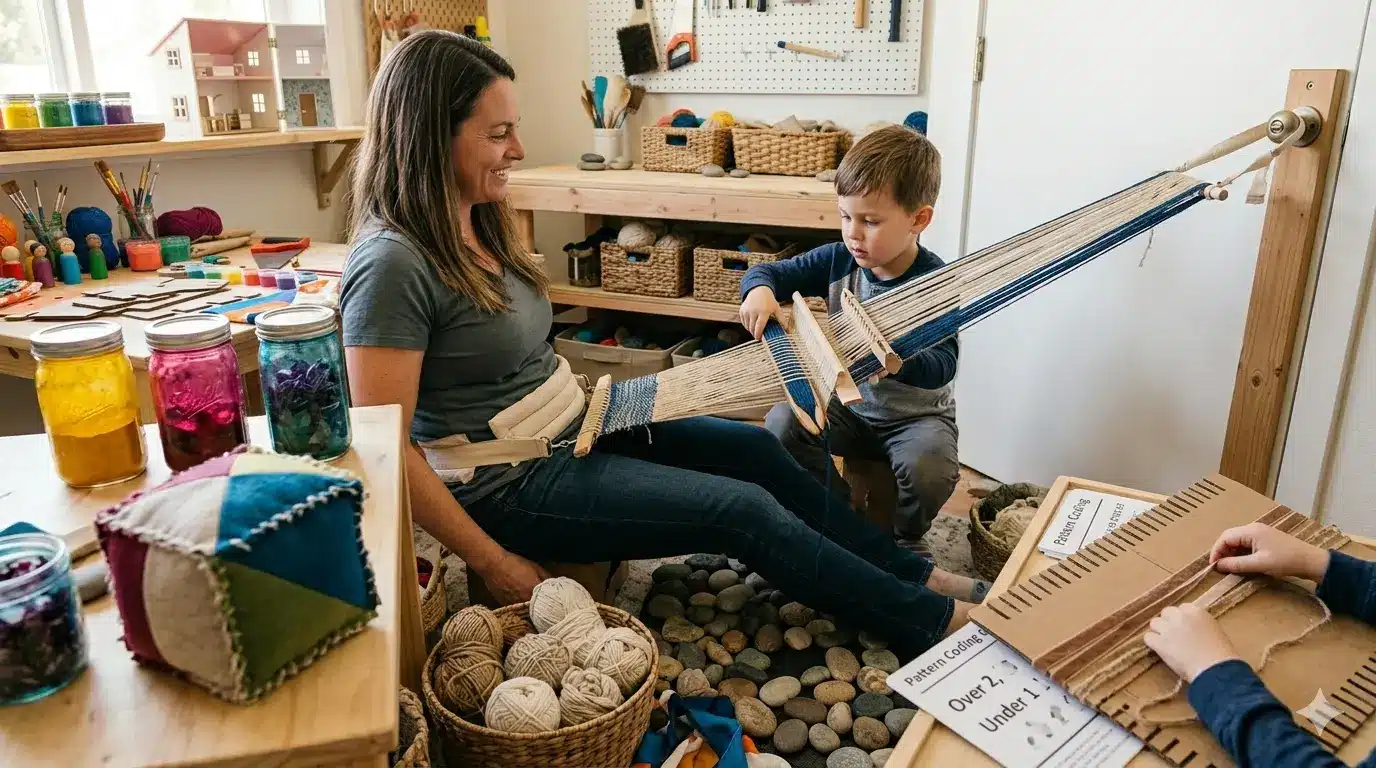
Most toy looms are rigid plastic frames that break easily. A high-quality DIY alternative is the Backstrap Loom, a traditional tool that uses the child’s own body as part of the machine.
The Build:
- The Warp Beams: Use two sturdy wooden dowels (about 12 inches long).
- The Heddle: Create a “fixed heddle” using a piece of stiff cardboard with holes punched every half-inch and slots cut between the holes.
- The Tension System: Tie one dowel to a fixed point (like a doorknob or a fence post). The other dowel is tied to a strap that goes around the child’s waist.
- The Play: By leaning back, the child creates the tension necessary to weave. By leaning forward, they release it.
Scientific Insight: This teaches mechanical advantage. The child learns that their body weight is a force that can be used to stabilize a manufacturing process.
2. The Geometry of “Finger Knitting” (Loop Logic)
Finger knitting is the perfect introduction to topology—the study of how shapes and lines connect. It requires no tools other than the child’s hands, making it a high-quality exercise in fine motor sequence.
The Logic of the Stitch:
- The Foundation: Weaving the yarn in a “figure-eight” pattern across four fingers.
- The Row: Placing a new strand of yarn across the fingers.
- The Loop: Lifting the bottom loop over the top strand.
This repetitive action creates a sturdy, “knitted” rope. It introduces the concept of algorithms: a sequence of steps that, when repeated, produce a predictable and complex result.
3. The “Sun-Drenched” Dye Lab: Natural Chemistry
High-quality textiles often involve color theory. Instead of using synthetic store-bought dyes, we can engineer a Natural Dye Lab using kitchen scraps.
The Extraction Process:
- The Colors: * Yellow: Turmeric powder or onion skins.
- Pink/Purple: Avocado pits or beet scraps.
- Blue: Red cabbage (mixed with a pinch of baking soda).
- The Mordant: To make the color “stick” (lightfastness), soak the fabric in a mixture of water and vinegar (4:1 ratio).
- The Experiment: “Solar Dyeing.” Place the fabric and the natural dye materials in a glass jar filled with water. Leave it in the sun for three days. The sun’s UV radiation and heat act as a catalyst for the chemical bond between the pigment and the fiber.
4. Textile Architecture: The “No-Sew” Soft Sculpture
Many children are intimidated by needles. We can bridge this gap with Soft Architecture using fabric scraps and “stuffing” to create 3D forms.
Techniques for Strength:
- The “Tie-Join”: Instead of sewing, cut 2-inch fringes along the edges of two pieces of fleece or felt. Tie the fringes together in double knots.
- The Filling: Use “upcycled” filling—old, clean socks or fabric scraps. This teaches volume and density. How much “trash” does it take to make the sculpture firm?
- The Form: Challenge the child to create a specific geometric shape, like a cube or a pyramid, using only flat fabric and ties.
5. The “Binary” Weaving Board
Weaving is essentially a binary system: the thread is either up (1) or down (0). This is the same logic used in modern computer programming.
The Project: Pattern Coding
- The Board: A piece of heavy cardboard with notches at the top and bottom.
- The Code: Create “Pattern Cards” that tell the child the sequence: Over 2, Under 1, Over 2, Under 1.
- The High-Quality Difference: Use contrasting textures rather than just colors—one row of rough twine, one row of soft velvet ribbon. This adds a sensory-cognitive layer to the “coding” process.
Textile Safety and Standar
- Fiber Awareness: Use natural fibers (cotton, wool, silk) whenever possible. They absorb dye better and provide a superior tactile experience compared to “squeaky” synthetic acrylics.
- Tension Safety: When using backstrap looms, ensure the anchor point is a sturdy, non-moving object.
- Dye Safety: While using food-based dyes, remind children that “natural” doesn’t always mean “edible.” Turmeric, for example, will stain skin and surfaces instantly—aprons are mandatory!
Summary of Textile Concepts
| Project | Concept | Mathematical Skill | Focus |
| Backstrap Loom | Mechanical Tension | Force Distribution | Manufacturing |
| Finger Knitting | Loop Topology | Sequencing / Algorithms | Fine Motor |
| Natural Dye Lab | Organic Chemistry | PH Balancing / Catalysts | Color Theory |
| Tie-Sculpture | 3D Volume | Geometric Assembly | Architecture |
| Weaving Board | Binary Logic | Pattern Recognition | Coding Basics |
Final Thoughts
Textile play is the ultimate marriage of the ancient and the modern. As a child pulls a thread through a loom, they are echoing the movements of ancestors from thousands of years ago, while simultaneously practicing the logic that powers modern computers. High-quality textile DIY isn’t just about making a scarf; it’s about understanding that everything around us—from our clothes to the carbon-fiber wings of a plane—is “built” through the careful interlacing of smaller parts.