
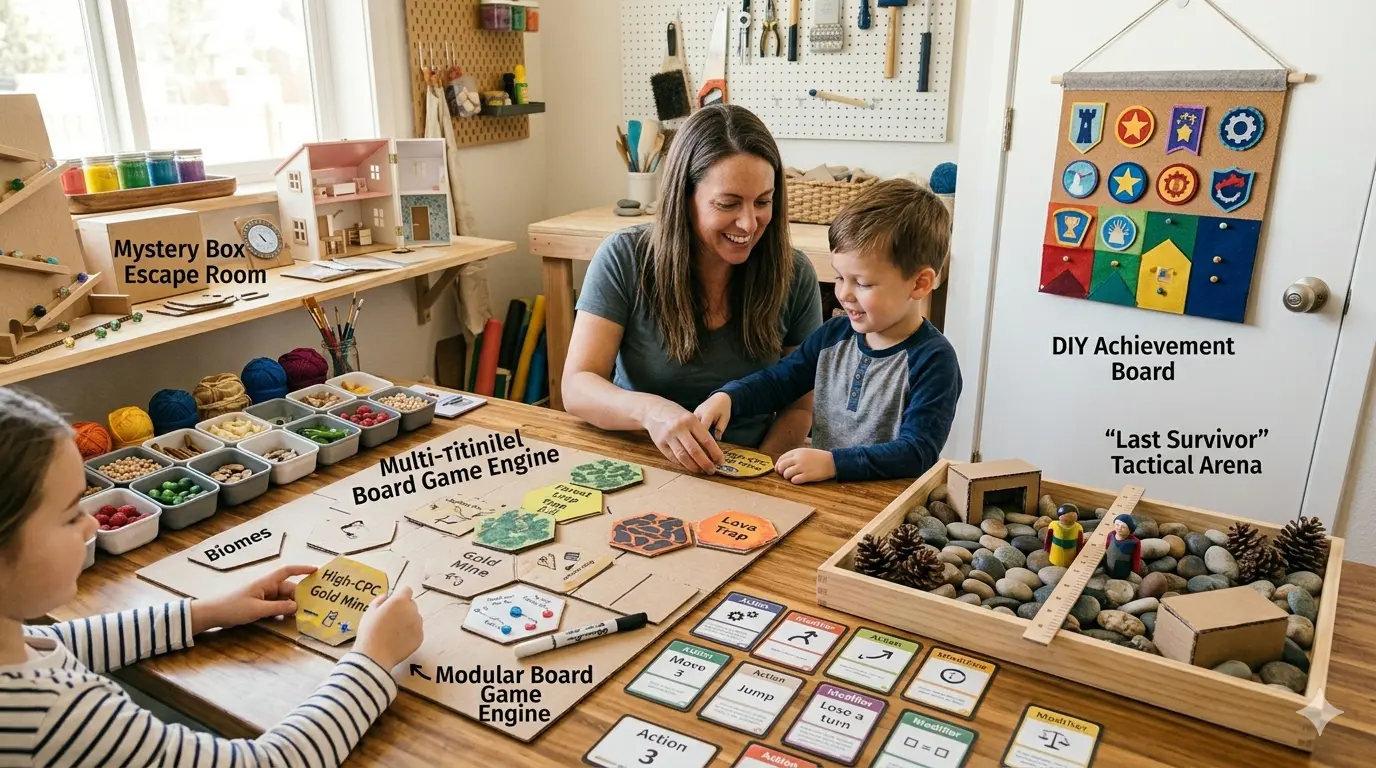
In this final deep dive, we move from building objects to building systems. Throughout this series, we’ve created mechanical marvels and electronic bridges, but the ultimate high-quality DIY plaything is the one that evolves every time it is used: the Analog Game.
Game design is the highest form of “playful engineering.” It requires the creator to balance probability, spatial logic, and the “user experience” (UX). When a child builds their own game, they are no longer just a player; they are the architect of rules and the master of balance.
1. The Modular Board Game Engine
Instead of making one static board, create a tile-based system that allows for infinite “procedural generation.” This is how professional game designers prototype high-end titles.
The Components:
- The Tiles: Cut heavy-duty cardboard into 4×4 inch squares or hexagons.
- The “Biomes”: On one side, draw a specific terrain (e.g., a “high-CPC” gold mine, a forest, or a lava trap).
- The Connection Logic: Use notches or small magnets on the edges so tiles snap together.
- The High-Quality Difference: Use a clear matte sealant over the tiles. This allows children to use dry-erase markers to add temporary power-ups or traps during a live “production run” of the game.
Developmental Focus: This teaches spatial reasoning and resource management. How many tiles do I need to reach the goal? What are the odds of landing on a trap?
2. The “Roguelike” Card System: DIY Deckbuilding
If the board is the world, the cards are the “logic” that dictates movement and action. Creating a DIY card system introduces children to conditional logic (If/Then statements).
Crafting the Deck:
- Action Cards: “Move 3 spaces,” “Jump over obstacle,” or “Shield.”
- Modifier Cards: “Double the next move,” “Reverse direction,” or “Lose a turn.”
- The Art of Balance: A high-quality game isn’t fun if one player always wins. Teach the child to “playtest.” If a card is too powerful, they must “nerf” it by adding a cost to play it.
The Logic Hook: This is the foundation of programming. Each card is a line of code. When played in sequence, they create an algorithm for winning.
3. The “Last Survivor” Miniature Arena
Building on the concept of survival and tactical movement, a miniature arena uses 3D terrain to create a “tactical” play experience.
The Build:
- The Arena: A shallow wooden tray filled with “loose parts” like river stones, pinecones, and cardboard bunkers.
- The Miniatures: Use the “Peg People” from our earlier articles, customized with felt armor and toothpick “gear.”
- The Mechanics: Use a DIY Measuring Stick (a dowel marked in 1-inch increments) to dictate movement. Instead of “I move there,” it becomes “My character moves 4 inches.”
- The Physics: Use a simple catapult or a marble-launcher (from our Mechanical Marvels article) to resolve “combat.” If the marble hits the bunker, the bunker is destroyed.
4. The “Mystery Box” Escape Room
Escape rooms are immersive puzzles that turn an entire room into a playable object. This is the ultimate test of a child’s ability to create interconnected logic.
Engineering the Clues:
- The Cipher: Create a DIY “Substitution Wheel” (two cardboard circles of different sizes pinned in the center). This introduces cryptography.
- The Weight Trigger: A simple balance scale. “Place exactly 5 stones here to unlock the next clue.”
- The Invisible Ink: Use lemon juice (which turns brown when heated by a DIY “Solar Oven” or a low-heat lamp) to hide messages.
This project requires the child to think like a Level Designer, guiding the “user” through a story using only physical cues.
5. The “Trophy Room”: Achievement and Rewards
High-quality play systems often include a sense of progression. Create a DIY Achievement Board where players can pin “badges” made of felt or wood for specific feats (e.g., “The Architect” for building a tower, “The Tactician” for winning without a modifier card).
Summary of Game Design Concepts
| System | Primary Logic | Physical Component | Skill Developed |
| Tile Engine | Spatial Geometry | Cardboard Hexagons | Modular Planning |
| Deckbuilding | Conditional Logic | Action Cards | Algorithmic Thinking |
| Tactical Arena | Measurement / Stats | 3D Terrain & Minis | Mathematical Precision |
| Escape Room | Cryptography / Narrative | Ciphers & Triggers | Holistic Problem Solving |
| Achievement Set | Incentive Design | Felt Badges | Persistence & Goal Setting |
Final Thoughts: From Player to Creator
As we conclude this series on DIY play, we realize that the most “high-quality” part of any toy isn’t the material it’s made of—it’s the agency it gives the child. By building their own games, children learn that rules are not just things to be followed; they are systems to be understood, challenged, and improved. They learn that with a few scraps of cardboard, some logical thinking, and a bit of imagination, they can build entire universes.