
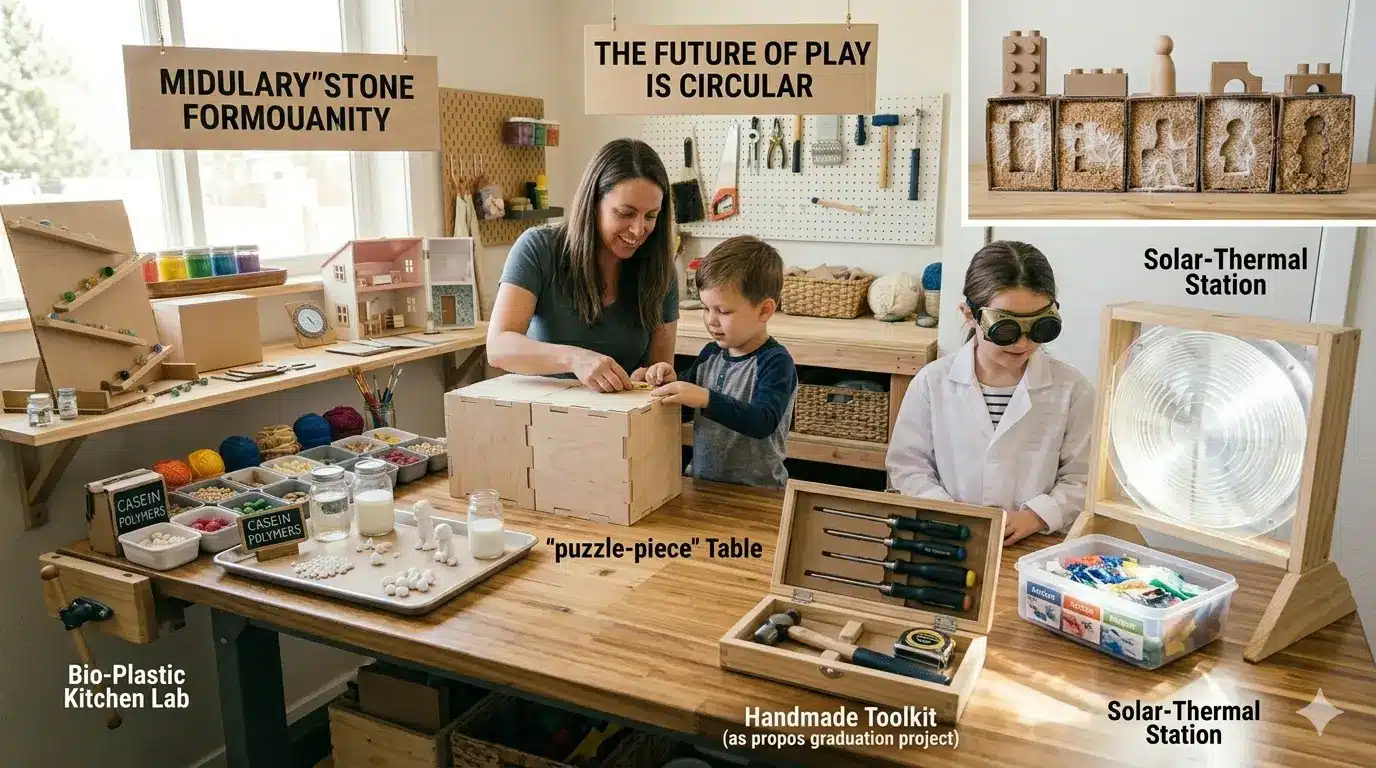
As we reach the final installment of this series, we move beyond individual projects to the macro-system of play. In a world increasingly conscious of resource scarcity and waste, high-quality DIY is shifting toward the “Circular Economy.” This isn’t just about recycling; it is about designing playthings with their entire lifecycle in mind—objects that can be disassembled, repurposed, or returned to the earth without a trace.
This article explores “Adaptive DIY,” where the toys of today become the raw materials for the inventions of tomorrow.
1. The “Forever Box” Modular Furniture System
Children outgrow toys, but they rarely outgrow the need for a dedicated space. High-quality DIY furniture systems grow with the child using modular joinery.
The Build: Plywood Cube Logic
- The Component: Create six identical 15×15 inch squares from 1/2-inch birch plywood.
- The Joinery: Use “puzzle-piece” notched edges rather than permanent screws.
- The Evolution: * Age 2: A sturdy “step-up” stool or a low sensory table.
- Age 5: A modular dollhouse or a garage for the Mechanical Marvels we built earlier.
- Age 10: Stacked cubes become a bookshelf or a bedside charging station for “phygital” devices.
Sustainability Standard: By using high-grade plywood and no permanent fasteners, the wood remains “virgin” and can be sanded and refinished for decades.
2. Bio-Plastic: The Kitchen Lab Revolution
We often rely on plastic for durability, but you can engineer compostable bioplastics using common organic polymers found in your pantry.
The Project: Casein “Stone” Sculptures
- The Chemistry: Warm a cup of milk (but do not boil) and stir in 4 tablespoons of white vinegar. The acid causes the casein proteins to clump together.
- The Process: Strain the “curds” through a cloth and knead them into a dough.
- The Result: This dough can be molded into beads, figurines, or even custom dice for our Game Designer’s Lab. Once it dries, it becomes as hard as rock.
Because this “plastic” is made entirely of milk protein, it is 100% biodegradable. When the child is done with the toy, it can go into the garden compost.
3. The “Solar-Thermal” Repurposing Station
High-quality play involves teaching children that “waste” is just a resource in the wrong place. A DIY Solar-Thermal station allows you to reshape materials using concentrated sunlight.
The Setup:
- The Tool: A large Fresnel lens (often found in old projection TVs or purchased as a thin plastic sheet).
- The Safety: This project requires adult supervision and specialized welding goggles.
- The Play: Use the lens to focus sunlight onto old wax crayons or scrap plastic (Type 2 HDPE). The intense heat allows you to melt and remold these materials into new shapes, such as colorful “marbled” bricks for the Tactical Arena.
4. The “Living” Playroom: Mycelium Bricks
One of the most advanced frontiers in sustainable DIY is bio-fabrication. You can “grow” your own building blocks using mushroom roots (mycelium).
How to Grow a Toy:
- The Substrate: Mix hemp hurds or sawdust with water and a small amount of mycelium spawn (available in kits).
- The Mold: Pack the mixture into a custom cardboard mold (like a brick or a character shape).
- The Growth: Leave it in a dark, warm place for 5–7 days. The mycelium will “weave” through the substrate, binding it into a lightweight, structural foam.
- The Fixation: Bake the shape at a low temperature to stop the growth. You now have a high-quality, lightweight block that is stronger than Styrofoam but entirely organic.
5. The “Legacy” Toolkit: Tools as Toys
The final “playing thing” isn’t an object at all; it is the Toolkit itself. High-quality DIY play concludes when the child transitions from using tools on toys to using tools as a way of life.
The Professional-Grade Junior Kit:
- Measurement: A real 10-foot steel tape measure.
- Force: A 4oz ball-peen hammer (sized for smaller hands but with the weight of real steel).
- Precision: A set of high-quality screwdrivers with magnetic tips.
- Storage: A handmade wooden toolbox (built by the child as their “graduation” project).
Summary of Adaptive Concepts
| System | Material Focus | Life Cycle | Core Lesson |
| Modular Cubes | Timber / Plywood | Multi-Decade | Structural Evolution |
| Casein Stone | Milk Proteins | Compostable | Molecular Polymers |
| Thermal Station | Upcycled Wax/HDPE | Infinite Loop | Energy Transformation |
| Mycelium Bricks | Fungi / Sawdust | Biological Growth | Bio-Fabrication |
| The Legacy Kit | Steel / Wood | Lifetime | Mastery of Tools |
Final Thoughts: The Infinite Loop of Creation
We have traveled from the simplicity of a cardboard box to the complexity of bio-fabricated blocks and digital bridges. High-quality DIY play is a journey toward autonomy. It is the process of teaching a child that they are not a spectator in a world of finished products, but an active participant in an ongoing story of creation.