
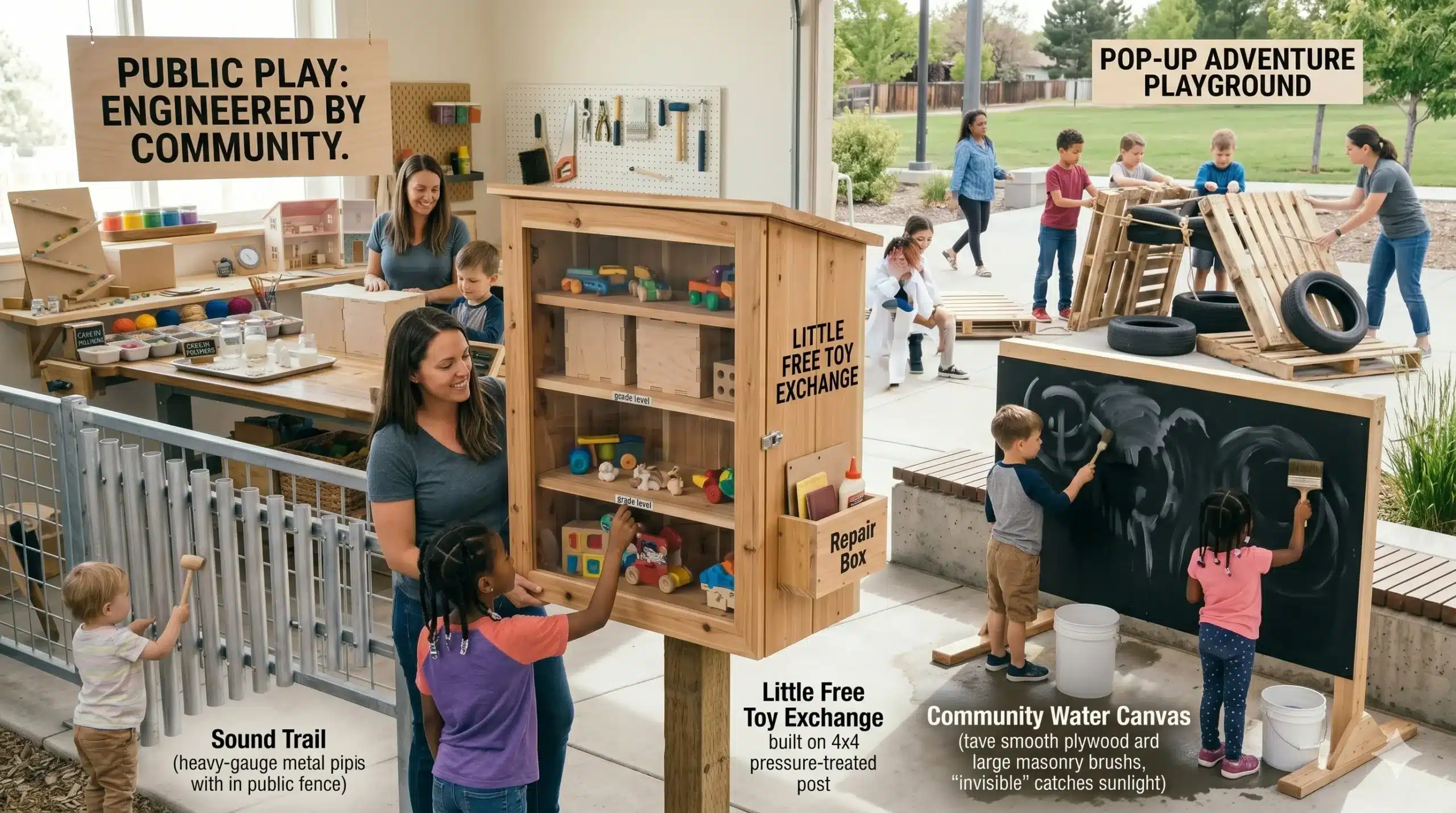
We have mastered the home workshop, the backyard laboratory, and the digital bridge. In this final expansion of our series, we move beyond the family unit and into the public square. High-quality DIY play reaches its zenith when it becomes a shared community resource. By building “Public Play Systems,” children learn the vital skills of civic engagement, collective maintenance, and the “Tragedy of the Commons”—learning to care for what belongs to everyone.
This article explores how to design and deploy DIY playthings intended for communal use, from “Little Free Toy Libraries” to neighborhood-wide scavenger hunts.
1. The “Little Free Toy Exchange” (The Sharing Economy)
Inspired by the popular “Little Free Library” movement, a Toy Exchange is a permanent neighborhood fixture designed to facilitate the circulation of high-quality DIY items.
Engineering for the Elements:
- The Structure: A weather-proof wooden cabinet with a transparent plexiglass door. It must be elevated on a 4×4 pressure-treated post to prevent moisture wicking.
- The Interior: Divided into “Grade Levels.” Low shelves for the heavy wooden blocks; eye-level shelves for the “Phygital” kits and card games.
- The Maintenance Kit: Attach a small “Repair Box” to the side containing wood glue and sandpaper. This encourages the community to help keep the “patients” in the Toy Hospital healthy.
2. The Neighborhood “Sound Trail”
Building on the “Music Wall” concept, a Sound Trail spreads acoustic DIY stations across a local park or walking path, turning a stroll into a rhythmic exploration.
Building for Durability:
- The Stations: Instead of a single wall, create “Tuned Percussion” stations using heavy-gauge metal pipes (conduit) of varying lengths.
- The Science of Pitch: The length of the pipe determines the speed of the vibration. A long pipe vibrates slowly, creating a low note; a short pipe vibrates quickly, creating a high note.
- The Installation: Use tamper-resistant Torx screws to mount the instruments to public fences or dedicated posts. High-quality community play must be “vandal-resistant” but not “interaction-resistant.”
3. The “Community Canvas” (Chalk and Water)
Public art is often static. A DIY Community Canvas is a responsive surface that allows for infinite iteration without creating permanent waste.
The “Ephemeral” Art Station:
- The Canvas: Paint a large, smooth section of an outdoor wall or a dedicated plywood board with high-quality chalkboard paint.
- The DIY Chalk Lab: Create custom “Sidewalk Chalk” using Plaster of Paris and tempera paint molded in silicone tubes.
- The Water Brush: Provide large masonry brushes and buckets of water. Children can use water to “erase” or to create “invisible” paintings that disappear as the sun evaporates the liquid—a lesson in phase changes and the water cycle.
4. The Geocache “Puzzle Box”
Geocaching is a global treasure hunt powered by GPS. By creating a DIY “Puzzle Box” for a local cache, your child becomes a Game Master for the entire city.
The High-Tech Secret:
- The Box: A military-grade ammo can or a heavy-duty gasket-sealed plastic container.
- The Trigger: Instead of a key, use a Magnetic Reed Switch. The box only opens if a magnet (hidden nearby or carried by the “seeker”) is placed on a specific, unmarked spot on the lid.
- The Logbook: A high-quality, hand-bound notebook where travelers from all over the world can record their visits.
5. The “Pop-Up” Adventure Playground
An “Adventure Playground” is a space where children are given raw materials (pallets, tires, ropes, tools) to build their own environment. You can organize a “Pop-Up” version for a local block party.
The Toolkit for Success:
- The Raw Goods: 10 clean wooden pallets, 5 used tires, and 100 feet of sisal rope.
- The Facilitation: Adult “playworkers” supervise for safety but do not intervene in the design.
- The Lesson: This project teaches collaborative engineering. “How do we move this heavy tire?” “How do we lash these pallets together to make a bridge?”
Community Standards and Safety
When play goes public, the “quality” definition expands to include social responsibility:
- Permitting: Always check with local parks departments or HOA boards before installing permanent fixtures.
- The “Leave No Trace” Rule: If a DIY project starts to weather or break, the community must be empowered to fix it, or it must be removed.
- Inclusivity: Ensure DIY stations are at heights accessible to children in wheelchairs and include tactile elements for those with visual impairments.
Summary of Community Play Impacts
| Project | Social Skill | Technical Focus | Reach |
| Toy Exchange | Generosity / Trust | Weatherproofing | Neighborhood |
| Sound Trail | Respect for Space | Acoustic Physics | Park-wide |
| Water Canvas | Collaborative Art | Evaporation | Local Plaza |
| Geocache Box | Global Connection | Magnetic Logic | International |
| Pop-Up Play | Conflict Resolution | Heavy Construction | Community Event |
Final Thoughts: The Infinite Workshop
Our journey through high-quality DIY play began with a single cardboard box on a kitchen table. It concludes here, in the heart of the community. By taking our “playing things” into the world, we prove that making is not a solitary act—it is a way of building a better, more creative society.