
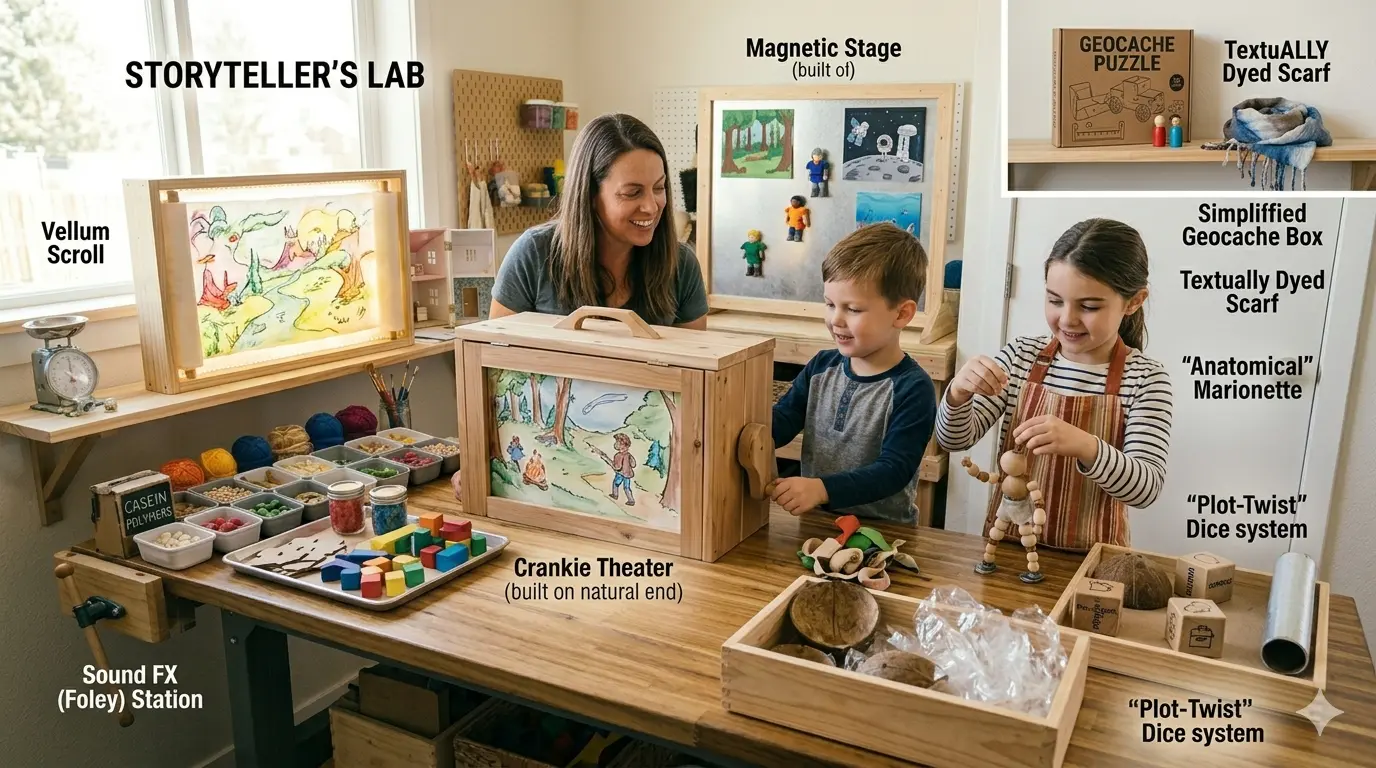
Throughout this series, we have mastered the physical, the mechanical, and the communal. For this installment, we explore the bridge between engineering and literacy. High-quality DIY play in the realm of storytelling isn’t just about “putting on a show”; it is about Narrative Engineering—designing physical systems that allow children to manipulate plots, characters, and settings with the same precision they used for their robots and looms.
This guide focuses on building durable, modular theater systems that transform a child from a passive listener into a director of their own epic tales.
1. The “Multi-Scene” Crankie Theater
A “Crankie” is an old-fashioned storytelling device that uses a long, illustrated scroll moved by two hand-turned cranks. It is a masterpiece of simple mechanical design that teaches pacing and sequence.
The Build:
- The Frame: Use a sturdy wooden wine crate or a deep cardboard box.
- The Spools: Two wooden dowels passing through the top and bottom of the box.
- The Scroll: A long roll of butcher paper or a series of taped-together “cells.”
- The Mechanism: Affix handles to the tops of the dowels. As the child turns the right crank, the story “plays” across the viewing window.
The High-Quality Touch: Add a “backlight” (an LED strip) inside the box. If the child uses thin vellum or parchment paper for the scroll, the images will glow, creating a cinematic experience that rivals digital screens.
2. The “Anatomical” String Puppet (Simple Marionettes)
Most DIY puppets are static, but an Anatomical Marionette introduces the concept of articulated joints and weight distribution.
Engineering Movement:
- The Body: Use wooden beads or small sections of pool noodles for the limbs.
- The Joints: Instead of rigid glue, use flexible twine or small metal rings. This allows for a “natural” range of motion.
- The Control Bar: A simple “T” shape made of two Popsicle sticks.
- The Balance: Attach small metal washers to the puppet’s feet. The extra weight ensures the puppet “walks” with gravity rather than floating aimlessly.
Learning Focus: This project teaches physics in motion. The child learns how to pull a specific string to achieve a specific result—lifting a hand, nodding a head, or taking a step.
3. The “Infinite Setting” Magnetic Stage
Stage design often takes up too much space. A high-quality DIY solution is the Magnetic Backdrop System, which uses vertical space and interchangeable “sets.”
The Setup:
- The Stage: A large cookie sheet or a piece of galvanized steel mounted inside a wooden frame.
- The Sets: Landscapes (forests, space stations, underwater caves) drawn on cardstock with small magnets glued to the back.
- The Characters: Use the “Peg People” or flat cardboard cutouts with magnets.
Because the characters and scenery are magnetic, they can “climb” walls and defy gravity. This allows for vertical storytelling, which encourages children to think about three-dimensional space during their narratives.
A high-quality story isn’t just visual; it’s auditory. In the film industry, “Foley Artists” create sound effects using everyday objects. Build a dedicated station for your child to “soundtrack” their plays.
The Foley Toolkit:
- Hoofbeats: Two half-coconut shells or plastic cups tapped on a wooden board.
- Fire Crackling: Crinkling a piece of stiff cellophane or heavy parchment paper.
- Thunder: A large, flexible sheet of thin metal or a “thunder tube” (a cardboard tube with a spring attached).
- Rain: A “Rainstick” built from a mailing tube filled with rice and nails driven through the sides in a spiral.
5. The “Plot-Twist” Dice System
To prevent “storyteller’s block,” engineer a set of Narrative Dice. These are large wooden or cardboard cubes that dictate the variables of the story.
| Die Type | Faces (Examples) | Role |
| The Protagonist | Explorer, Robot, Animal, Chef | Who is the story about? |
| The Setting | Desert, Underwater, Kitchen, Moon | Where are they? |
| The Conflict | Lost, Broken, Hungry, Trapped | What is the problem? |
| The Tool | Compass, Magic Key, Hammer, Map | How will they solve it? |
Rolling the dice forces the child to improvise and synthesize disparate ideas—a core skill in both creative writing and high-level problem solving.
Narrative Standards and Safet
- Voice Over: Encourage the child to record their play using a simple voice recorder. Hearing their own “theatrical voice” builds immense confidence and public speaking skills.
- Material Integrity: Ensure puppet strings are a manageable length (approx. 18-24 inches) to prevent tangling and safety hazards.
- The “Director’s Cut”: Allow for failure. If a puppet’s arm falls off mid-scene, treat it as a “plot twist.” This builds improvisational resilience.
Summary of Narrative Engineering
| Project | Primary Skill | Technical Focus | Creative Goal |
| Crankie Theater | Sequence / Pacing | Mechanical Spools | Visual Narrative |
| Marionette | Physics / Balance | Articulated Joints | Character Motion |
| Magnetic Stage | Spatial Logic | Magnetism | World Building |
| Foley Station | Auditory Processing | Sensory Synthesis | Atmosphere |
| Plot Dice | Improvisation | Combinatorics | Plot Construction |
Final Thoughts: The Architect of Worlds
When a child builds a theater, they aren’t just making a toy; they are building a vessel for their inner life. High-quality DIY play in storytelling proves that the most powerful “engine” in the workshop is the human imagination. By giving them the tools to frame, move, and soundtrack their thoughts, you are giving them the power to define their own reality.