
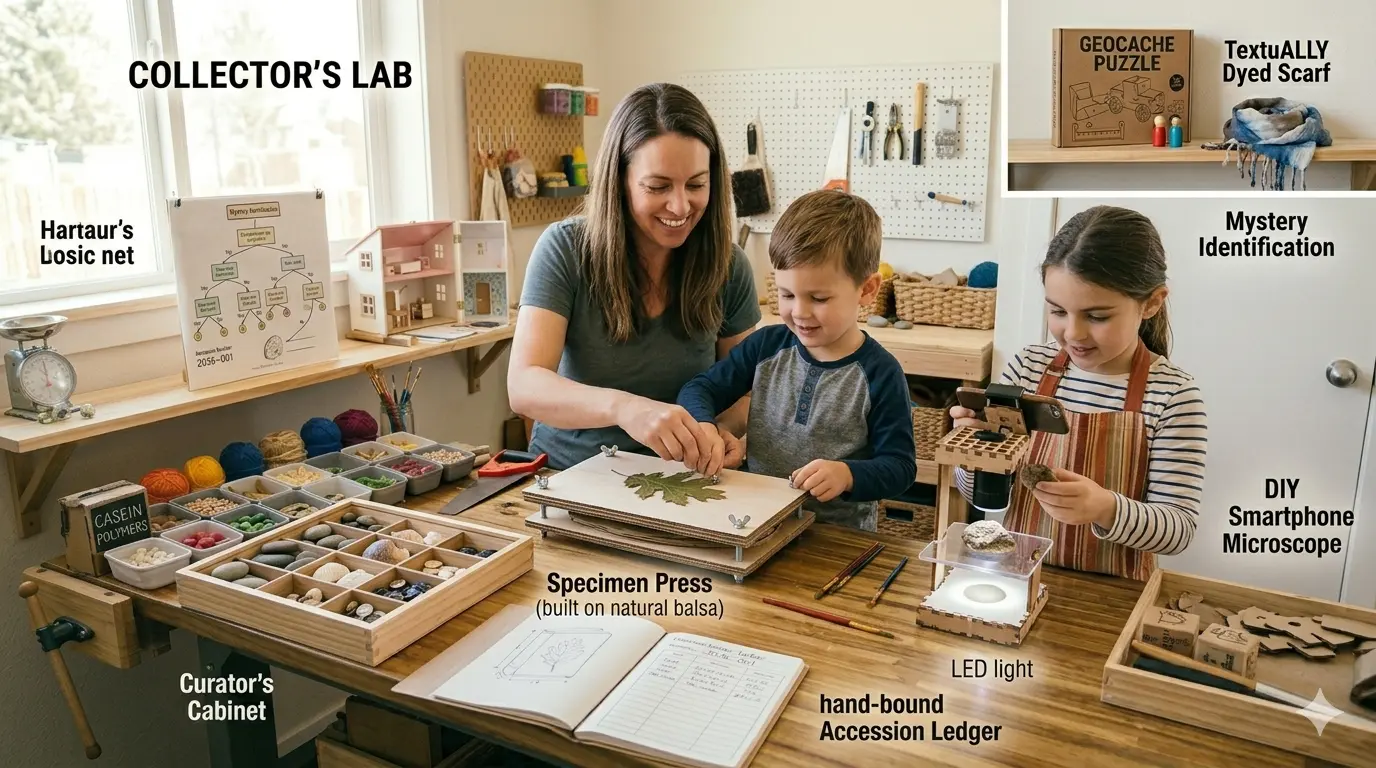
throughout this series, we have built machines, theaters, and ecosystems. For this installment, we delve into the logic of organization. High-quality DIY play isn’t just about making new things; it’s about making sense of the things we already have. DIY Taxonomy—the science of naming, describing, and classifying—is a foundational skill for both biologists and data scientists.
By building a “Collector’s Archive,” children learn to spot patterns, recognize minute differences, and understand the hierarchical nature of information.
1. The “Specimen Press”: Preserving the Natural World
Before a collection can be archived, it must be preserved. A high-quality DIY plant press is an engineering lesson in even pressure distribution.
The Build:
- The Plates: Two thick squares of 3/4-inch plywood.
- The Hardware: Four long carriage bolts with wing nuts at each corner.
- The Layers: Alternating sheets of corrugated cardboard (for airflow) and blotting paper (to absorb moisture).
- The Science: By tightening the wing nuts, the child applies mechanical compression. This stops biological decay by removing moisture while keeping the structural “map” of the leaf or flower intact.
2. The “Curator’s Cabinet”: Modular Sorting Logic
A high-quality archive needs a home that encourages categorization. Instead of a single bin, we build a Shadow Box with adjustable dividers.
Engineering the Grid:
- The Frame: A shallow wooden tray.
- The Dividers: Thin strips of wood or stiff cardboard with “half-lap” joints (slots cut halfway through so they interlock).
- The Logic: Challenge the child to sort their collection (stones, shells, or buttons) by different attributes:
- By Texture: Smooth vs. Rough.
- By Origin: Igneous vs. Sedimentary.
- By Spectrum: A gradient from lightest to darkest.
The Cognitive Hook: This is the physical equivalent of a database schema. The child decides which “fields” (attributes) are most important for their system.
3. The DIY Microscope: Optics from Scrap
To be a true taxonomist, one must see what is hidden. You can engineer a high-magnification “Macro-Lens” for a smartphone using a single drop of water or a lens from a laser pointer.
The Build:
- The Stand: A “Plexiglass Stage” held up by three long bolts.
- The Lens: A tiny glass lens salvaged from a broken laser pointer or a cheap magnifying glass.
- The Light: A white LED positioned underneath the stage (the “Transmitted Light” method).
- The Result: This setup allows children to photograph the micro-structures of their specimens—the scales on a butterfly wing or the cells of an onion skin—creating a digital companion to their physical archive.
4. The “Accession Ledger”: Information Engineering
A collection without data is just a pile of things. A high-quality archive includes a hand-bound Ledger where each item is assigned a unique “Accession Number.”
The Data Fields:
- ID Number: (e.g., 2026-001)
- Date of Acquisition: When was it found?
- Locality: Where exactly was it found? (Introduces GPS coordinates or map reading).
- Description: A “Scientific Sketch” focusing on accuracy over artistic beauty.
The Skill: This teaches meticulousness and record-keeping. It transforms a hobby into a “Scientific Method,” showing the child that their observations have permanent value.
5. The “Mystery Identification” Key
The final piece of the archive is the Dichotomous Key—a tool that leads the user to an identification through a series of “Yes/No” questions.
Building the Logic Tree:
- Step 1: Does the specimen have legs? (Yes -> Go to 2 / No -> Go to 5)
- Step 2: Does it have more than 6 legs? (Yes -> Spider / No -> Insect)
- The Geometry: Map this out as a Flowchart.
Shutterstock
Explore
Archive Standards and Ethics
- Sustainable Sourcing: Teach the “Rule of Ten.” Only take a specimen (like a leaf or a stone) if you can see ten more just like it. Never disturb living creatures for a permanent collection.
- Archival Materials: Use acid-free paper for labels to ensure they don’t yellow or brittle over time.
- The “Live-Study” Exception: If a child finds a living insect, build a “temporary observation hotel” with air holes and native plants, then release it after 24 hours.
Summary of Taxonomy Concepts
| Project | Scientific Focus | Technical Tool | Skill Developed |
| Specimen Press | Preservation | Compression Bolts | Biological Prep |
| Curator’s Cabinet | Classification | Interlocking Dividers | Database Logic |
| DIY Microscope | Optics | Macro Lenses | Visual Analysis |
| Accession Ledger | Documentation | Hand-Bound Journal | Data Management |
| Dichotomous Key | Logic / ID | Flowchart | Systematic Thinking |
Final Thoughts: The Keeper of Knowledge
The “Collector’s Archive” is the point where DIY play becomes professional inquiry. By teaching a child to press, sort, observe, and document, you are giving them the eyes of a scientist. They learn that the world isn’t just a chaotic blur of “stuff,” but a beautifully ordered system waiting to be understood. High-quality play is the act of bringing order to that wonder.