
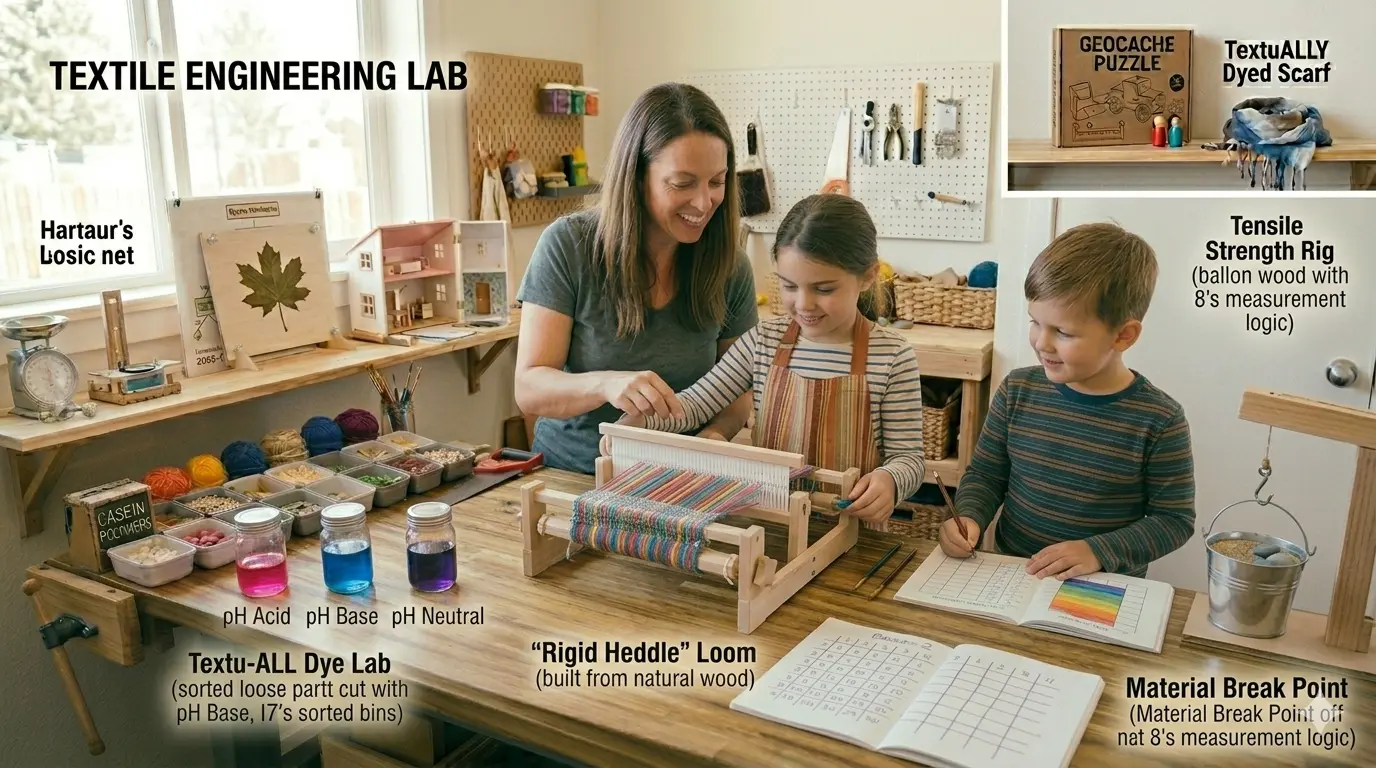
In this installment of our high-quality DIY series, we move into the ancient and sophisticated world of Soft Engineering. Textiles are often viewed as “craft,” but they are actually one of the earliest forms of Material Science. By building a “Textile Lab,” children learn about the structural integrity of fibers, the chemistry of natural dyes, and the mathematical logic of weaving patterns.
This guide focuses on “Fiber-Logic”—turning raw materials into functional, engineered structures.
1. The “Heddle” Loom: Mechanical Logic in Fabric
A loom is a mechanical computer that manages two sets of threads: the Warp (vertical) and the Weft (horizontal). A high-quality DIY loom introduces the “Heddle”—the mechanism that lifts specific threads to create a path for the shuttle.
The Build:
- The Frame: A sturdy rectangular wooden frame (an old picture frame or 1×2 pine boards).
- The Heddle: A notched wooden bar or a series of string loops.
- The Interaction: By lifting the heddle, the child creates a “Shed” (an opening). This allows the shuttle to pass through in one motion rather than weaving over-under by hand.
- The Science: This teaches Efficiency and Automation. The child realizes that a mechanical shift can replace a repetitive manual task.
2. The “Textu-ALL” Dye Lab: PH-Sensitive Chemistry
High-quality play connects biology to art. You can engineer “Smart Dyes” using red cabbage, which acts as a natural pH indicator.
Engineering the Color:
- The Base: Boil red cabbage to create a deep purple liquid.
- The Modifiers: Set out three jars: one with vinegar (Acid), one with plain water (Neutral), and one with baking soda (Base).
- The Reaction: Dipping a wool string into the “Acid” jar turns it bright pink; the “Base” jar turns it blue or green.
- The Result: The child isn’t just coloring fabric; they are performing Chemical Titration. They can create a “Gradient Scarf” that documents the chemical spectrum.
3. The “Tensile” Strength Test: Fiber Analysis
Before building a structure (like a rope bridge for a toy), a child must understand the Breaking Point of their materials.
The Lab Setup:
- The Rig: A wooden beam with a hook.
- The Weights: A bucket filled slowly with sand or stones.
- The Variable: Test different fibers—cotton, wool, nylon, and DIY “Plarn” (plastic yarn made from bags).
- The Data: Record how many kilograms each fiber holds before it snaps. This introduces Young’s Modulus—the measure of a material’s elasticity and strength.
4. The “Felt” Factory: Non-Linear Engineering
Not all textiles are woven. Felt is created through Mechanical Entanglement.
The Process:
- The Material: Raw wool roving.
- The Catalyst: Warm water and soap (to open the “scales” on the wool fibers).
- The Work: Friction (rubbing and rolling).
- The Logic: This teaches Micro-Structures. Under a DIY microscope (from our previous article), the child can see the tiny hooks on the wool fibers that allow them to lock together into a solid, waterproof mat without a single stitch.
5. The “Symmetrical” Block Print: Pattern Replication
To create high-quality branding for their “Druvion-style” textile studio, children can engineer their own Print Blocks.
The Build:
- The Block: A smooth wooden block or a large potato.
- The Carving: Use a safety gouge to carve a geometric icon.
- The Math: Challenge the child to create a “Tessellation”—a pattern where the shapes fit together perfectly with no gaps.
- The Result: This teaches Repeat Logic and User Interface (UI) Design—how a single icon can scale to cover a large “screen” of fabric.
Textile Standards and Safety
- Fiber Ethics: Use natural fibers whenever possible to discuss biodegradability.
- Tool Mastery: Supervise the use of carving tools and boiling water in the dye lab.
- Precision: In weaving, “Tension” is everything. If the warp is too loose, the structure fails. This teaches the importance of Calibration.
Summary of Fiber Concepts
| Project | Concept | System Variable | Skill Developed |
| Heddle Loom | Mechanical Logic | Thread Shed | Automation |
| Dye Lab | pH Indicator | Acidity / Alkalinity | Chemical Analysis |
| Strength Test | Tensile Strength | Load Mass | Material Science |
| Felt Factory | Entanglement | Friction / Heat | Micro-Engineering |
| Block Printing | Tessellation | Geometric Pattern | UI / Graphic Design |
Final Thoughts: The Fabric of Reality
The “Master Weaver” article proves that the soft things in our world are built with the same rigorous logic as the hard things. By understanding how a single thread becomes a structure, children learn that the “big picture” is always a sum of its parts.