
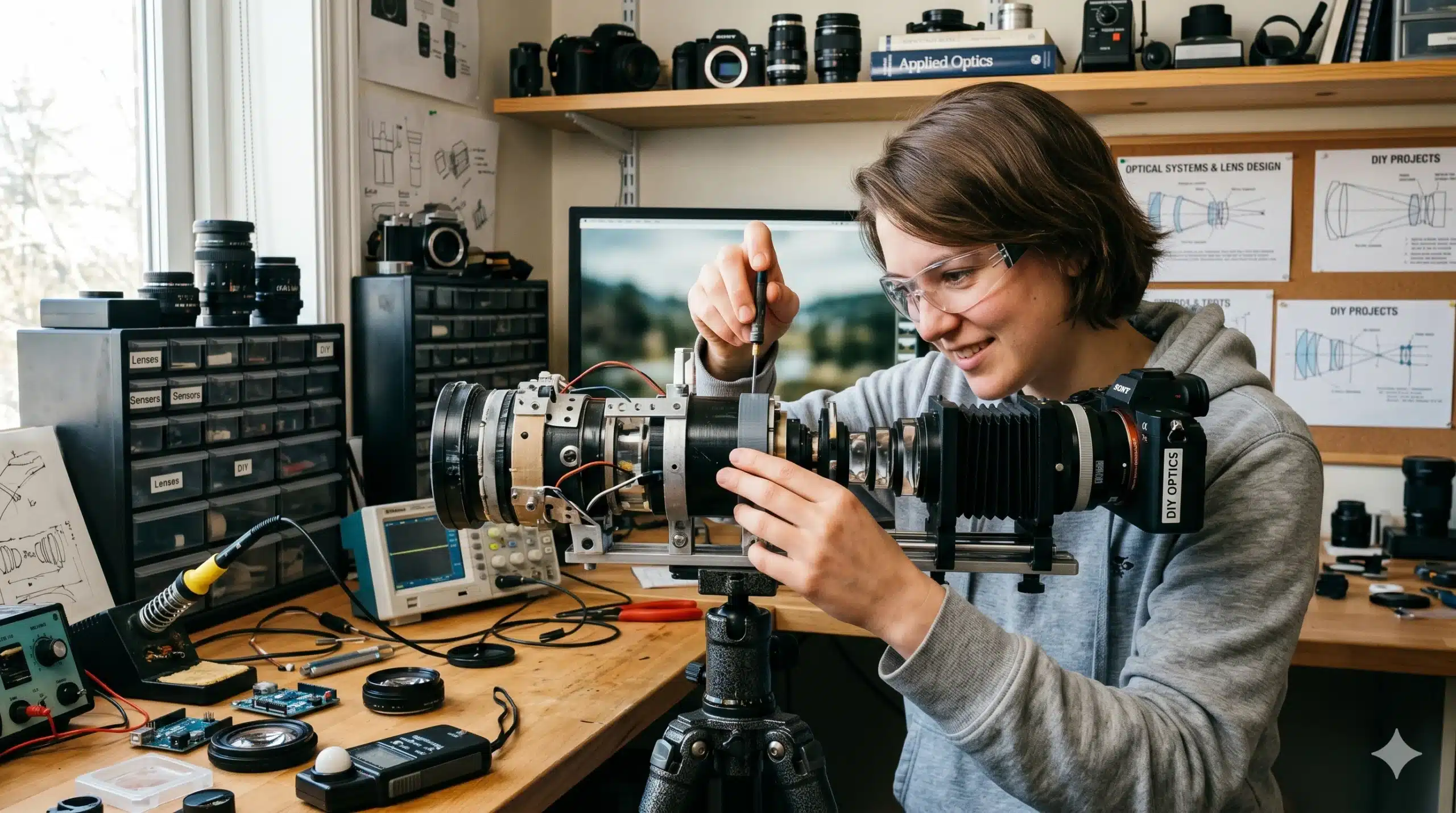
In this final phase of our high-quality DIY series, we bridge the gap between the physical world and digital immortality. Photography is the ultimate “Capture System”—a combination of Geometry, Chemistry, and Physics. By building “Light Engines,” children learn that an image is not just a file on a phone, but a physical footprint of light.
This guide focuses on “Optical Engineering”—understanding how to bend, focus, and record the world through a lens.
1. The “Camera Obscura”: The Original Image Engine
Before sensors and film, there was the “Dark Chamber.” This project demonstrates the fundamental way light travels in straight lines.
The Build:
- The Chamber: A completely darkened room with a single window covered in black paper.
- The Aperture: A tiny, clean hole (the size of a pencil lead) poked through the black paper.
- The Screen: A white sheet or wall opposite the hole.
- The Result: An upside-down, full-color moving image of the outside world appears on the wall.
- The Science: This teaches Rectilinear Propagation of Light. The image is inverted because the light rays from the top of an object must pass through the hole to reach the bottom of the screen.
2. The “Pinhole” Camera: Chemical Data Storage
Once you understand the Camera Obscura, you can shrink it into a portable box to “save” an image.
Engineering the Capture:
- The Body: A small wooden box or a sturdy tin painted matte black inside to prevent internal reflections.
- The Shutter: A simple piece of black tape over the pinhole.
- The “Sensor”: A piece of light-sensitive photographic paper (loaded in a darkroom or under a red light).
- The Exposure: Open the tape shutter for 30–60 seconds.
- The Development: Use the “Dye Lab” logic to develop the paper in chemicals. This teaches Latent Image Theory—the idea that data is stored invisibly until it is “processed”.
3. The “Lens” Lab: Bending the Data
Pinhole cameras are clear but “slow” (they need a lot of light). To speed up the capture, we need a Lens to gather more light.
The Setup:
- The Material: Convex magnifying glasses of different sizes.
- The Variable: The “Focal Length.” Move the lens back and forth until the image on a piece of paper becomes sharp.
- The Logic: This is exactly how the Auto-Focus in a mobile game works. The system is moving a virtual lens to find the point where light rays converge perfectly.
Shutterstock
4. The “Zoetrope”: Engineering Motion
Photography captures a moment; cinema captures a system of moments. You can engineer a Zoetrope to understand the “Frame Rate” of the human eye.
The Mechanism:
- The Cylinder: A spinning drum with vertical slits.
- The Content: A strip of paper inside with 12 drawings of a character in slightly different poses.
- The Interaction: When the drum spins, the slits act as a “Mechanical Shutter.”
- The Science: This demonstrates Persistence of Vision. If the images move fast enough, the brain “stitches” them together into a smooth animation. This is the foundation of the 60fps (frames per second) targets you set for your studio’s mobile games.
5. The “Macro” Explorer: DIY Smartphone Microscope
To connect high-quality DIY to the digital age, you can engineer a “Macro Lens” for a smartphone using a single drop of water or a lens from a laser pointer.
The Build:
- The Optic: A tiny glass lens taped over the phone’s camera.
- The Subject: The “Micro-Structures” of your felted wool or the “Radicle” of your hydroponic bean.
- The Digital Link: This allows the child to take high-resolution “Data Samples” of their physical experiments, bridging the gap between the Analog Workshop and the Digital Portfolio.
Optical Standards and Safety
- Eye Safety: Never look at the sun through a lens or a pinhole.
- Chemical Handling: When developing pinhole photos, use tongs and keep the workspace ventilated.
- Light Integrity: In optics, a “Light Leak” is a “Data Breach.” Teach the child to use black tape and gaskets to keep their camera “system” secure
Summary of Optical Concepts
| Project | Concept | Physical Component | Skill Developed |
| Camera Obscura | Light Propagation | Aperture / Hole | Geometric Analysis |
| Pinhole Camera | Exposure / Storage | Photo Paper | Chemical Processing |
| Lens Lab | Refraction | Convex Glass | Focal Calibration |
| Zoetrope | Frame Rate | Slit Shutter | Animation Logic |
| Macro Explorer | Magnification | Micro-Lens | Digital Documentation |
Final Thoughts: The Captured Legacy
We have traveled from the raw earth to the logic of computers and finally to the capture of light itself. By building these optical systems, your child realizes that the wo