
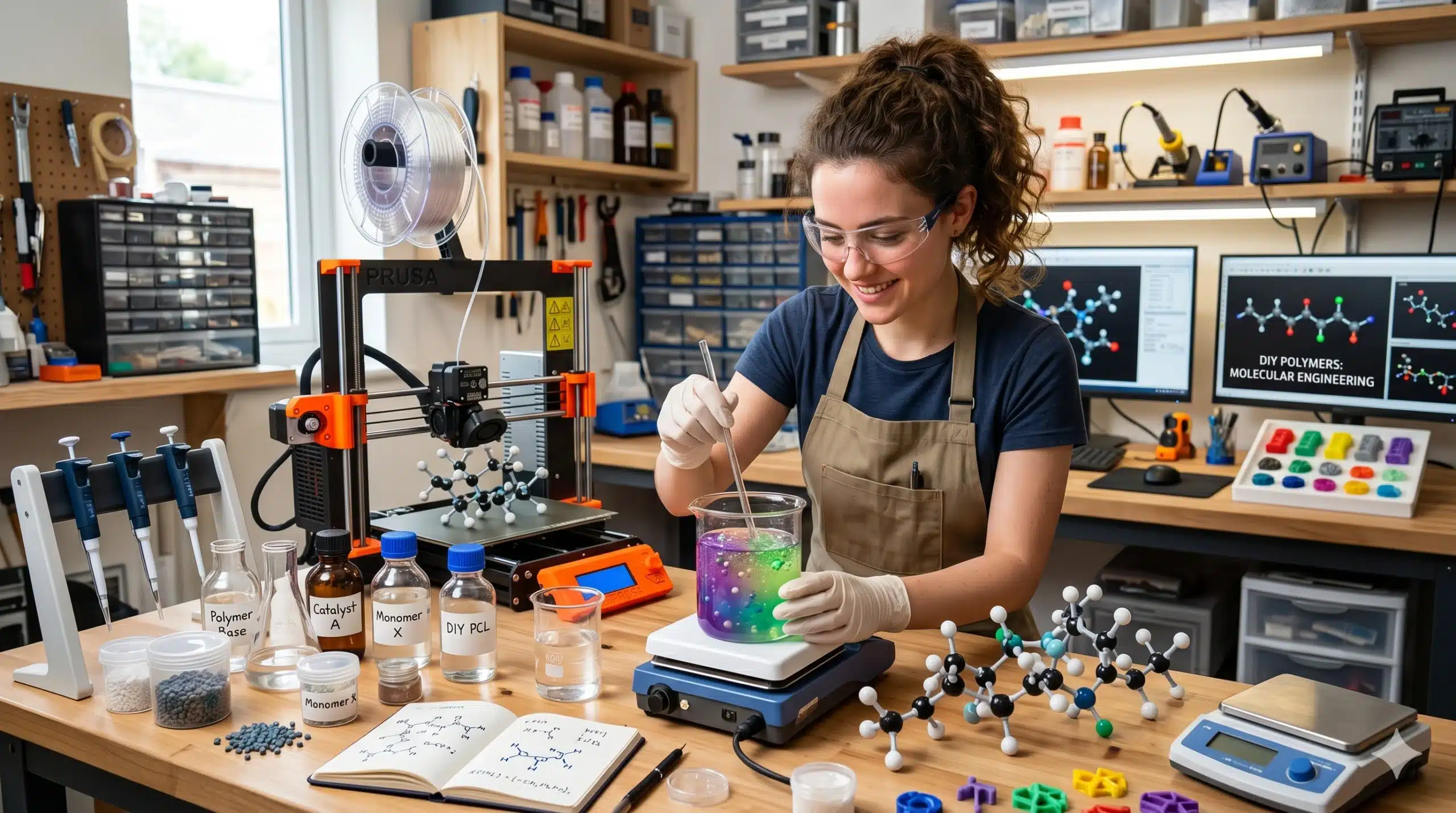
In this final deep-dive of our high-quality series, we move from the macro world of machines and optics into the microscopic world of chemical bonds. Material science is the foundation of all manufacturing; everything from the casing of your smartphone to the components of a satellite is chosen based on its molecular properties. By building a “Polymer Lab,” children learn that they can actually engineer new materials with specific textures, strengths, and behaviors.
This guide focuses on “Molecular Logic”—understanding how small chains of molecules (monomers) link together to form long, resilient chains (polymers).
1. The “Casein” Plastic: Bio-Engineering from Mil
Before modern petroleum-based plastics, engineers used milk proteins to create durable items like buttons and combs.
The Build:
- The Catalyst: Warm milk and white vinegar (acetic acid).
- The Reaction: Stirring vinegar into the milk causes the Casein proteins to unfold and clump together, a process known as “denaturing.”
- The Result: Strain the clumps, knead them into a dough, and mold them into shapes. Once dry, it becomes a hard, durable bio-plastic.
- The Science: This teaches Polymerization. The child is literally watching liquid proteins reorganize into a solid structural network.
2. The “Non-Newtonian” Fluid: Stress-Reactive Matter
Is it a solid or a liquid? A “Oobleck” station introduces children to Shear-Thickening fluids, where the material’s viscosity changes based on how much force is applied.
Engineering the Fluid:
- The Mix: 2 parts cornstarch to 1 part water.
- The Test (Low Force): Dip a finger in slowly; it behaves like a liquid.
- The Test (High Force): Punch the surface rapidly; it becomes a rock-hard solid.
- The Logic: This is the same principle used in high-tech body armor and “liquid” speed bumps. It teaches the child that force is an input that changes a material’s state.
3. The “Cross-Linking” Lab: Engineering Slime
Standard “Slime” is actually a sophisticated lesson in Cross-Linking. Without the right chemical bridge, the molecules just slide past each other.
The Setup:
- The Monomer: PVA glue (long, sliding chains).
- The Cross-Linker: A borax solution or contact lens solution.
- The Interaction: As you add the linker, the liquid thickens instantly.
- The Data: Use the “Tensile Strength Rig” from the Weaver article to see how far the slime stretches before the molecular “bridges” snap.
Shutterstock
Explore
4. The “Conductive” Dough: Engineering Circuits into Matter
Building on our “Electronics” article, we can create a material that is both a structural dough and an electrical conductor.
The Build:
- The Formula: Flour, water, and a high concentration of Salt (the electrolyte).
- The Insulator: Create a second dough using sugar instead of salt (sugar does not conduct).
- The Play: Use the salty dough to build “sculptural circuits” that light up LEDs.
- The Insight: This demonstrates that chemical composition dictates functional utility. A material’s “job” is determined by the ions hidden inside it.
5. The “Crystal” Growth Station: Molecular Geometr
Crystals are the most “organized” form of matter. Growing them teaches children about Lattice Structures.
The Process:
- The Solution: A supersaturated mixture of warm water and Alum or Epsom salts.
- The Seed: A single small crystal tied to a string.
- The Result: Over several days, molecules from the water “stack” perfectly onto the seed crystal, following a strict geometric blueprint.
- The Science: This is Self-Assembly. The child sees that when given the right conditions, nature builds its own high-quality structures without any manual tools.
Material Safety and Standards
- Chemical Hygiene: Always wear the “Surveyor’s” apron and eye protection. Wash hands thoroughly after handling borax or glue.
- Waste Management: Never pour polymers like slime or glue down the sink; they can clog pipes just as they “clog” molecular gaps.
- Observation: Use the “Macro Explorer” (smartphone microscope) to look at the edges of a dried Casein shape versus a salt crystal.
Summary of Material Science Concepts
| Project | Concept | System Change | Skill Developed |
| Casein Plastic | Bio-Polymers | Denaturation | Structural Molding |
| Non-Newtonian Fluid | Viscosity | Shear-Thickening | Force Analysis |
| Slime Lab | Cross-Linking | Molecular Bridges | Chemical Engineering |
| Conductive Dough | Electrolytes | Ion Flow | Hardware-Matter Integration |
| Crystal Station | Lattice Structure | Self-Assembly | Geometric Observation |
Final Thoughts: The Architect of Atoms
You have now traveled from the stars, through the atmosphere, across the digital landscape, and finally into the very atoms of the earth. Your child is no longer just a “maker”—they are a Materials Scientist. They understand that the world is a kit of parts, and by changing the “code” at a molecular level, they can create anything they can imagine.