
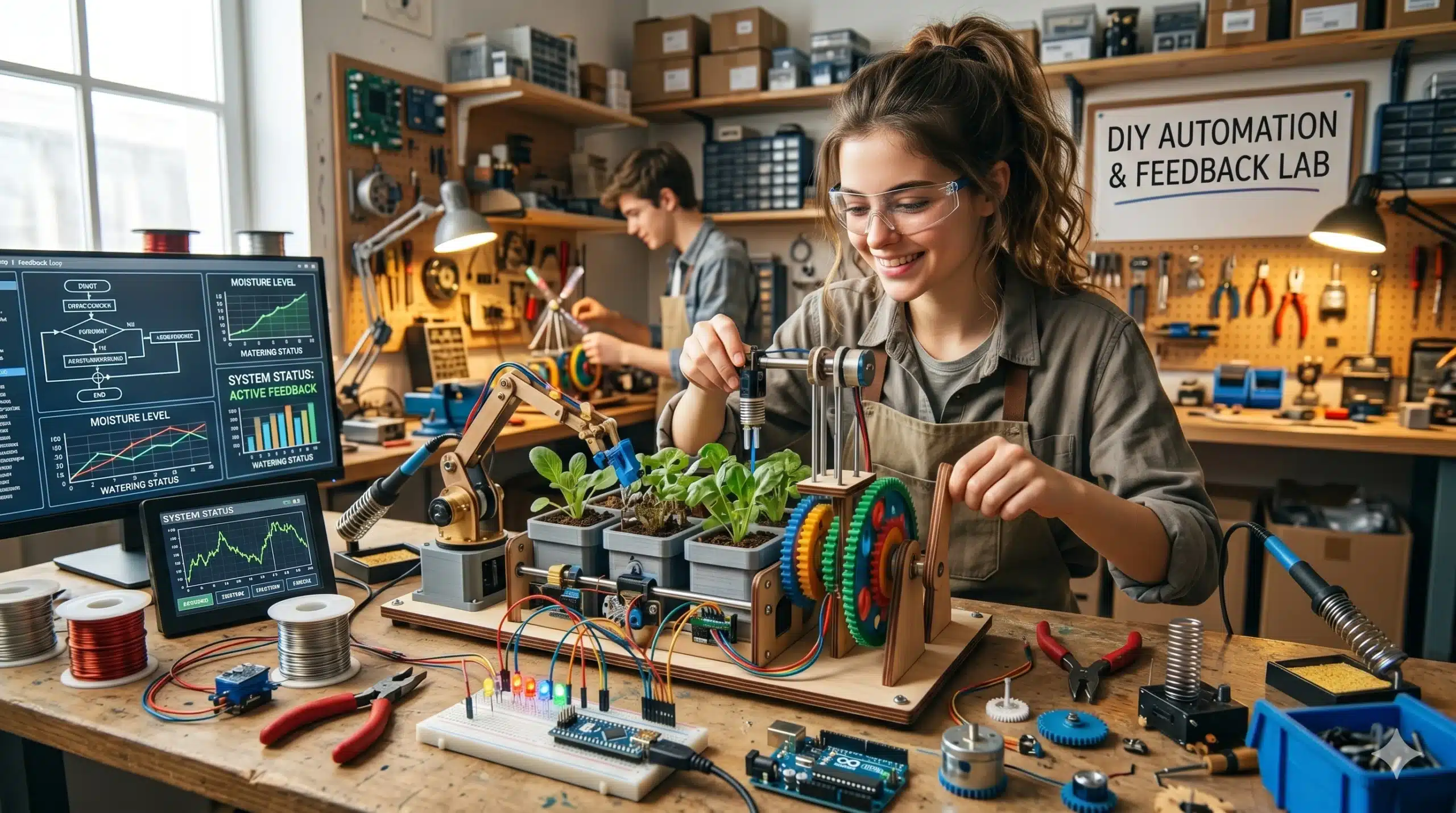
In this culminating article of our high-quality series, we synthesize mechanical engineering, electronics, and digital logic into the ultimate discipline: Robotics. A robot is more than just a machine; it is an autonomous system that can sense its environment, process that data, and perform an action. By building “Automated Playthings,” children learn the vital concept of the Feedback Loop.
This guide explores “Control Logic”—how to give a physical object a “brain” and the ability to react to the world.
1. The “Bristle-Bot”: Vibrational Locomotion
Before building complex joints, children can explore Kinetic Energy through a simple vibration-driven robot.
The Build:
- The Chassis: The head of a toothbrush.
- The Motor: A tiny pager motor (vibration motor) and a 3V coin cell battery.
- The Interaction: The offset weight on the motor causes the toothbrush bristles to vibrate rapidly.
- The Science: This teaches Center of Mass and Friction. By trimming the bristles at different angles, the child can “program” the robot to move in circles, straight lines, or erratic patterns.
2. The “Hydraulic” Robotic Arm: Fluid Power
High-quality robotics often relies on Actuators. You can engineer a powerful robotic gripper using the “Pneumatic Logic” we explored in earlier articles, but using water for non-compressible strength.
Engineering the Motion:
- The Joints: Cardboard or balsa wood segments joined with brass fasteners.
- The Muscles: Two plastic syringes connected by vinyl tubing filled with water.
- The Control: Pushing one syringe (the master) forces the other (the slave) to extend, moving the arm.
- The Logic: This demonstrates Force Multiplication. The child realizes that they can move heavy objects by managing fluid pressure, a core principle in industrial robotics.
3. The “Light-Seeker”: Simple Sensor Logic
A robot needs to “see.” You can build a Photo-sensitive Circuit that allows a robot to navigate toward a light source without any computer code.
The Setup:
- The Sensor: Two LDRs (Light Dependent Resistors) placed on the left and right sides.
- The Motors: Two small DC motors connected to wheels.
- The Feedback Loop: If the left sensor sees more light, it sends more power to the right motor, turning the robot toward the light.
- The Insight: This is Analog Computing. The robot is “deciding” where to go based on real-time environmental inputs.
4. The “Cable-Driven” Hand: Bio-Mechanical Robotics
To understand the complexity of human-like movement, children can engineer a Prosthetic Hand model using “Master Weaver” string logic.
The Build:
- The Structure: Five cardboard fingers with “joints” scored into the material.
- The Tendons: Fishing line or heavy thread running through “pulley” guides (straw segments) on each finger.
- The Interaction: When the child pulls a string, the finger curls.
- The Science: This teaches Tension and Range of Motion. It bridges the gap between biological anatomy and mechanical engineering.
5. The “Logic-Gate” Maze: Navigational Algorithms
Using the “Marble Logic” from our computing article, you can create a physical Decision Tree for a small rolling robot or marble.
The Protocol:
- The Maze: A series of “Flip-Flop” gates made of wood.
- The Rule: Each time a robot passes a gate, the gate flips to the opposite direction.
- The Result: The child “programs” the maze so that the robot must visit every corner before finding the exit.
- The Logic: This is State Management. The robot’s future path is determined by the “memory” stored in the physical state of the gates.
Robotics Standards and Safety
- Battery Management: Use a dedicated “Power Station” (battery holder) to prevent loose wires from short-circuiting.
- Structural Integrity: Robots undergo constant vibration and stress. Use “druvion-style” reinforcement (triangulation and strong adhesives) to keep the chassis together.
- The “Kill Switch”: Every high-quality robot needs a physical way to cut power instantly. This introduces the concept of Emergency Safety Protocols.
| Project | Concept | System Function | Skill Developed |
| Bristle-Bot | Locomotion | Kinetic Vibration | Weight Balancing |
| Hydraulic Arm | Actuation | Fluid Pressure | Mechanical Advantage |
| Light-Seeker | Sensing | Photo-Feedback | Input/Output Loops |
| Cable-Hand | Bio-Mechanics | Tensile Tendons | Precision Control |
| Logic Maze | Algorithms | State Memory | Navigational Logic |
Summary of Robotics Concepts
Final Thoughts: The Birth of the Autonomous
You have built a workshop that can sense, think, and move. By reaching the level of Robotics, your child has moved beyond simple crafting into the realm of System Integration. They understand that a robot is a “Community of Parts” working together toward a single goal.