
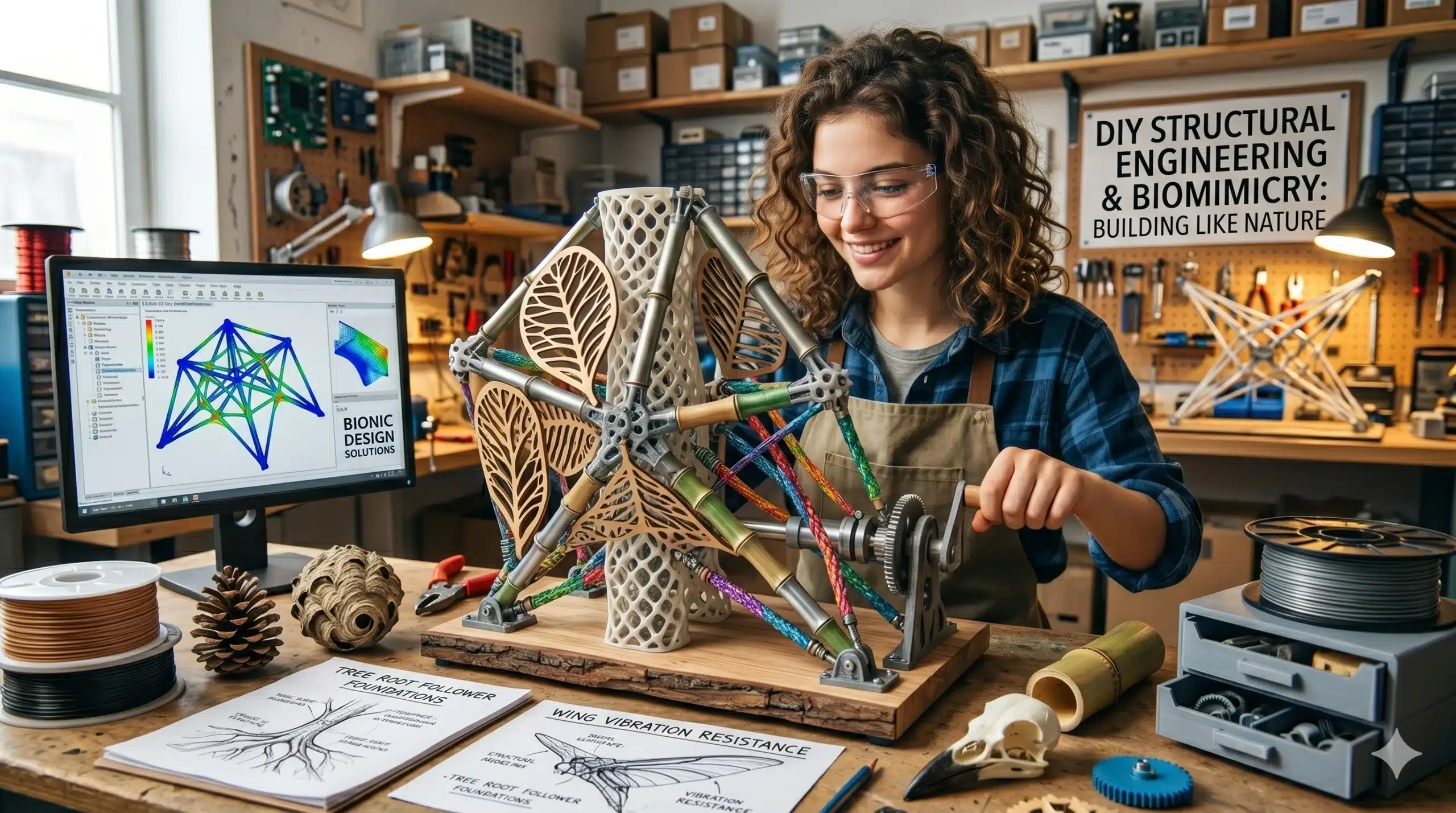
In this culminating phase of our high-quality DIY journey, we move from individual machines to the science of systems and structures. Structural engineering is the art of managing forces—gravity, tension, and compression—to create stability. By applying Biomimicry, children learn to borrow “design patterns” from nature, which has had billions of years to perfect its “hardware.”
This guide focuses on “Integrative Logic”—building resilient frameworks that mirror the efficiency of the natural world.
1. The “Geodesic” Dome: Geometry of Strength
A geodesic dome is one of the most efficient structural systems ever engineered. It distributes stress across its entire surface through a network of triangles.
The Build:
- The Material: Rolled newspaper tubes or balsa wood struts.
- The Blueprint: Use the “Binary Abacus” logic to calculate two specific lengths of struts ($A$ and $B$) to form a perfect sphere.
- The Science: This teaches Triangulation. The child realizes that while a square can be crushed, a triangle is “rigid” because its angles cannot change without changing the length of its sides.
2. The “Tensegrity” Table: Defying Gravity
Tensegrity (Tensional Integrity) structures appear to “float.” They are held together by a balance of continuous tension and discontinuous compression.
Engineering the Balance:
- The Struts: Two “C-shaped” wooden or cardboard frames.
- The Tensioners: High-quality nylon fishing line or the “Plarn” from your material science lab.
- The Magic: The central “gravity” string holds the weight, while the outer strings provide stability.
- The Logic: This mirrors how Human Anatomy works. Our bones are the compression struts, and our tendons and muscles provide the tension that keeps us upright.
3. The “Honeycomb” Sandwich: Material Efficiency
Nature uses hexagonal structures to maximize strength while minimizing weight. This project demonstrates how Geometry can make a weak material incredibly strong.
The Lab Setup:
- The Core: Hundreds of small paper hexagons glued together.
- The Faces: Two thin sheets of cardstock or balsa wood.
- The Test: Place the “Honeycomb” panel between two stacks of books and add weights.
- The Data: Compare its strength to a solid block of wood of the same weight. This teaches Specific Strength—a critical metric in aerospace and mobile game asset optimization.
4. The “Leaf-Fold” Solar Array: Deployable Engineering
Following the “Master Weaver” logic, we look at Origami Engineering. Many plants use complex folding patterns to pack large surface areas into tiny buds.
The Build:
- The Pattern: The “Miura-ori” fold (a single-motion deployment pattern).
- The Application: Attach your “Conductive Dough” circuits to the paper.
- The Interaction: With one pull, the tiny square expands into a massive “Solar Array.”
- The Science: This is used by NASA to pack giant satellites into small rockets. It teaches Kinetic Geometry—how a structure’s “state” can change through folding.
5. The “Ecosystem” Workshop: Final Systems Integration
To conclude the series, the child creates a Master Schematic of their entire workshop, connecting every lab they have built.
The Protocol:
- The Map: Use the “Thermal Map” and “Cartography” skills.
- The Connections: Draw lines showing how the “Hydroponic Lab” provides oxygen, the “Energy Lab” provides power, and the “Robotics Lab” provides automation.
- The Insight: This is Systems Thinking. The child realizes that a high-quality life—and a high-quality game—is not a collection of parts, but a web of interconnected dependencies.
Engineering Standards and Safety
- Load Awareness: When testing tensegrity or domes, always stand clear of the “Collapse Zone.”
- Structural Symmetry: In engineering, an “off-center” joint is a “bug.” Use your “Surveyor’s Chain” to ensure perfect alignment.
- Biomimetic Respect: Remind the child that we are “copying” nature’s homework because nature is the most efficient engineer on the planet.
Summary of Structural Concepts
| Project | Concept | Force Focus | Skill Developed |
| Geodesic Dome | Triangulation | Stress Distribution | Geometric Scaling |
| Tensegrity Table | Tensional Integrity | Tension vs. Compression | Anatomical Logic |
| Honeycomb Panel | Specific Strength | Weight-to-Strength Ratio | Material Efficiency |
| Miura-ori Fold | Deployable Space | Kinetic Geometry | Aerospace Logic |
| Workshop Schematic | Systems Integration | Dependencies | Holistic Architecture |
Final Thoughts: The Infinite Architect
We have come full circle. Your child started by playing with boxes and has ended by understanding the structural logic of the universe. They have become Architects of Reality, capable of seeing the “physics engine” behind every leaf, building, and line of code.
r