
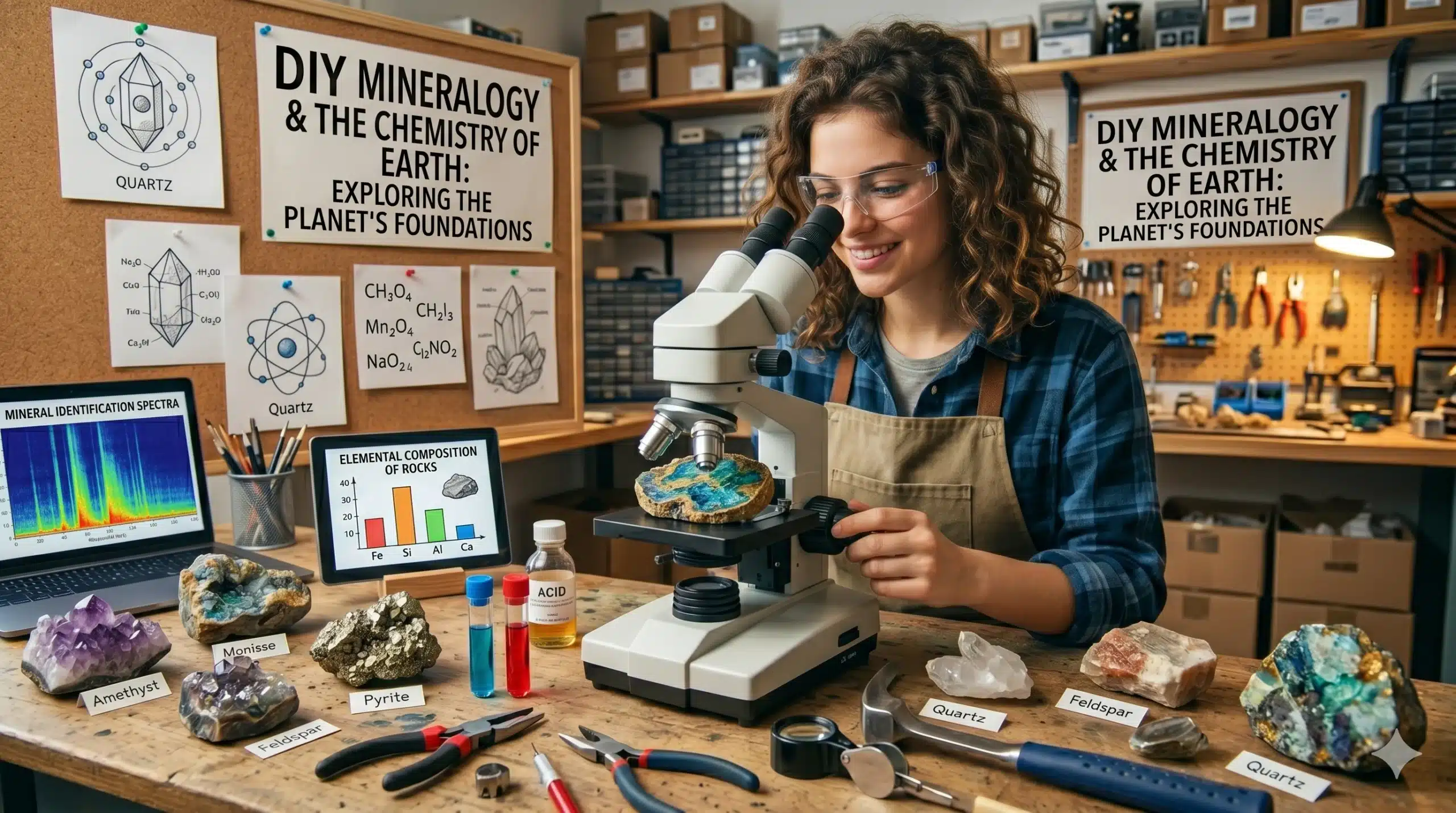
In this chapter of our high-quality DIY series, we delve into the foundation of our planet: Mineralogy. While it may seem like just “looking at rocks,” mineralogy is the study of the chemical composition and crystalline structure of natural solids. By building an “Earth Lab,” children learn to identify the building blocks of the physical world and understand the chemical cycles that shape the crust.
This guide focuses on “Chemical Taxonomy”—the process of identifying, classifying, and testing minerals using the scientific method.
1. The “Mohs” Hardness Rig: Measuring Resistance
In mineralogy, hardness is not a feeling; it is a measurable resistance to being scratched. You can engineer a high-quality testing kit to determine where a specimen sits on the Mohs Scale.
The Build:
- The Reference Set: Common household items with known hardness levels: a fingernail (2.5), a copper coin (3.5), a steel nail (5.5), and a glass plate (6.5).
- The Test: Attempt to scratch the unknown mineral with each item in sequence.
- The Science: This teaches Atomic Bond Strength. A mineral like quartz can scratch steel because its molecular lattice is more tightly bound than the iron atoms in the nail.
2. The “Streak” Plate: Finding the Hidden Color
The color of a mineral’s exterior can be misleading due to weathering or impurities. The Streak Test reveals the mineral’s true color in its powdered form.
Engineering the Test:
- The Tool: An unglazed porcelain tile (a “streak plate”).
- The Action: Firmly drag the mineral across the tile.
- The Result: Hematite may look black or silver, but it leaves a reddish-brown streak. Pyrite (“Fool’s Gold”) looks like gold but leaves a greenish-black streak.
- The Logic: This is a lesson in Trace Impurities. The exterior color is often changed by external factors, but the powder remains a consistent diagnostic feature.
3. The “Specific Gravity” Scale: Measuring Density
Two rocks of the same size can have very different weights. By building a high-quality balance scale, children can calculate a mineral’s Specific Gravity (SG)—its density relative to water.
The Lab Setup:
- The Tool: A precision balance scale (similar to the one in your “Material Break Point” rig).
- The Measurement: Weigh the mineral dry ($W_{dry}$), then weigh it while it is completely submerged in water ($W_{wet}$).
- The Math: Calculate $SG = \frac{W_{dry}}{W_{dry} – W_{wet}}$.
- The Science: This teaches Mass-to-Volume Ratios. It allows the child to distinguish between minerals that look identical but have different atomic weights.
4. The “Effervescence” Test: Chemical Reactivity
Some minerals react chemically to acids. This is a masterclass in Geological Chemistry.
The Experiment:
- The Catalyst: A weak acid (white vinegar or lemon juice).
- The Reaction: Place a drop of the acid on a mineral like Calcite or Limestone.
- The Result: The mineral will “fizz” (effervesce) as it releases carbon dioxide gas.
- The Science: This is a Neutralization Reaction. It shows the child that rocks aren’t just “dirt”—they are active participants in the planet’s carbon cycle.
5. The “Fluorescence” Dark-Box: UV Light Energy
Some minerals have a “secret” identity that only appears under ultraviolet light.
The Build:
- The Chamber: A black-lined box with a small UV-flashlight mounted inside.
- The Interaction: Place minerals like Fluorite or Sodalite inside.
- The Science: This is Photoluminescence. The atoms in the mineral absorb the UV light and re-emit it at a lower energy level, creating a glowing effect. This connects back to our “Optical Lab” and “Energy Lab” concepts.
Mineralogy Standards and Safety
- Safety First: Always wear eye protection when using a rock hammer or testing with vinegar.
- Documentation: Every specimen should be logged in the “Accession Ledger” with its hardness, streak, and density results.
- Contextual Awareness: Remind the child that the silicon in their smartphone and the lithium in their batteries were once minerals found in the ground.
Summary of Mineralogy Concepts
| Project | Concept | Variable | Skill Developed |
| Hardness Rig | Mohs Scale | Scratch Resistance | Lattice Analysis |
| Streak Plate | Powder Color | Diagnostic Consistency | Impurity Filtering |
| Gravity Scale | Density (SG) | Weight-to-Volume | Atomic Mass Analysis |
| Effervescence | Reactivity | pH Interaction | Chemical Identification |
| Fluorescence | Photoluminescence | Light Energy Absorption | Spectral Observation |
Final Thoughts: The Chemistry of the Crust
By studying minerals, your child learns that the “solid” ground beneath them is actually a complex, moving system of chemistry. They