
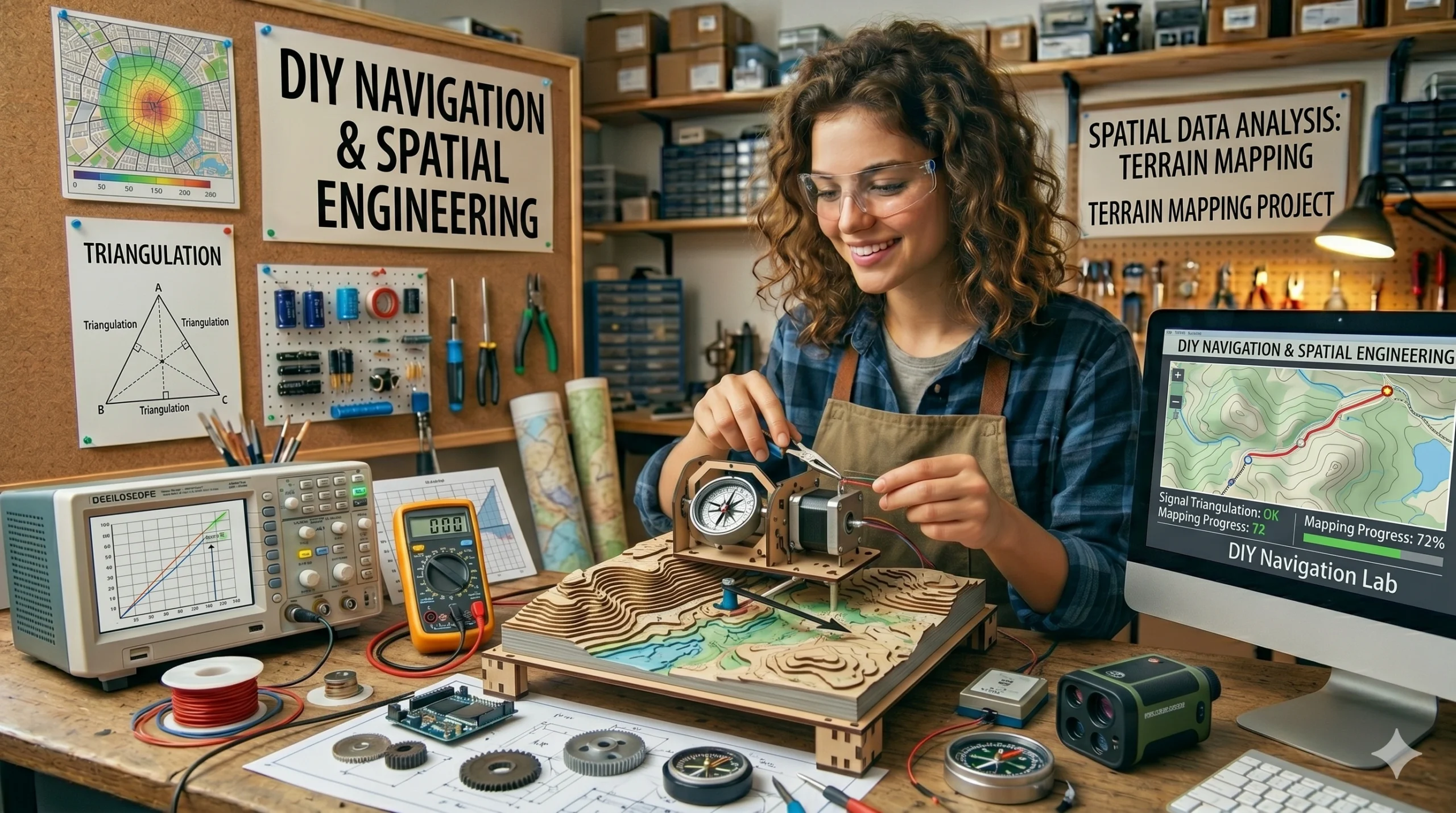
In this final chapter of our high-quality DIY journey, we move from the laws of physics and biology into the science of the world itself. Cartography is the ultimate “Visual Database”—a way to compress the infinite complexity of the physical landscape into a functional, two-dimensional system. By building a “Navigation Lab,” children learn the mathematical logic of scale, coordinates, and orientation.
This guide focuses on “Spatial Logic”—understanding how to measure the earth and translate it into a readable code.
1. The “Surveyor’s Chain”: Measuring the Grid
Before we can map a space, we must be able to measure it with absolute precision. You can engineer a high-quality Surveyor’s Chain to understand the foundation of “Standard Units.”
The Build:
- The Material: Heavy-duty twine or small metal chain links.
- The Calibration: Mark the chain every 1 meter using colored thread or paint.
- The Tool: Use two wooden stakes to keep the chain perfectly level during measurement.
- The Science: This teaches Linear Measurement. The child realizes that a map is only as accurate as the “ground truth” data collected in the field.
2. The “Magnetic” Compass: Finding the Global Axis
A map is useless without orientation. You can engineer a Floating Needle Compass to connect your local workshop to the earth’s magnetic field.
Engineering the Orientation:
- The Needle: A steel sewing needle magnetized by rubbing it against a strong magnet.
- The Pivot: A small piece of cork floating in a bowl of water.
- The Result: The needle will align itself with the North-South magnetic axis.
- The Logic: This demonstrates Magnetoreception. The child sees that the earth itself is a giant “hard drive” with a magnetic signature that we can read to stay “on-track.”
3. The “Clinometer”: Measuring the Third Dimension
The world isn’t flat, and high-quality maps must account for height. You can build a Clinometer to measure the elevation of trees, buildings, or hills.
The Lab Setup:
- The Rig: A protractor with a viewing straw taped to the straight edge.
- The Plumb Line: A string with a heavy weight (like a washer) hanging from the center point.
- The Math: By sighting the top of an object through the straw, the string marks the angle of elevation. Using basic Triangulation, the child can calculate height based on their distance from the object.
- The Data: This is the physical version of the “Z-axis” logic used in 3D game environments.
4. The “Topographic” Sandbox: Visualizing Elevation
To understand “Contour Lines,” children can build a Topographic Model of their own backyard or a local landmark.
The Build:
- The Medium: Damp sand or clay.
- The Process: Build a hill and use a string to “slice” it every 2 centimeters horizontally.
- The Translation: Trace each slice onto a piece of paper.
- The Insight: This teaches Contour Mapping. The child learns that lines drawn closer together represent a steep slope, while lines further apart represent flat terrain.
5. The “Geocache” Puzzle: Digital-Analog Integration
To wrap up the series, the child can create a “Hidden Data Point” (a Geocache) for a family member to find.
The Protocol:
- The Latitude/Longitude: Use a smartphone to find the exact coordinates of a hidden “treasure” in the workshop.
- The Clues: Create a map using the “Symmetrical Block Prints” for landmarks.
- The Skill: This teaches Wayfinding. It connects the abstract numbers on a screen to a physical location in the real world.
Cartography Standards and Safety
- Compass Accuracy: Keep magnets away from your “Navigation Lab” when using the compass, as they will create “data interference.”
- Field Safety: When surveying outside, always wear the “Surveyor’s” apron and stay aware of your surroundings.
- Scale Integrity: Every map must have a “Scale Bar” (e.g., 1 cm = 1 meter). This reinforces the importance of Proportional Logic.
Summary of Cartography Concepts
| Project | Concept | System Variable | Skill Developed |
| Surveyor’s Chain | Standard Units | Linear Distance | Empirical Precision |
| Magnetic Compass | Orientation | Magnetic North | Global Positioning |
| Clinometer | Elevation | Angular Degree | 3D Space Analysis |
| Topographic Model | Contour Mapping | Vertical Relief | Data Visualization |
| Geocache Puzzle | Coordinates | Lat/Long Data | System Navigation |
Final Thoughts: The Map is the Territory
You have now mapped the earth, the sky, the atoms, and the logic of machines. By understanding cartography, your child realizes that they can navigate any system—whether it’s a physical forest or the complex code of a mobile game.