
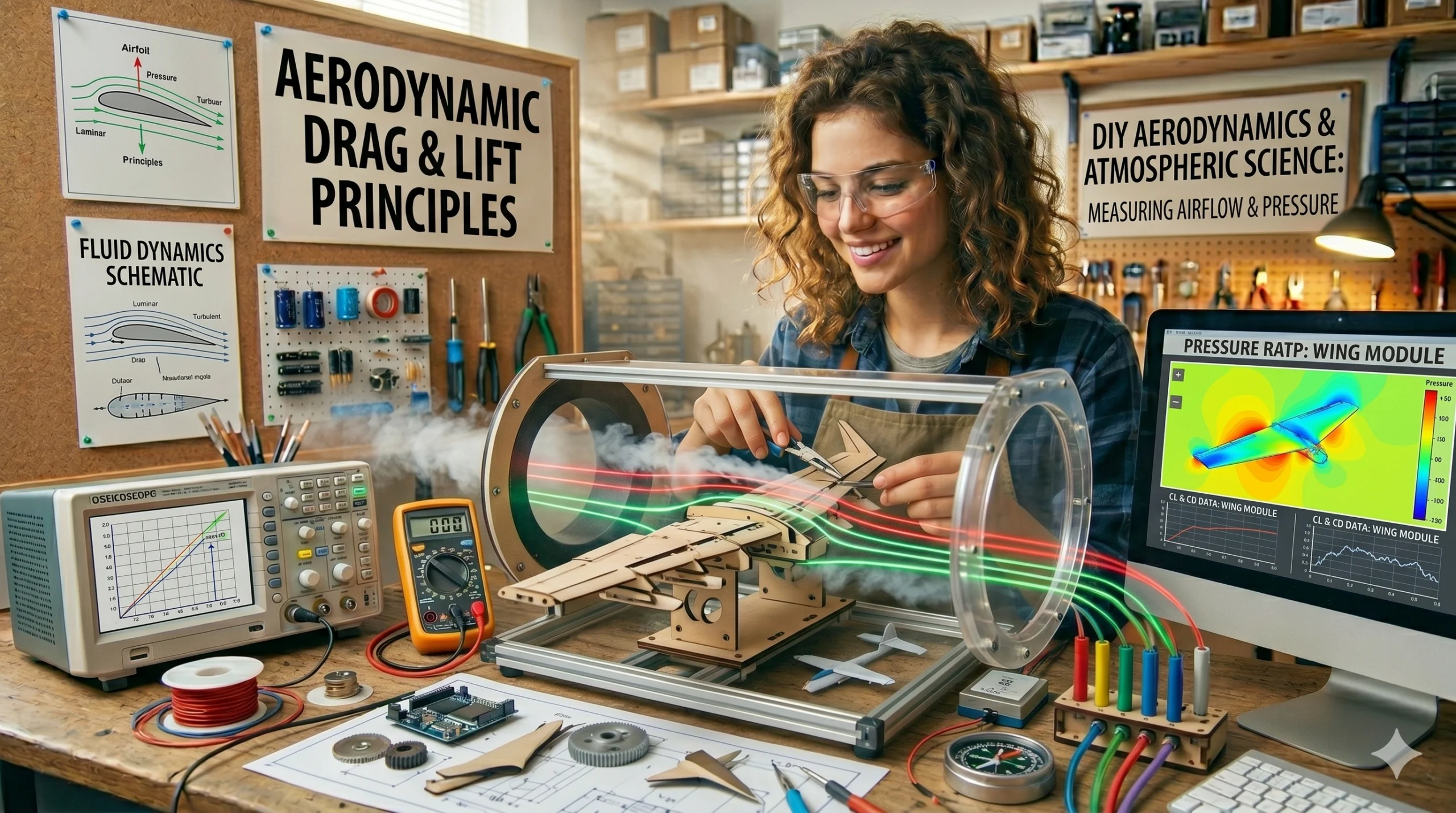
After mapping the earth and its minerals, we turn our attention upward to the invisible ocean of air. Aerodynamics is the study of how gases interact with moving bodies. By building a “Sky-High Lab,” children learn the four fundamental forces of flight—Lift, Weight, Thrust, and Drag—and how to engineer structures that navigate the atmosphere.
This guide focuses on “Fluid Dynamics”—the logic of air in motion and how to harness it for travel and power.
1. The “Venturi” Wind Tunnel: Visualizing Airflow
High-quality aeronautical engineering requires a way to see the invisible. You can build a tabletop Wind Tunnel to observe how different shapes create or reduce “Drag.”
The Build:
- The Body: A clear plastic or acrylic tube.
- The Intake: A honeycomb of drinking straws to straighten the incoming air.
- The Engine: A small, high-velocity fan at one end.
- The Visualization: A piece of incense or a dry-ice mister to create a “smoke stream”.
- The Science: This teaches Laminar vs. Turbulent Flow. The child sees how a teardrop shape allows air to slide past smoothly, while a flat block creates a chaotic “wake” of drag.
2. The “Bernoulli” Lift-Wing: Engineering Pressure
Why do planes fly? It’s a matter of Differential Pressure. You can engineer a precision “Airfoil” to demonstrate Bernoulli’s Principle in real-time.
Engineering the Lift:
- The Wing: A curved balsa wood or cardstock airfoil balanced on a vertical guide wire.
- The Input: Use the fan from your wind tunnel.
- The Result: As air moves faster over the curved top of the wing, the pressure drops, and the wing “magically” climbs the wire.
- The Logic: This teaches Pressure Gradients. The child learns that “Lift” is a physical force generated by the geometry of the wing itself.
3. The “Stomp” Rocket: Propulsive ForceThrust is the force that moves an object forward. By building a high-quality Pneumatic Launcher, children can explore the relationship between pressure and distance.
The Lab Setup:
- The Launcher: A length of PVC pipe connected to a flexible hose and a 2-liter bottle.
- The Rocket: A lightweight tube with balanced fins and a weighted nose cone.
- The Experiment: Launch at different angles (30°, 45°, 60°).
- The Data: Measure the “Flight Path” and record it in your Accession Ledger. This teaches Ballistics and Trajectory, core concepts in physics and strategic game mechanics.
4. The “Parachute” Drop: Managing Terminal Velocity
Drag isn’t always the enemy; sometimes, it’s a safety feature. This project explores how to maximize Surface Area to slow down a descent.
The Build:
- The Variable: Test different “Canopy” materials—silk, plastic, and the “Plarn” from your material science lab.
- The Geometry: Compare circular, square, and “cross” shaped parachutes.
- The Metric: Use a stopwatch to measure the time from drop to impact.
- The Science: This teaches Terminal Velocity. The child learns that the larger the “drag profile,” the slower the object falls through the air.
5. The “Aeolian” Anemometer: Measuring Wind Speed
To round out the lab, you must be able to measure the atmosphere. You can engineer a Cup Anemometer to calculate wind velocity in your workshop.
The Protocol:
- The Rotor: Four small cups (or halved ping-pong balls) mounted on a cross-arm.
- The Pivot: A low-friction needle or ball-bearing mount.
- The Calibration: Count the “RPM” (Rotations Per Minute) when walking at a known speed.
- The Skill: This teaches Data Acquisition. It turns the wind from a “feeling” into a numerical “Input” that can be used for further engineering.
Atmospheric Standards and Safety
- Flight Zone: Always launch rockets and fly gliders in open areas away from power lines and trees.
- Eye Protection: Use safety goggles when working with pressurized systems like stomp rockets.
- Precision Weighting: In aerodynamics, a single gram of “off-center” weight can ruin a flight. Use your precision scale to ensure all wings and rockets are perfectly balanced.
Summary of Aerodynamic Concepts
| Project | Concept | Physical Force | Skill Developed |
| Wind Tunnel | Drag | Resistance | Fluid Visualization |
| Lift-Wing | Bernoulli’s Principle | Lift | Pressure Engineering |
| Stomp Rocket | Thrust | Propulsion | Trajectory Analysis |
| Parachute Drop | Terminal Velocity | Air Resistance | Surface Geometry |
| Anemometer | Wind Velocity | Kinetic Input | RPM Calibration |
Final Thoughts: Navigating the Invisible
The sky is no longer a mystery; it is a laboratory. By understanding aerodynamics, your child moves from “throwing” objects to “engineering” flights. They see that every curve on a wing and every fin on a rocket is a calculated decision.