
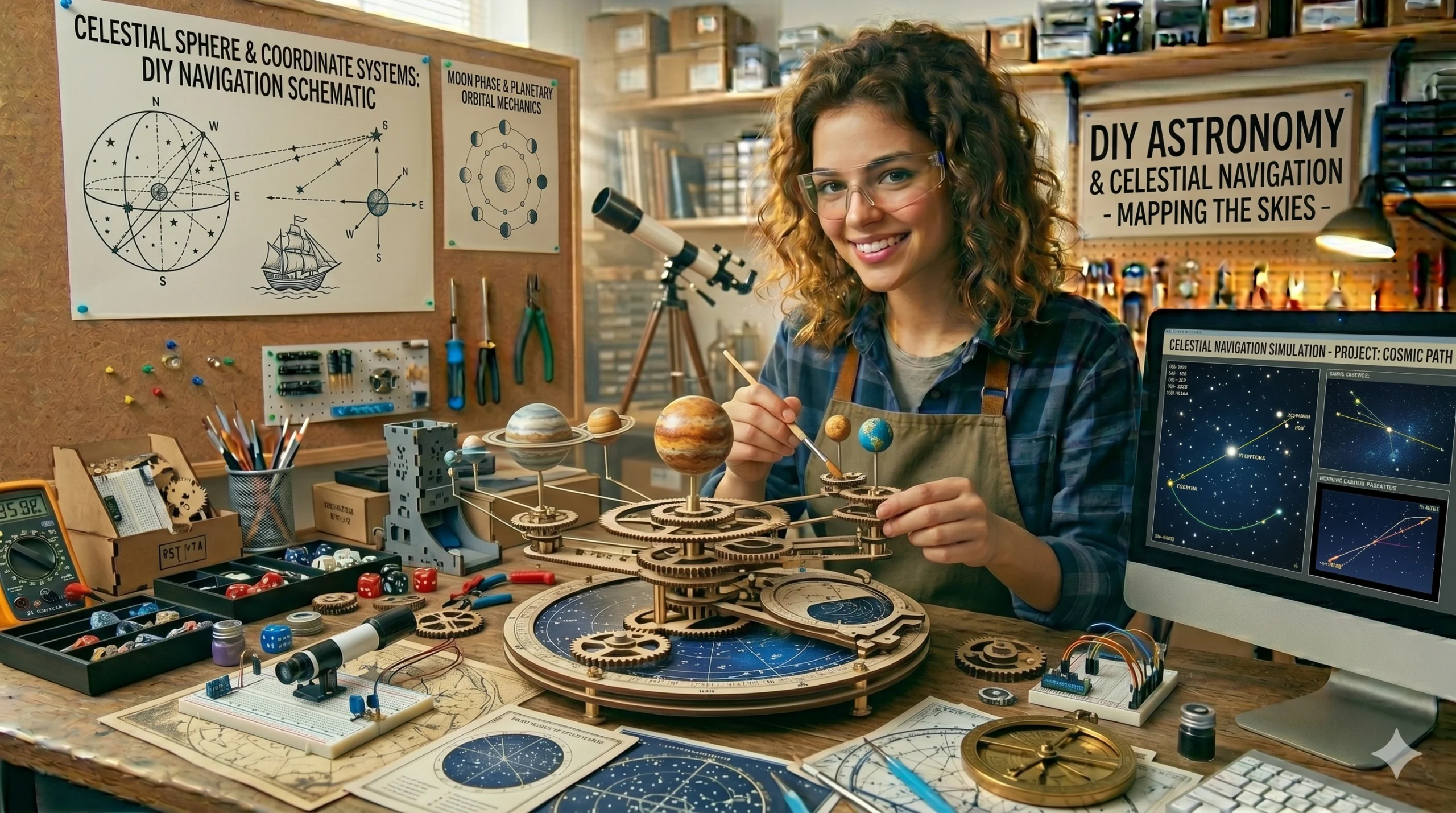
In this final phase of our high-quality DIY journey, we look beyond the workshop and into the vast expanse of the Solar System. Astronomy is the ultimate study of “Scale and Motion”—understanding how gravity, light, and geometry govern the movement of planets and stars. By building a “Space Lab,” children learn that the universe follows a strictly defined “Source Code” of physics.
This guide focuses on “Celestial Logic”—engineering tools to capture distant photons and track the rotation of the Earth.
1. The “Galilean” Refractor: Engineering the Lens Train
The telescope is the fundamental hardware of the astronomer. Building one from scratch teaches the logic of Optical Magnification.
The Build:
- The Lenses: A large, weak convex lens (Objective) and a small, strong concave lens (Eyepiece).
- The Tubes: Two nesting cardboard or PVC tubes painted matte black inside to prevent internal reflections.
- The Calibration: Slide the tubes back and forth until the image of a distant object (not the sun!) becomes sharp.
- The Science: This teaches Refraction. The child observes how light bends as it passes through different mediums to converge at a “focal point.”
2. The “Sundial” Chronometer: Tracking Earth’s Rotation
Timekeeping was the first practical application of astronomy. You can engineer a high-quality Equatorial Sundial to turn the Earth’s rotation into a visible clock.
Engineering the Time:
- The Gnomon: A straight rod positioned parallel to the Earth’s axis (pointing toward Polaris).
- The Dial: A plate tilted at an angle equal to your local latitude.
- The Result: As the Earth rotates, the shadow moves exactly 15° every hour.
- The Logic: This demonstrates Apparent Solar Motion. The child realizes that the sun isn’t moving across the sky; the “User” (Earth) is spinning.
3. The “Spectroscope” Lab: Analyzing Light Data
How do we know what stars are made of without visiting them? We use Spectroscopy to read the chemical “barcode” hidden in light.
The Lab Setup:
- The Component: An old CD or a diffraction grating.
- The Chamber: A dark box with a thin slit at one end.
- The Interaction: View a light source through the grating.
- The Data: Different elements produce different colored lines. This teaches Quantum Emission. The child learns that light is a carrier of information, much like the data packets in your digital publications.
4. The “Parallax” Rig: Measuring Cosmic Distance
In game development, “Parallax” creates a sense of depth. In astronomy, it is used to measure the distance to nearby stars.
The Experiment:
- The Tool: A sighting stick and a fixed background scale.
- The Action: View a “planet” (a ball in the yard) from two different positions.
- The Math: By measuring the “shift” against the background, the child can calculate the distance using Trigonometry.
- The Logic: This connects to the “Z-axis” logic you use in your mobile runner games like Last Armor: King Survival.
5. The “Astrophotography” Mount: Capturing the Stars
To conclude the lab, you can engineer a simple “Barn Door Tracker” to allow for long-exposure photography with a smartphone or camera.
The Build:
- The Hardware: Two wooden boards joined by a hinge.
- The Drive: A threaded rod that you turn manually at a rate of one rotation per minute.
- The Skill: This compensates for the Earth’s rotation, preventing “star trails.” It teaches Precision Tracking and matches the 60fps targets you set for your studio’s mobile game performance.
Astronomy Standards and Safety
- Solar Warning: Never look at the sun through any optical device. It will cause permanent eye damage instantly.
- Dark Adaptation: It takes 20 minutes for human eyes to fully adjust to the dark. Use a red-filtered flashlight to maintain your “Night Vision.”
- Atmospheric Clarity: Higher altitudes and low humidity provide better “Signal-to-Noise” ratios for observation.
Summary of Celestial Concepts
| Project | Concept | System Variable | Skill Developed |
| Refractor Telescope | Magnification | Focal Length | Optical Calibration |
| Equatorial Sundial | Earth Rotation | Latitude Angle | Temporal Mapping |
| Spectroscope | Light Spectra | Diffraction | Chemical Analysis |
| Parallax Rig | Trigonometry | Viewpoint Shift | Distance Calculation |
| Barn Door Tracker | Tracking | Rotational Velocity | Image Stabilization |
Final Thoughts: The Universe as a System
By building an astronomy lab, your child realizes that our world is part of a much larger, perfectly engineered system. They learn that the same laws of physics they used to build a “Stomp Rocket” or a “Binary Abacus” also govern the orbits of the planets.