
Before starting the activities, pique your students’ or children’s interest with these fascinating tidbits:
- Ancient Origins: The Ancient Egyptians were among the first to discover a ratio between the radius and circumference of a circle.
- Alphabet Coincidence: Pi is the 16th letter of the Greek alphabet. Coincidentally, “P” is also the 16th letter of the English alphabet!
- A Genius Birthday: Albert Einstein was born on March 14th, 1879. It seems he was destined for a life of mathematical greatness!
- Universal Accuracy: NASA has stated that you only need about 39 or 40 decimal places of Pi to calculate the circumference of the entire observable universe with incredible precision.
- The Fractions: Many students use 22/7 as a shorthand fraction for Pi when they aren’t using the decimal version.
1. Pi Day Color-by-Number Printables
For younger learners, start with a “Color by Number” set. These printables feature different variations of the Pi symbol or circular patterns. It’s a low-stress way to introduce the symbol while practicing color recognition and fine motor skills.
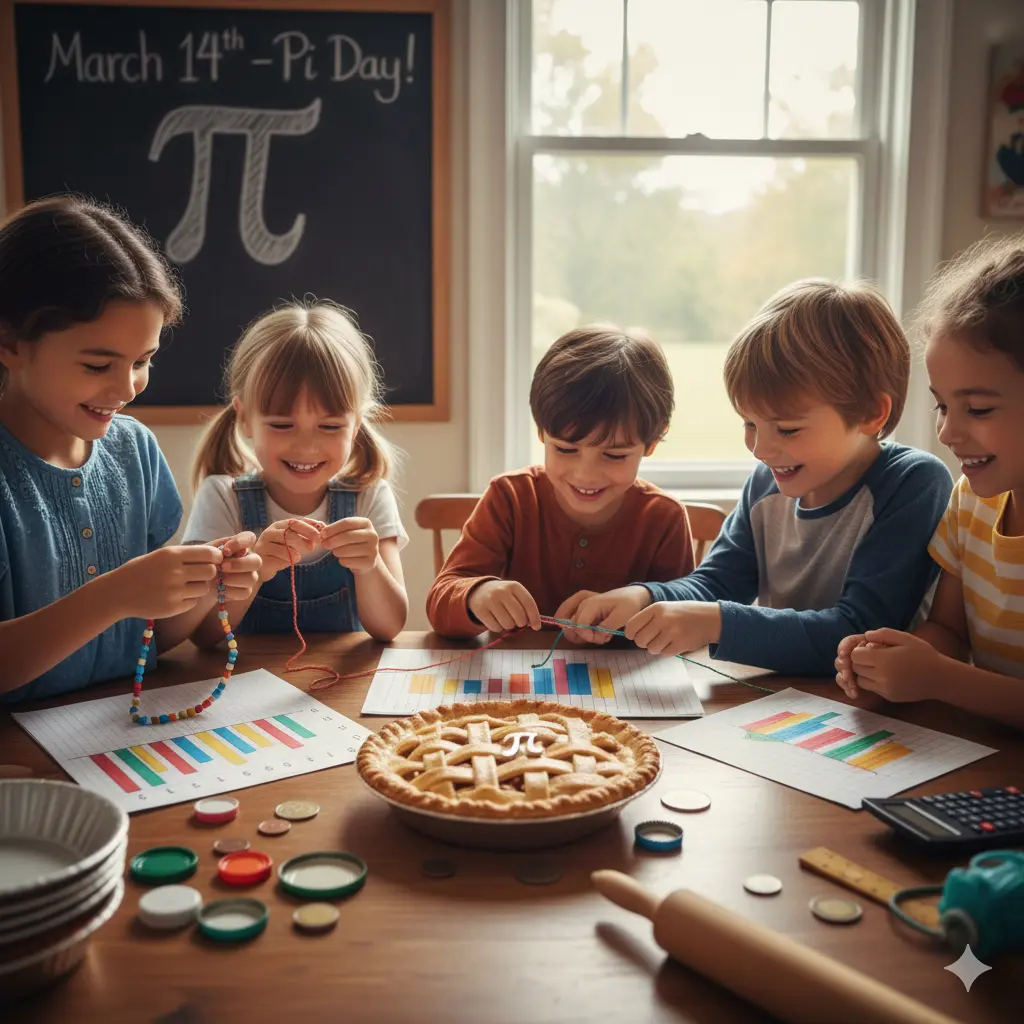
2. The “Pi Skyline” Graph Art
This is one of the most visually stunning ways to represent the digits of Pi.
- The Activity: Give kids graph paper. For each digit of Pi (3, 1, 4, 1, 5, 9…), they color in a column of squares corresponding to that number.
- The Result: A jagged “city skyline” appears! They can paint the sky behind their “Pi buildings” for a gorgeous mathematical sunset.
3. Pi Bead Necklaces or Bracelets
Turn digits into wearable art!
- The Concept: Assign a specific color bead to each digit from 0 to 9 (e.g., 1 is red, 2 is blue, 3 is yellow).
- The Task: Kids string the beads in the order of Pi’s digits.
- Learning: This serves as a great memory tool and a colorful representation of how random the digits appear.
4. Circular Object Scavenger Hunt
Pi is all about the relationship between a circle’s circumference and its diameter.
- The Hunt: Have kids find circular objects around the house or classroom (clocks, lids, plates, coins).
- The Math: Using a piece of string and a ruler, have them measure the distance around (circumference) and the distance across (diameter). When they divide the two, they’ll see it always comes out to roughly 3.14!
5. “Pie” Baking and Geometry
You can’t celebrate Pi Day without actual pie.
- The Activity: Bake a round apple or pumpkin pie. Before eating, use the opportunity to calculate the area of the pie using the formula
$$A = \pi r^2$$
. - Reward: The best part of math class is definitely getting to eat the results!
6. Pi Digit Recitation Contest
Challenge the competitive spirits in the room!
- The Task: Give kids a week to memorize as many digits of Pi as possible.
- The Prize: The winner gets a “Pi-rate” hat or the first slice of pie.
7. Pi “Sudoku” Puzzles
Create or find Sudoku-style puzzles that use the first nine digits of Pi instead of the standard 1-9. It adds a layer of thematic fun to a classic logic game.
8. Create a “Pi-em” (Pi-Poem)
Have you heard of “Pilish”? It’s a style of writing where the number of letters in each word matches the digits of Pi.
- Example: “May (3) I (1) draw (4) a (1) round (5) circle (6)…”
- The Goal: It’s a fantastic way to combine English Literature with Mathematics.
9. Geometric Bubble Wands
Can you blow a square bubble?
- The Experiment: Use pipe cleaners to make bubble wands in the shapes of circles, squares, and triangles.
- The Discovery: No matter the shape of the wand, the bubble almost always becomes a sphere. Discuss why the “circle” (or sphere) is nature’s most efficient shape.
10. Pi Day “Hidden Pictures”
Create a drawing made entirely out of small circles and Pi symbols. Challenge kids to find and count how many symbols are hidden within the artwork.
11. The “Race to Pi” Dice Game
This is a fast-paced game for two players.
- How to Play: Players roll two dice and try to add or subtract the numbers to get the digits of Pi in order.
- Example: If you need a “3” and roll a 1 and 2, you’ve got it! Now move on to “1.”
12. “March 14th” Time Capsule
Since March 14th is a specific date, have kids write down one math problem they learned this year and one thing they love about school. Hide it in a circular container to be opened next Pi Day!
13. Dot Art and Pointillism
Inspired by the “circle,” have kids create an art piece using only dots (Pointillism).
- The Twist: They can use the tip of a pencil or a Q-tip dipped in paint to create a large Pi symbol made of thousands of tiny circles.
14. NASA’s “Pi in the Sky” Challenges
For older kids or those who want a real challenge, NASA offers “Pi in the Sky” problems online. These are real-world problems that space scientists solve using Pi, such as calculating the craters on Mars or the rotation of a distant planet.
15. The Human Pi Chain
If you are in a large group or school, have each child hold a sign with one digit of Pi. Line up in the hallway to see how far the “infinite” number can stretch!
Supplies Needed for a Perfect Pi Day
| Activity | Materials Needed |
| Bead Jewelry | Colored beads, string, digit key. |
| Skyline Art | Graph paper, markers, ruler. |
| Scavenger Hunt | String, rulers, household circular objects. |
| Baking | Pie crust, filling, measuring tape. |
Why Celebrating Pi is Important for Kids
Math can often feel abstract or “dry.” Activities like these help ground mathematical concepts in reality. When a child sees that the ratio of a hula-hoop is the same as the ratio of a penny, it clicks—math is a universal language.
Furthermore, celebrating Pi Day encourages:
- Curiosity: Why doesn’t the number ever end?
- Visual Learning: Seeing the “Skyline” helps kids understand data visualization.
- Persistence: Memorizing digits or solving complex circular problems builds grit.
Pi Day is more than just a date on the calendar; it’s an opportunity to show kids that math is everywhere—in the stars, in our food, and in our art. So, this March 14th, grab a calculator and a fork, and let the celebrations begin!