
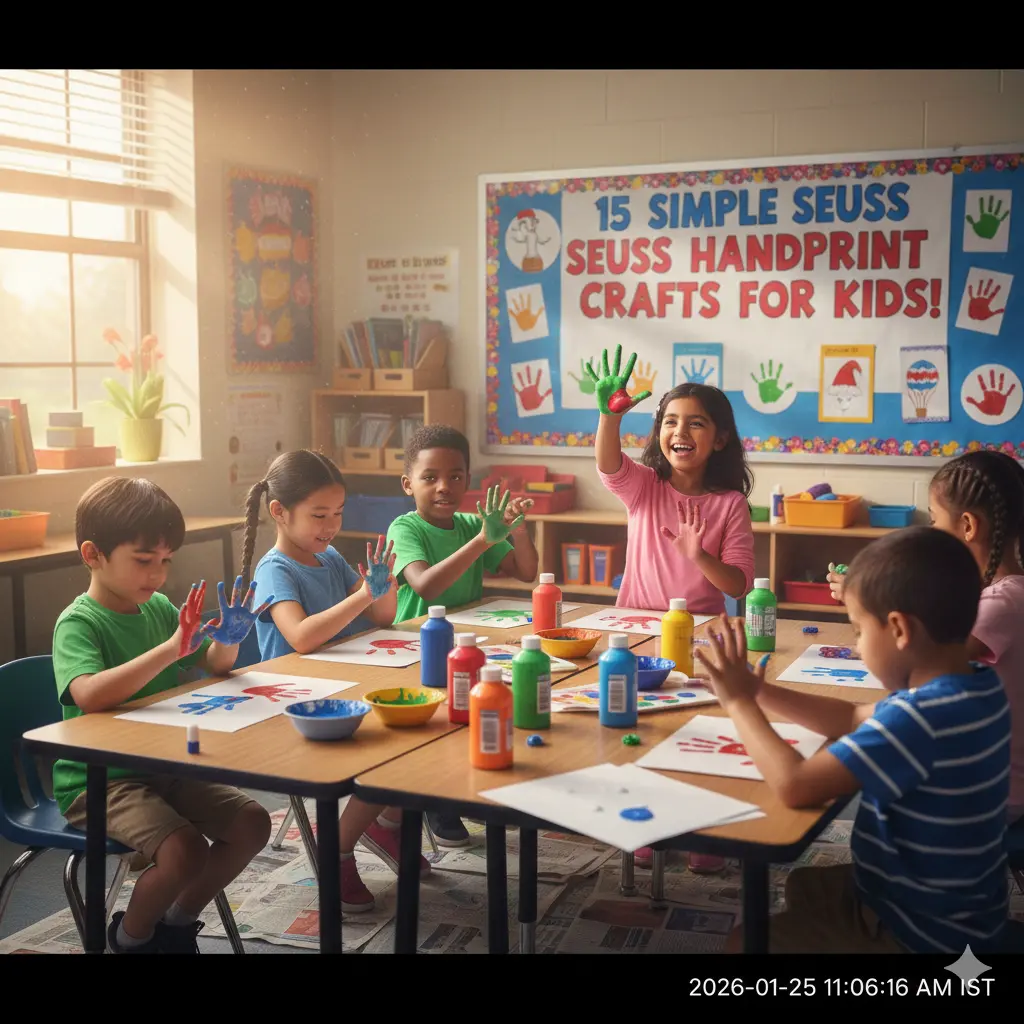
Handprint art is more than just a messy fun time—it’s a powerful educational tool. When children use their hands as stamps, they are engaging in sensory play, which is vital for brain development.
- Self-Identity: Kids love seeing their own body parts transformed into art. It builds a sense of “self” and accomplishment.
- Texture Exploration: Feeling the wet paint on their palms helps children process different tactile sensations.
- Story Retention: By creating a physical version of a character like the Grinch or Thing 1, children are more likely to remember the plot and the “moral of the story.”
Top 15 Dr. Seuss Handprint Craft Ideas
1. The Grinch Handprint (The Change of Heart)
The Grinch is a holiday staple who learns that Christmas isn’t about “packages, boxes, or bags.”
- How-to: Paint the palm and fingers bright green. Press it onto the paper with the fingers pointing downward. Once dry, draw a red “Santa hat” on the palm area and a mischievous (but soon-to-be-kind) face.
2. Thing 1 and Thing 2 (The Chaos Creators)
These two are famous for the wild blue hair and red suits.
- How-to: Paint the palm red and the fingers bright blue. When you press it down, the blue fingers become the iconic crazy hair, and the red palm becomes the suit!
3. One Fish, Two Fish, Red Fish, Blue Fish
This book is a masterclass in opposites and colors.
- How-to: Let your child choose their favorite colors. Paint the hand and press it horizontally. The thumb becomes the dorsal fin, and the fingers become the tail. Add a googly eye near the palm!
4. The Lorax (Speaker for the Trees)
The Lorax is a champion for the environment.
- How-to: Paint the hand bright orange. Press it down with fingers spread. Use yellow paint to draw a giant, bushy mustache across the palm.
5. Horton the Elephant
“A person’s a person, no matter how small!”
- How-to: Use gray paint. The thumb acts as Horton’s trunk, while the four fingers are his sturdy legs. Add a tiny pink “speck” on a clover near the trunk.
6. The Cat in the Hat’s Stripes
- How-to: Instead of the whole cat, paint the hand in alternating red and white stripes. Press it down to create a “living” version of the famous hat.
7. Green Eggs and Ham
- How-to: Paint the palm white and the fingers green. This represents the “ham.” For the “egg,” use a simple green thumbprint in the center of a white circle.
8. Fox in Socks
- How-to: Use orange paint for the hand (the fox) and blue paint for the tips of the fingers (the socks!). It’s a great way to practice color coordination.
9. The Sneetches (Star-Belly)
- How-to: Paint the hand yellow. Once dry, use a green marker to draw a single star in the middle of the palm.
10. Hop on Pop
- How-to: Create two handprints side-by-side—a large one (Pop) and a small one (the child) “hopping” on top.
11. Thidwick the Big-Hearted Moose
- How-to: Use a brown handprint where the fingers represent Thidwick’s massive, crowded antlers.
12. There’s a Wocket in My Pocket!
- How-to: Draw a “pocket” on a piece of paper and have a colorful handprint “peeking” out from inside it.
13. Oh, The Places You’ll Go! (Hot Air Balloon)
- How-to: Paint the hand in multiple colors. Press it upside down to serve as the balloon, and draw a small basket underneath.
14. Yertle the Turtle
- How-to: Stack green handprints on top of each other to show the tower of turtles reaching for the sky.
15. Mr. Brown Can Moo! Can You?
- How-to: Make a brown handprint cow. This is a great time to practice all the “noises” Mr. Brown can make!
Lessons from the Whimsical World of Seuss
While you are painting and stamping, it’s the perfect time to talk about the deeper meanings behind these stories. Dr. Seuss was a master of the “hidden lesson.”
| Character | The “Big Idea” |
| The Grinch | Kindness and community matter more than material things. |
| The Lorax | We have a responsibility to protect our planet. |
| Horton | Every life has value, regardless of size or status. |
| The Sneetches | Our differences shouldn’t divide us; we are all equal. |
Tips for a Mess-Free (or Mess-Minimized) Craft Session
Let’s be honest: paint and toddlers can be a “Thing 1 and Thing 2” level of chaos. Here is how to keep it under control:
- Wet Wipes are Key: Keep a pack of baby wipes or a damp cloth immediately next to the crafting station.
- The “Stamping Station”: Have one adult apply the paint with a brush while the child keeps their hand still. This prevents “splatter.”
- Washable is Non-Negotiable: Ensure you are using high-quality, non-toxic, washable tempera paint.
- Paper Weight: Use cardstock rather than thin printer paper. The moisture from the handprint can cause thin paper to curl or tear.
Encouraging a Lifetime of Reading
The goal of National Read Across America Day is to show kids that reading isn’t a chore—it’s an adventure. By creating these handprint characters, you are giving children a “buddy” to hold while they listen to the story.
After the paint dries, try these activities:
- The Character Voice Challenge: Read a page of the book and have the child move their handprint craft whenever that character speaks.
- The Rhyme Game: Look at the craft (e.g., the Cat) and see how many words the child can find that rhyme with it (Sat, Mat, Bat, Fat).
- Seuss Gallery: Hang all 15 crafts along a ribbon in your hallway to create a “Seuss Lane” for the month of March.
Conclusion
Dr. Seuss once said, “You can find magic wherever you look. Sit back and relax, all you need is a book.” By adding a splash of paint and a little imagination, you can make that magic tangible. These 15 Seuss Handprint Crafts are more than just art; they are memories in the making and a celebration of a man who taught the world that “it is fun to have fun, but you have to know how!”