
How would you feel if you were asked to sit in the back of the bus, stand in a separate line, or wait for everyone else—all because your skin was a certain color? You would likely feel that it was unfair, unjust, and hurtful. You would probably want to speak out.
In a nutshell, that is exactly what Rev. Martin Luther King Jr. did. However, because of the era he lived in and the laws of the time, speaking out wasn’t just “complaining”—it was a brave, heroic, and dangerous act. His courage changed the lives of millions of people in America and across the globe.
As we approach Martin Luther King Jr. Day (celebrated on the third Monday of January, which falls on January 20th this year), parents and teachers have a unique opportunity. It is a time to move beyond just a day off from school and turn it into a “day on” for learning, growing, and serving.
Who Was Martin Luther King Jr.?
Before diving into the crafts and activities, it is essential to set the stage. Martin Luther King Jr., often referred to as MLK, was an American minister and the most visible spokesperson for the Civil Rights Movement.
He was a champion of non-violence. Inspired by his Christian faith and the teachings of Mahatma Gandhi, MLK believed that love and peaceful protest were more powerful than hate and violence. Because of his tireless work, discriminatory laws were overturned, and the Civil Rights Act was passed. In 1964, he became the youngest man to receive the Nobel Peace Prize.
Why Start the Conversation Early?
You might think your children are too young to talk about race or civil rights, but science suggests otherwise. According to the American Academy of Pediatrics, children as young as 2 years old can internalize racial bias and notice differences in skin color. By age 4, many children have begun to categorize people by race.
This makes early conversations vital. We must teach children that while it is beautiful to have different skin tones, a person’s skin color in no way dictates their goodness, talent, ability, or intelligence. We need to teach them that everyone is exactly the same on the inside.
Here are 15 inspiring MLK Jr. Day activities for kids to help us remember the great man, the dream he shared, and the lessons he taught us.
1. The “Brown Egg vs. White Egg” Experiment
This is perhaps the most classic and effective object lesson for younger children to understand racial equality.
- The Activity: Present your child with two eggs—one with a brown shell and one with a white shell. Ask them to describe the differences they see on the outside. Then, crack both eggs into a clear bowl.
- The Lesson: Ask the child if they can tell which yolk came from which egg. They won’t be able to! Explain that just like eggs, people might look different on the outside, but on the inside, we are all the same. We all have feelings, hearts, and value.
2. The “I Have a Dream” Cloud Mobile
MLK’s “I Have a Dream” speech is one of the most famous speeches in history.
- The Activity: Cut out fluffy cloud shapes from white construction paper. Have your children write (or draw) their own dreams for a better world on the clouds. Examples might include “Everyone is friends,” “No more hungry people,” or “Everyone shares.”
- The Lesson: String these clouds together with yarn to create a mobile. Hang it up to remind the family that big changes start with a single dream.
3. The M&M Diversity Lesson
If the egg experiment is too messy, try this tasty alternative.
- The Activity: Pour a bowl of M&Ms. Ask the kids to sort them by color. Ask, “Which color tastes the best?”
- The Lesson: Have them close their eyes and eat a few different colors. They will realize that despite the different candy shells, the chocolate inside is exactly the same. It’s a sweet way to reinforce that external appearance doesn’t change internal nature.
4. The “Content of Character” Mirror
Dr. King famously said he wanted his children to be judged not by the color of their skin, but by the “content of their character.”
- The Activity: Take a small mirror or a sheet of aluminum foil. Glue it to the center of a piece of paper. Have the child look in the mirror and write words around it that describe their character (e.g., kind, brave, funny, helpful, honest).
- The Lesson: This teaches children to value internal traits over physical appearance in themselves and others.
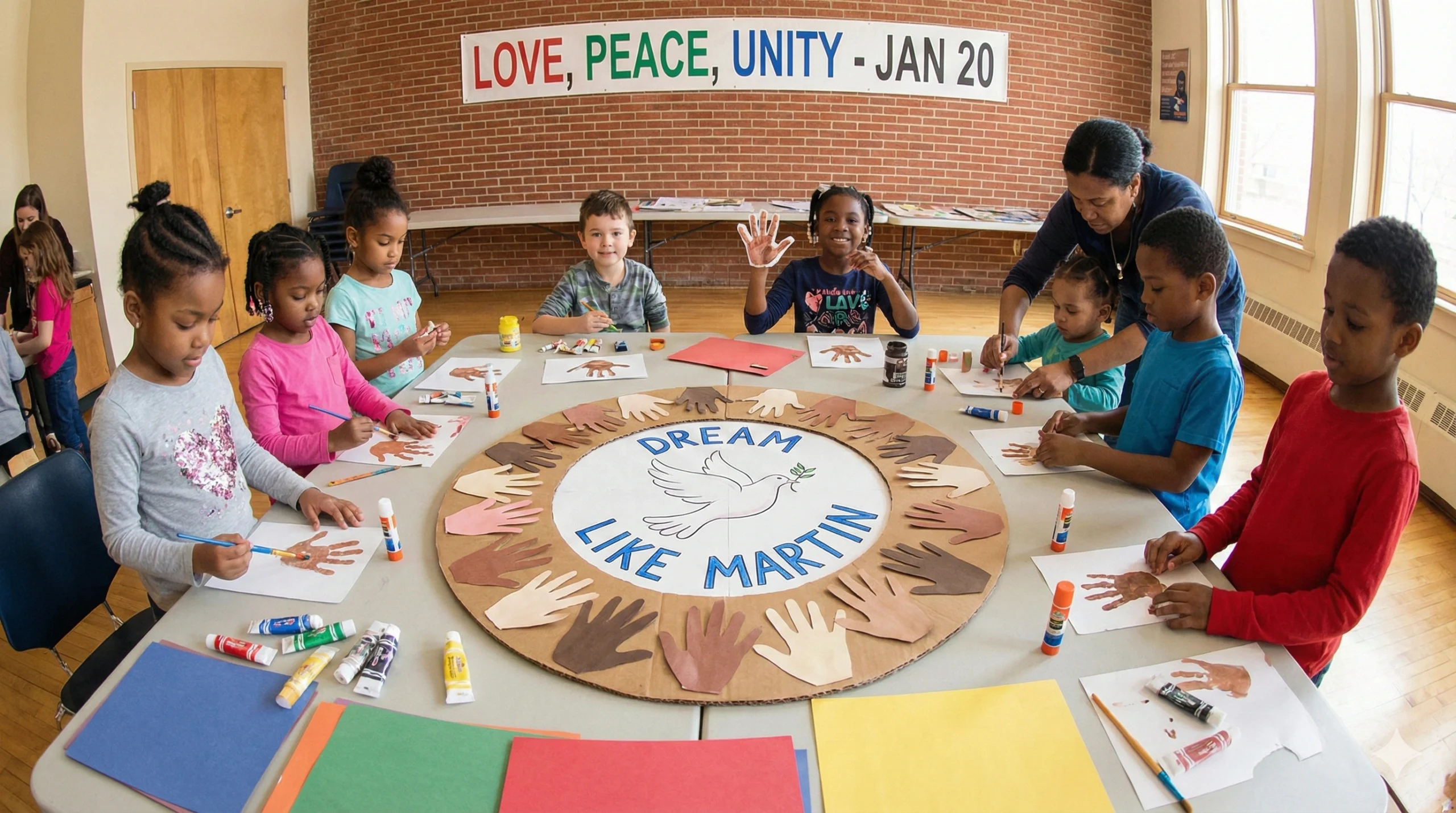
5. Multi-Colored Handprint Wreath
- The Activity: Use skin-tone paints (shades of beige, brown, tan, black, and white) or construction paper. Trace and cut out several of your child’s handprints in different colors. Arrange them in a circle to form a wreath.
- The Lesson: This wreath represents unity. It shows that when different hands come together, they can create something beautiful and complete.
6. Peace Dove Paper Plates
The dove is a universal symbol of peace and non-violence, the core tenets of MLK’s philosophy.
- The Activity: Take a paper plate and cut out a wedge to make the tail. Use the wedge to make the wing. Glue it on, add an eye and a beak. Let the kids write the word “PEACE” on the wing.
- The Lesson: Discuss what “peace” means in a home or a playground. It means solving problems with words, not fists.
7. A “Day of Service” Project
MLK Day is the only federal holiday designated as a National Day of Service. The motto is “Make it a day on, not a day off.”
- The Activity: Choose a simple service project. It could be baking cookies for a neighbor, cleaning up litter in a local park, or gathering old toys to donate.
- The Lesson: Dr. King said, “Life’s most persistent and urgent question is, ‘What are you doing for others?'” This moves the holiday from passive learning to active doing.
8. The Unity Chain
- The Activity: Cut strips of construction paper in red, yellow, black, white, and brown. On each strip, write a word related to MLK (Love, Peace, Justice, Dream, Equality). Link the strips together to form a paper chain.
- The Lesson: Demonstrate how easy it is to tear a single strip of paper, but how much harder it is to break the chain when they are linked together. We are stronger when we are united.
9. Reading Corner: “The Crayon Box That Talked”
While not strictly about MLK, this poem/book is perfect for this day.
- The Activity: Read the story about a box of crayons that didn’t get along until a little girl used them all to make a picture.
- The Lesson: If the picture were only one color, it would be boring. We need every color to make the “picture” of our world complete and beautiful.
10. Listen to the Speech (Snippets)
- The Activity: While the full speech might be too long for toddlers, play the audio of the “I Have a Dream” segment for older kids.
- The Lesson: Hearing Dr. King’s actual voice—the cadence, the passion, and the rhythm—is a powerful auditory history lesson. Ask your kids how his voice makes them feel (Excited? Hopeful? Strong?).
11. “Let Freedom Ring” Bell Craft
Dr. King ended his famous speech by crying out, “Let freedom ring!”
- The Activity: Use plastic cups, styrofoam cups, or even clean yogurt pots. Decorate them with stickers and markers. Punch a hole in the bottom, thread a string with a bead on the end (to act as the clapper), and tie it off.
- The Lesson: Have a “freedom parade” around the living room, ringing the bells. Explain that freedom means being free to live your life and chase your dreams without unfair rules stopping you.
12. Freedom Bus Art
To honor the Montgomery Bus Boycott and Rosa Parks (whom MLK supported).
- The Activity: Draw a large yellow bus or make one out of a cardboard box. Cut out pictures of people from magazines—people of all different backgrounds—and glue them in the windows of the bus.
- The Lesson: Remind the children that once upon a time, the rules were unfair about where people could sit. Celebrating MLK means celebrating that today, we can all sit together.
13. Friendship Bracelets
- The Activity: Use different colored threads or beads to create simple friendship bracelets.
- The Lesson: As you weave the threads together, talk about how your child can be a good friend to everyone, especially someone who might look different or feel left out at school.
14. Virtual Civil Rights Tour
Technology allows us to travel without leaving home.
- The Activity: Look up the National Civil Rights Museum or the Martin Luther King, Jr. National Historical Park online. Many offer virtual tours or photo galleries.
- The Lesson: Seeing real photos of the era helps ground the stories in reality. It shows that Dr. King was a real person, not just a character in a book.
15. Write a Letter to “Future Me”
- The Activity: Have your child write a letter (or dictate it to you) to themselves for next year. Ask them to write down one way they promise to be kind or brave this year.
- The Lesson: Dr. King’s work isn’t finished. It continues through us. This encourages personal accountability and goal setting.
Final Thoughts: Keeping the Dream Alive
Martin Luther King Jr. Day is more than a history lesson; it is a lesson in humanity. By engaging in these crafts and activities, we are not just keeping little hands busy; we are molding little hearts.When we teach our children to appreciate diversity, to stand up against unfairness, and to dream of a better world, we are ensuring that the legacy of MLK lives on. As Dr. King famously said, “Darkness cannot drive out darkness; only light can do that. Hate cannot drive out hate; only love can do that.”