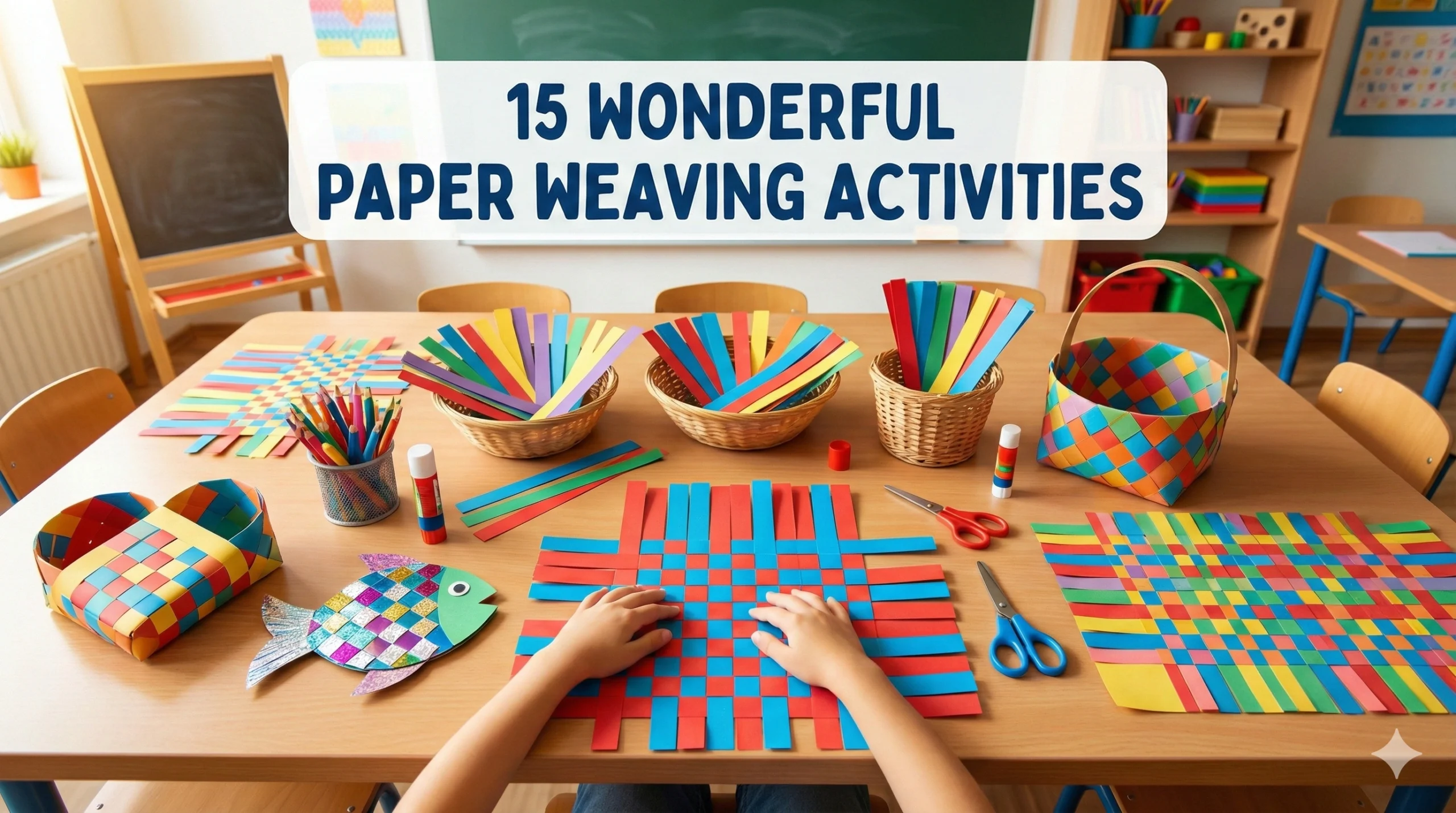
There are some crafts that nearly every school child has tried out at least once in their life. You know exactly what I’m talking about—making long paper chains for parties, folding paper boats for rain puddles, and the classic art of weaving paper strips into colorful placemats.
Little did we know back then that these simple classroom activities actually have a rich history behind them! For instance, while paper folding connects to Origami (the Japanese art form), paper weaving has roots in folk art across the globe, including distinct traditions in China’s Fujian Province. We were getting our first taste of international culture and complex geometry, and we didn’t even realize it!
Today, paper weaving remains one of the best low-cost, high-reward activities for children. It is accessible, requires minimal supplies, and offers massive developmental benefits.
If you are a parent, teacher, or caregiver looking for screen-free entertainment, you have come to the right place. Below, we explore the benefits of weaving and present 15 wonderful paper weaving activities for kids that range from beginner basics to advanced 3D art.
The Surprising Benefits of Paper Weaving for Kids
Before we dive into the projects, it is important to understand why this craft is so highly recommended by occupational therapists and early childhood educators. It isn’t just about making something pretty; it is a workout for the brain and hands.
1. Fine Motor Skill Development
Weaving strips of paper involves a specific “pincer grasp” and requires the coordination of both hands working together (bilateral coordination). Creating the “over and under” pattern forces young kids to manipulate small objects with precision, strengthening the muscles they will later use for writing and tying shoelaces.
2. Pattern Recognition and Math
Weaving is essentially math in motion. Kids learn about AB patterns (over, under, over, under). As they get more advanced, they can try AABB patterns (over two, under two). This lays a foundational understanding of geometry, grid systems, and spatial awareness.
3. Focus and Patience
Unlike digital games that offer instant gratification, weaving is a slow, rhythmic process. It teaches children the value of patience. If they miss a step or skip a strip, they have to problem-solve, backtrack, and fix it. This resilience is a vital life skill.
Getting Started: The Essential Toolkit
The beauty of paper weaving is its simplicity. You don’t need expensive equipment. Here is your starter kit:
Paper: Construction paper is the standard, but cardstock, scrapbooking paper, magazine pages, and even old newspapers work wonders.
Scissors: Safety scissors for younger kids, precision scissors for older ones.
Ruler & Pencil: Essential for drawing straight guide lines.
Glue Stick or Tape: To secure the ends of the “weft” strips so they don’t slide out.
X-Acto Knife (Adults Only): Useful for cutting the internal slits in the base paper.
15 Wonderful Paper Weaving Activities for Kids
The ideal age to begin paper weaving activities is around four years old, but with help, even toddlers can enjoy the sensory experience of pulling paper. For older kids, the limit does not exist—the patterns can become incredibly complex!
Here are 15 projects to spark your imagination.
1. The Classic Paper Placemat
This is the “Introduction to Weaving 101.”
How to do it: Fold a large sheet of construction paper in half. Cut slits from the fold toward the edge, leaving about an inch uncut at the end. Unfold it to create your “loom.” Cut separate strips of colored paper and weave them over and under.
Why it’s great: It’s the perfect first project to teach the mechanics of the process. Laminate them to use as actual placemats!
2. Scandinavian Woven Hearts
A traditional Danish Christmas craft, these look complicated but are quite simple once you get the hang of it.
The Project: You weave two folded pieces of paper together to form a heart-shaped basket (often used to hold candy).
Skill Level: Intermediate. It requires weaving inside the strips rather than just over and under.
3. Tropical Woven Fish
Bring the ocean to your living room.
The Project: Cut a simple fish shape out of cardstock. Cut vertical slits in the belly of the fish. Weave colorful, thin strips through the belly.
Twist: Use metallic or glitter paper for the weaving strips to make the fish look like it has shimmering scales.
4. Mondrian-Inspired Checkerboard Art
Teach art history and crafting simultaneously. Piet Mondrian was famous for his grid-based paintings using primary colors.
The Project: Use black paper for the base loom and weave strips of bright red, yellow, blue, and white. The high contrast looks like a modern art masterpiece suitable for framing.
5. 3D Paper Weaving Baskets
Moving from 2D to 3D!
The Project: This involves weaving a base mat (like the placemat) and then folding up the edges and continuing to weave around the sides.
Tip: Use heavier cardstock for this, as regular paper might be too floppy to hold the basket shape.
6. Woven Paper Bookmarks
A practical craft that encourages reading.
The Project: Cut the “loom” small and long. Weave intricate ribbons or thin paper strips through it.
Finish: Punch a hole at the top and add a yarn tassel. These make excellent handmade gifts for teachers or grandparents.
7. The Woven Turtle Shell
Turtles are perfect for this craft because their shells naturally look like a woven grid.
The Project: Cut out a green turtle silhouette (head, legs, tail). Cut a separate oval for the shell, cut slits in it, and weave brown and dark green strips through it. Paste the woven shell onto the turtle’s body.
8. Recycled Newspaper Weaving
Teach sustainability alongside creativity.
The Project: Paint old newspaper sheets in bright watercolors. Once dry, cut them into strips. The text texture combined with the paint creates a beautiful, rustic “shabby chic” look when woven.
9. Woven Sun and Moon (Circular Weaving)
Who says weaving has to be square?
The Project: Cut a paper plate or a round piece of cardstock. Cut slits radiating from the center (like a pizza) but stop before the edge. Weave strips in and out in a circle.
Result: This creates a beautiful sunburst effect.
10. Pixel Art Weaving
For the older kids who love video games (Minecraft fans, this is for you!).
The Project: By using very thin strips and specific colors, kids can plan out a “pixelated” image. It requires graph paper planning beforehand to know which color strip goes where to form a picture like a heart, a smiley face, or a creeper.
11. Japanese Woven Fans (Uchiwa)
The Project: Create a tight weave using stiff cardstock. Once the weaving is done, cut the woven sheet into a rounded paddle shape and tape it to a large popsicle stick or dowel.
Utility: These actually work to cool you down on a hot day!
12. Rainbow Cloud Weaving
A whimsical decoration for a child’s bedroom.
The Project: Cut a cloud shape. Instead of weaving the whole thing, cut slits only at the bottom edge. Weave strips of rainbow-colored paper hanging down to look like colorful rain or light beams.
13. Woven Christmas Tree Cards
The Project: Cut a triangle out of the front of a green greeting card. On the inside of the card, tape a pre-woven square of colorful paper. When you close the card, the woven pattern shows through the triangular hole, looking like a decorated tree.
14. Chevron Pattern Weaving
Take the difficulty up a notch.
The Project: Instead of cutting straight strips, cut the weaving strips with a jagged “zig-zag” edge. When woven, this creates a cool chevron or lightning bolt effect rather than squares.
15. The “Friendship Bracelet” Paper Weave
The Project: Use very long, thin strips of durable paper. Fold and weave them using techniques similar to lanyard making or macrame.
Result: A flexible paper chain that can be worn as a bracelet.
Tips for a Frustration-Free Weaving Session
While weaving is fun, it can be tricky for little fingers. Here are some pro-tips to ensure success:
The Tape Trick: Tape the top of the “warp” (the vertical strips) to the table. This stops the paper from sliding around while the child tries to weave the “weft” (horizontal strips).
Use Contrasting Colors: If a child is learning, don’t use blue strips on a blue background. Using high-contrast colors (like black and white) makes it much easier for them to see the pattern they are creating.
Wider is Better: For preschoolers, cut the strips at least 1 inch wide. Thin strips are too fiddly for developing motor skills.
The “Slider”: If the paper strips are getting stuck, tape the leading end of the strip to a popsicle stick. The stick acts like a needle, helping guide the paper through the slits smoothly.
Conclusion
Paper weaving is the perfect blend of art, history, and geometry. It connects us to ancient traditions while providing a modern outlet for creativity. Whether you are making a simple placemat on a rainy afternoon or constructing complex 3D baskets, these 15 wonderful paper weaving activities prove that you don’t need expensive gadgets to create something amazing.
So, grab your scissors, raid your recycling bin for colorful paper, and start weaving today. You will be amazed at what your children can create with just a simple “over, under, over, under” rhythm!