
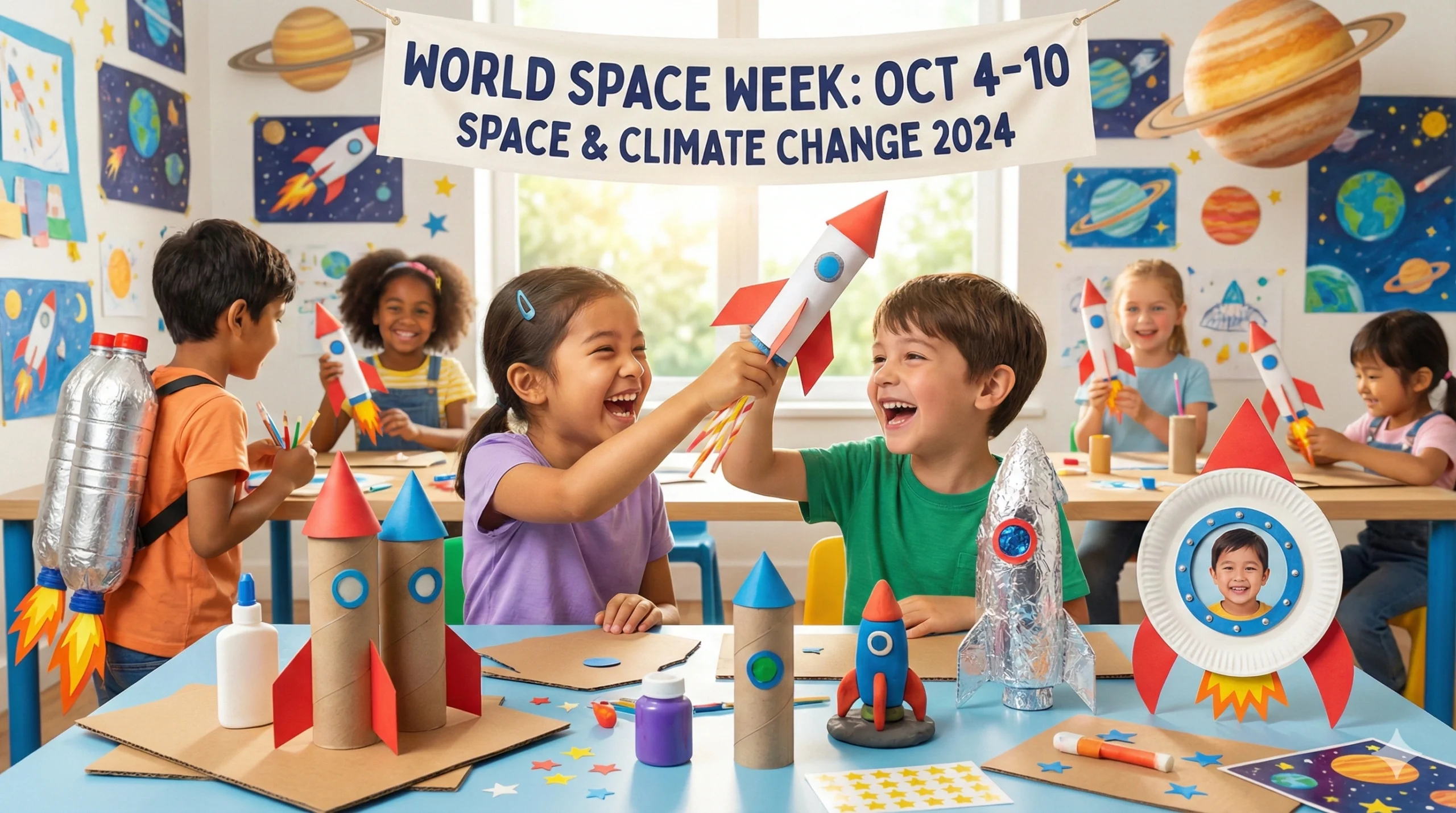
Kickstart World Space Week with some fun rocket crafts for kids! Whatever your child’s age, you’re sure to find something suitable here.
We are super excited because World Space Week is finally here! There is something universally fascinating about outer space. The twinkling stars, the mystery of black holes, and the sheer power of the machines that take us there captivate children and adults alike.
This week offers the perfect opportunity to put your “geek hat” on, gather your craft supplies, and celebrate everything related to the cosmos. Whether you are a teacher looking for classroom activities, a parent wanting to reduce screen time, or a homeschooler focusing on a STEM unit, this guide to 20 remarkable rocket crafts is your launchpad to creativity.
What is World Space Week?
Before we dive into the glue and glitter, let’s understand the significance of this celebration. It adds a layer of educational value to your crafting session!
World Space Week is a week-long, international celebration of space technology and its contributions to the improvement of the human condition. It was officially declared in 1999 by the United Nations General Assembly.
Here are a few quick facts to share with your little astronauts:
- The Dates: It is celebrated every year from October 4th to October 10th.
- The History: October 4th commemorates the launch of Sputnik 1 in 1957, the first human-made satellite. October 10th marks the signing of the Treaty on Principles Governing the Activities of States in the Exploration and Peaceful Uses of Outer Space in 1967.
- The Organizers: The United Nations and the World Space Week Association (WSWA) coordinate global events.
- 2024 Theme: The theme for 2024 is ‘Space & Climate Change’. This focuses on how space technology (like satellites launched by rockets!) helps us monitor and fight climate change on Earth.
A Tiny Lesson in Rocket Science
You often hear people say, “It’s not rocket science,” implying something is difficult. But the truth is, the basic principle behind rockets is actually quite simple!
It is based on Newton’s Third Law of Motion: “For every action, there is an equal and opposite reaction.”
Explain it to your kids like this: When a rocket pushes gas down at high speed (Action), that force pushes the rocket up (Reaction). Think of it like a balloon. If you blow up a balloon and let it go without tying it, the air rushes out the back, and the balloon zooms forward. That is exactly how a rocket works!
Now that our brains are fueled up, let’s fuel our imagination with these 20 amazing crafts.
Category 1: Paper & Cardboard Creations (Low Prep)
These crafts use materials you likely already have in your recycling bin. They are perfect for younger children and quick afternoon activities.
1. The Classic Toilet Roll Rocket
Don’t throw away those cardboard tubes!
- How to do it: Paint the tube your favorite color. Cut a circle out of cardstock, cut a slit to the center, and fold it into a cone for the nose. Glue triangles to the bottom for fins.
- Why it’s great: It encourages upcycling and imaginative play.
2. Paper Quilling Rocket
As mentioned in our introduction, paper quilling is a beautiful art form.
- How to do it: Use strips of colored paper. Roll them into tight coils and pinch them to form shapes (squares for the body, triangles for the fins). Glue them onto a black sheet of paper to create a 2D rocket scene.
- Skill Check: Excellent for developing fine motor skills and patience.
3. Geometric Shape Rocket
A perfect mix of math and art for preschoolers.
- How to do it: Pre-cut rectangles, triangles, and circles from colored construction paper. Ask your child to assemble a rocket using these shapes.
- Lesson: Helps toddlers identify shapes while building.
4. Paper Plate Porthole Rocket
- How to do it: Cut a porthole (circle) in the center of a paper plate. Stick a photo of your child behind it so it looks like they are the astronaut. Decorate the plate to look like the side of a spaceship.
5. Cardboard Tube Space Shuttle
Take the toilet roll craft to the next level.
- How to do it: Instead of a single tube, tape two smaller tubes (boosters) to the sides of a larger central tube. Paint it white and add the orange fuel tank detail often seen on space shuttles.
Category 2: STEM & Flying Rockets (Interactive)
These crafts don’t just sit on a shelf—they actually fly! These are perfect for demonstrating Newton’s Third Law.
6. The Straw Rocket
- Supplies: A drinking straw, paper, tape.
- How to do it: Make a small paper rocket that acts as a “cap” over one end of the straw. It must be loose enough to slide but tight enough to capture air.
- Action: Blow hard into the straw and watch the paper rocket shoot off!
7. Balloon Powered Rocket
This is a classic science experiment.
- Supplies: Balloon, string, straw, tape.
- How to do it: Thread a string through a straw and tie the string across the room (taut). Tape a blown-up balloon (untyed, held closed by fingers) to the straw. Let go!
- Science: The air escaping the balloon pushes the straw along the string.
8. Squeeze Bottle Rocket
- Supplies: Empty dish soap bottle (rinsed), a straw, paper rocket.
- How to do it: Place your paper rocket (from craft #6) over the nozzle of the empty bottle. Slam your hands together on the bottle. The burst of air launches the rocket.
9. Alka-Seltzer Canister Rocket
Note: Adult supervision required.
- How to do it: Use an old film canister (or mini M&M tube). Fill it 1/4 with water, drop in half an antacid tablet, snap the lid on quickly, and place it lid-down on the pavement. Stand back!
- The reaction: The gas builds pressure until—POP!—it launches.
10. The DIY Stomp Rocket
- How to do it: Connect an empty 2-liter soda bottle to a length of PVC pipe or old hose. Place a paper rocket on the open end of the pipe. Jump on the bottle to force air through the tube and launch the rocket.
Category 3: Wearable & Role-Play Crafts
Let your child become the astronaut with these immersive ideas.
11. Recycled Bottle Jet Pack
- Supplies: Two 2-liter soda bottles, silver spray paint, red/orange tissue paper, webbing or ribbon.
- How to do it: Spray the bottles silver. Glue them side-by-side onto a square of cardboard. Glue the tissue paper into the nozzle to look like fire. Attach straps so your child can wear it like a backpack.
12. Paper Mache Astronaut Helmet
- How to do it: Inflate a large balloon. Cover it in paper mache layers. Once dry, pop the balloon and cut out a hole for the face and the neck. Paint it white and add logos.
13. Rocket Control Panel
- How to do it: Use a large cardboard box. Paint it and glue on bottle caps, old switches, dials drawn on paper, and buttons. Let your child sit inside and “pilot” the ship.
14. Felt Rocket Board
- How to do it: Cover a piece of cardboard with black felt (space). Cut rocket parts out of colored felt. Felt sticks to felt, so kids can build and rebuild their rockets endlessly.
15. Rocket Name Puzzle
- How to do it: Cut out a rocket shape. Cut it horizontally into strips. On each strip, write one letter of your child’s name. They have to stack the strips in order to spell their name and build the ship.
Category 4: Artistic & Sensory Projects
For the kids who love textures, colors, and getting a little messy.
16. Clay Model Rockets
As mentioned in the introduction, rockets have specific parts: the nose cone, the body tube, the fins, and the engine.
- Activity: Provide different colors of modeling clay or playdough. Ask your child to build a 3D rocket. This is great for teaching the anatomy of a spacecraft.
17. Footprint Rocket Keepsake
- How to do it: Paint your child’s foot red or blue and stamp it onto black paper. Flip the paper so the heel is at the top. The heel becomes the nose cone, and the toes are the thrusters. Paint flames coming out of the toes!
18. Foil & Sticker Shiny Rocket
- How to do it: Cut a rocket shape out of cardboard. Give your child aluminum foil to wrap it (great for sensory play). Let them decorate the shiny silver surface with star stickers and gems.
19. Galaxy Rock Painting
- How to do it: Find long, smooth rocks. Paint them black or dark blue. Sponge on some purple and pink. Use a toothbrush to splatter white paint (stars). Draw a simple rocket silhouette on top.
20. Flying Cup Rocket
- How to do it: Take two paper cups. Cut a slit in the rim of one. Use a rubber band to create a launcher. Decorate the top cup like a rocket. Push it down onto the bottom cup (loading the rubber band) and let it pop up!
Why Crafts are Important for Space Education
You might wonder, why spend time cutting and pasting when you could just watch a documentary?
- Retention: Children learn best when they are active. Building a rocket helps them remember the parts better than just looking at a diagram.
- Fine Motor Skills: Cutting, gluing, rolling paper, and pinching clay all strengthen the hand muscles necessary for writing.
- Sparking Curiosity: A simple craft can lead to big questions. “How does it fly?” “Where does it go?” “What is the moon made of?” This curiosity is the foundation of all future scientists.
Conclusion
Space is a vast, limitless frontier, and so is a child’s imagination. By engaging in these 20 remarkable rocket crafts, you aren’t just making a mess with paper and glue; you are planting the seeds of curiosity about our universe.
Whether you build a simple toilet roll rocket or a high-flying balloon launcher, you are celebrating the spirit of World Space Week. Remember the theme for 2024 is Space & Climate Change, so as you craft, talk to your kids about how looking down from space helps us take better care of our beautiful Earth.
So, 3… 2… 1… Blast off into creativity!
Frequently Asked Questions (FAQs)
Q: Are these crafts suitable for toddlers? A: Yes! Specifically, the Geometric Shape Rocket and Footprint Rocket are designed for toddlers. Always supervise young children, especially with small parts like googly eyes or bottle caps.
Q: Where can I find materials for these crafts? A: Most of these crafts use upcycled materials found around the house (toilet rolls, bottles, cardboard). For specific items like quilling paper or modeling clay, any local stationery or dollar store will have them.