
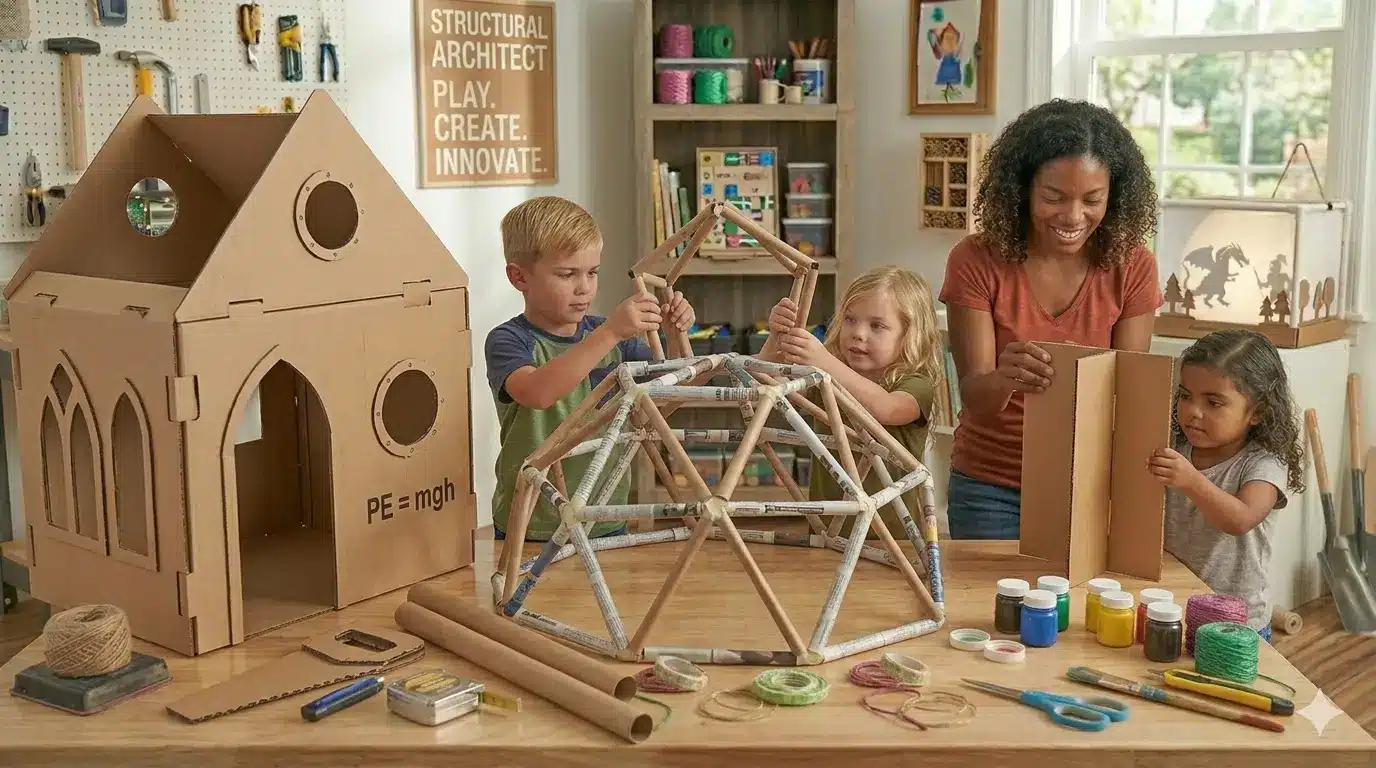
We have harnessed water, gravity, and light; now, we turn to the science of Large-Scale Structures. Building a DIY fort is a childhood rite of passage, but moving from a simple “blanket over a chair” to a engineered Geodesic Dome or a Truss-Frame Hideout is a masterclass in compression, tension, and geometry.
Working on a large scale teaches a child that the strength of a structure isn’t just in the material, but in the shape. This article provides the blueprints for lightweight, high-strength structures that can be built from common workshop “scraps.”
1. Project: The Newspaper Geodesic Dome
Target Skills: Triangulation, structural load, and assembly logic.
A geodesic dome is one of the strongest structures known to man. It is made entirely of triangles, which are the only polygons that are inherently rigid.
Materials You’ll Need:
- The Struts: Old newspapers or large sheets of heavy brown paper.
- The Connectors: Heavy-duty masking tape or a stapler.
- The Template: A measuring tape and a pencil.
The Build:
- The Paper Logs: Roll 35 sheets of newspaper into tight tubes. To make a stable dome, you need two specific lengths: 35 “A” tubes and 30 “B” tubes.
- Note: The ratio between the lengths is approximately 1 to 0.88.
- The Assembly: Connect the tubes into pentagons and hexagons.
- The Physics: Explain that triangles distribute stress evenly across the entire structure. While a single paper tube is weak, 65 tubes working in a dome can support the weight of a heavy blanket.
2. Project: The “Post-and-Beam” PVC Fort
Target Skills: Orthogonal geometry, joint stability, and modularity.
This project uses the plumbing skills from our Fluid Engineer article but applies them to “dry” structural framing.
Materials You’ll Need:
- The Frame: 1/2-inch PVC pipe (cut into 2ft and 3ft sections).
- The Joints: PVC “3-way” and “4-way” corner connectors.
- The Skin: Old bedsheets or a discarded parachute.
The Build:
- The Foundation: Build a rectangular base. This is where the Center of Gravity lives.
- The Truss: Instead of a flat roof, build a “triangle” top. This prevents the “skin” (blanket) from sagging in the middle.
- The Modularity: Because the pipes aren’t glued, the child can “re-configure” the fort from a castle into a tunnel or a space station.
3. Project: The Cardboard “Slot-and-Tab” Playhouse
Target Skills: Slot-fitting mechanics, friction, and surface area.
Slot-and-tab construction is the “no-tape” way to build. It relies on the thickness of the material to create a friction-locked joint.
Materials You’ll Need:
- The Panels: Large refrigerator boxes or appliance shipping containers.
- The Tool: A utility knife (adult use) or a cardboard “safety saw.”
The Build:
- The Slots: Cut a slot halfway through one piece of cardboard and a matching slot halfway through another.
- The Lock: Slide the two slots into each other. This creates a “cross-joint” that is incredibly stable.
- The Architecture: Cut out “Gothic” arches or “Porthole” windows. Explain that rounding the corners of a window prevents Stress Concentrations that can cause cardboard to tear.
4. The “Structural” Audit: Integrity and Safety
When building things a child can crawl inside, quality control is a safety requirement:
- The “Shake” Test: Once the frame is built, give it a firm shake. If it wobbles, it needs a Diagonal Brace. A diagonal brace turns a shaky rectangle into two rigid triangles.
- Head Clearance: Ensure there are no protruding screws or sharp PVC edges inside the structure.
- Ventilation: Large forts can get hot quickly. Ensure every DIY hideout has at least two “cross-ventilation” points to keep the interior fresh.
5. The Psychology of the “Secret Space”
Why do children love forts? It’s about Agency. In a world designed for adults, a DIY fort is a space where the child is the architect and the ruler.
- Independence: Designing the layout teaches them to think about how they use space.
- Focus: Many children find that the enclosed, quiet nature of a fort is the best place to work on their TCG Card Game (from image_16.png) or read a book.
- Collaboration: Building a dome requires “holding” and “taping”—the perfect two-person job for a parent and child.
Conclusion: Designing the World
By building their own structures, children stop seeing buildings as “static walls” and start seeing them as “balanced forces.” They understand that with enough triangles and some clever slot-fitting, they can turn a pile of paper into a palace.