
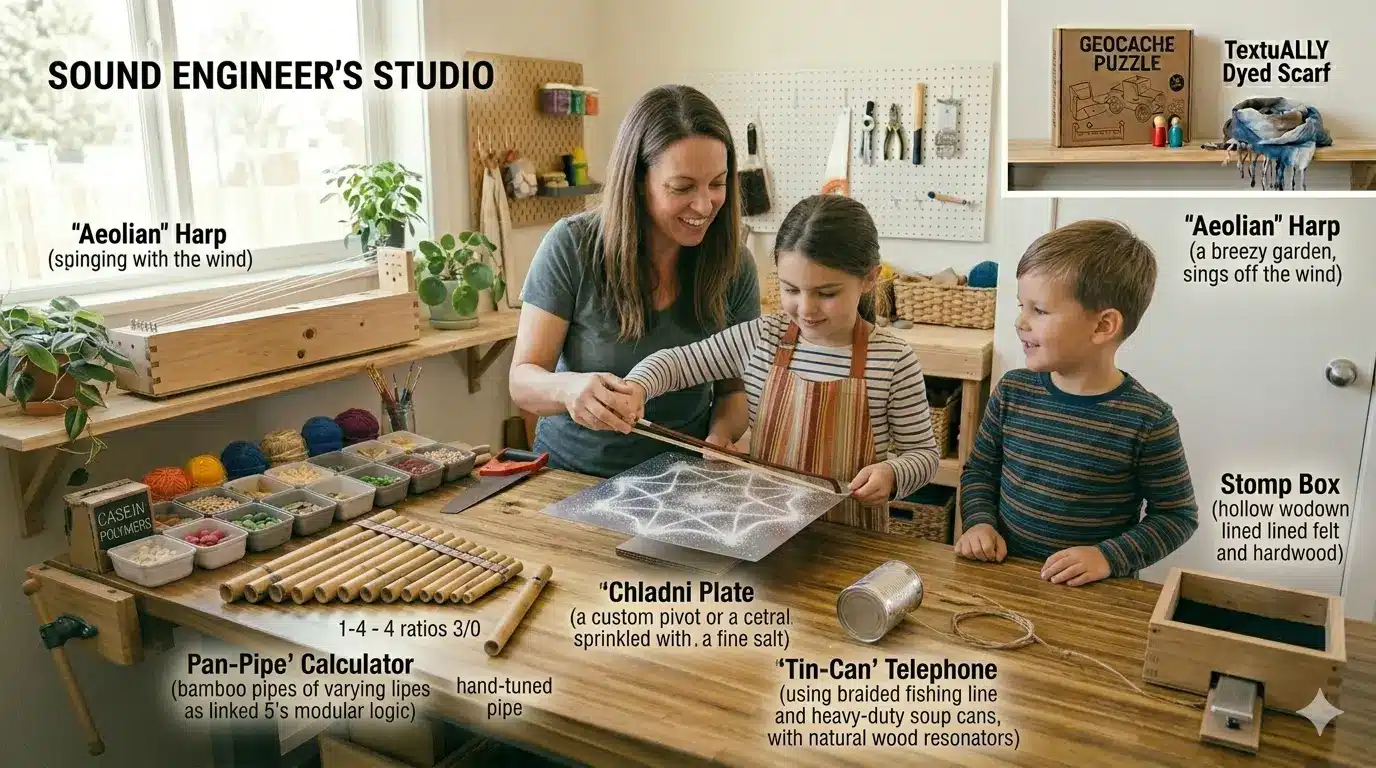
In this installment of our high-quality DIY series, we move from the visual and biological into the auditory world. Sound is not just something we hear; it is a physical wave that moves through matter. Acoustic Engineering allows children to manipulate these waves, exploring the relationship between frequency, vibration, and resonance.
By building their own “Sonic Playthings,” children learn that music is a beautiful intersection of mathematics and physical energy.
1. The “Pan-Pipe” Calculator: Frequency and Length
A set of pan-pipes is a living lesson in inverse proportionality. The longer the tube, the lower the note; the shorter the tube, the higher the note.
The Build:
- The Material: Bamboo stalks or 1/2-inch PVC pipe.
- The Math: To create a perfect “C Major” scale, you must cut the pipes to specific ratios.
- The Tuning: Use a handful of bees-wax or clay at the bottom of the tube to “fine-tune” the pitch. Adding material shortens the air column, raising the note.
- The Science: When you blow across the top, you create a standing wave. The length of the pipe dictates the wavelength, which our brain perceives as pitch.
2. The “Chladni” Plate: Visualizing Sound
If sound is a wave, what does it “look” like? A Chladni plate allows children to see the geometric patterns created by different frequencies.
Engineering the Visuals:
- The Plate: A thin square of metal or stiff plastic (like a bucket lid) mounted on a single central pivot.
- The Medium: Fine sand or salt sprinkled across the surface.
- The Input: Draw a violin bow against the edge of the plate or place it over a high-quality DIY speaker.
- The Result: At specific frequencies, the sand will move away from the vibrating areas and settle in the “nodes” (the still parts), creating intricate, star-like patterns.
3. The “Tin-Can” Telephone: Mechanical Conduction
While we are used to digital signals, the “Tin-Can” phone is a masterclass in mechanical energy transfer. It proves that sound can travel through solids much faster and clearer than through air.
The High-Quality Difference:
- The Resonators: Use heavy-duty soup cans or wooden boxes rather than plastic cups.
- The “Wire”: Braided fishing line or thin copper wire provides much better tensile strength and vibration conduction than cotton string.
- The Logic: For the “signal” to travel, the line must be perfectly taut. This teaches the child that sound requires a medium to move, and the tension of that medium dictates the quality of the “data.”
4. The DIY “Stomp” Box: Rhythm and Percussion
Electronic music often uses “triggers.” You can engineer a purely analog Stomp Box to understand how a physical impact becomes a resonant beat.
The Setup:
- The Chamber: A hollow wooden box (a cigar box or a small crate).
- The “Beater”: A spring-loaded wooden dowel or a simple foot-pedal.
- The Acoustics: Line the inside with different materials. Felt dampens the sound (shorter decay); hard wood reflects it (sharper “crack”).
- The Interaction: The child learns about timbre—why a “thud” sounds different from a “click,” even if they have the same volume.
5. The “Aeolian” Harp: Wind-Powered Music
An Aeolian harp is a stringed instrument played by the wind. It introduces the concept of Vortex Shedding—the same physics that makes power lines “hum” in a storm.
The Build:
- The Frame: A long, shallow wooden box with a sound-hole in the center.
- The Strings: Multiple strands of nylon fishing line, all tuned to the same note but at slightly different tensions.
- The Placement: Set the harp in a window or a breezy part of the garden.
- The Magic: As the wind passes over the strings, it creates tiny “whirlpools” of air that pluck the strings, creating haunting, ethereal chords.
Acoustic Standards and Safety
- Hearing Protection: When experimenting with Chladni plates or high-frequency whistles, ensure the volume stays within safe limits (below 85 decibels).
- Structural Integrity: Instruments under tension (like the Aeolian harp or the Tin-Can phone) can snap. Use eye protection during the “stringing” phase.
- Precision: In acoustics, a millimeter matters. Encourage the child to use the “Surveyor’s Chain” logic to measure their pipes and strings with total accuracy.
Summary of Acoustic Concepts
| Project | Concept | System Variable | Skill Developed |
| Pan-Pipes | Frequency | Pipe Length | Ratio / Math |
| Chladni Plate | Nodal Patterns | Resonance | Visual Analysis |
| Tin-Can Phone | Conduction | Line Tension | Mechanical Physics |
| Stomp Box | Timbre / Decay | Material Density | Percussion Logic |
| Aeolian Harp | Vortex Shedding | Wind Velocity | Fluid Dynamics |
Final Thoughts: The Resonance of Creation
Sound engineering teaches children that they are surrounded by invisible energy. By building harps that sing with the wind and plates that draw with sand, they realize that they can “tune” the world around them. High-quality play is the act of finding the harmony between a physical object and the energy moving through it.