
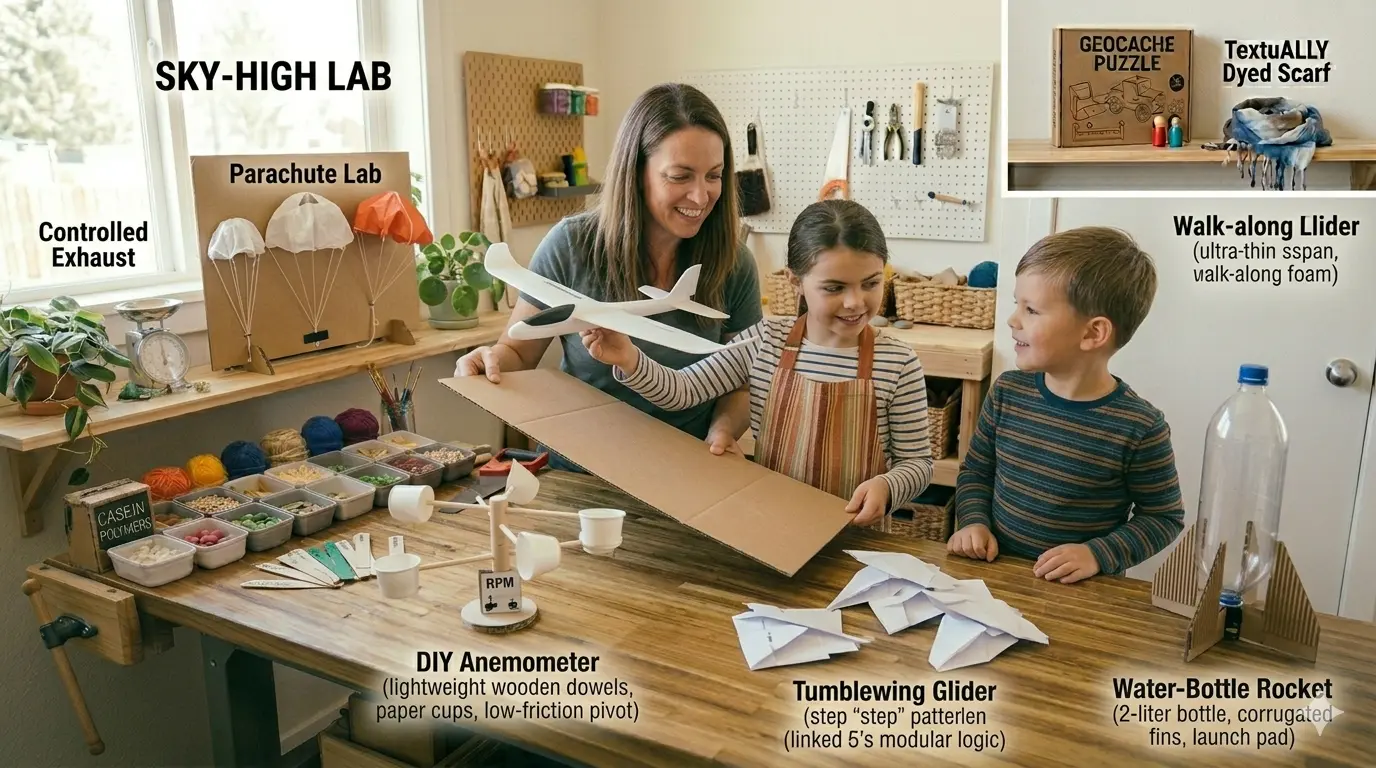
In our final transition from the ground and the stars, we tackle the physics of the atmosphere. Aerodynamics is the ultimate test of high-quality DIY construction; if a project is slightly off-balance or lacks structural integrity, it simply won’t fly. By building “Flight Engines,” children learn the delicate relationship between lift, weight, thrust, and drag.
This guide explores how to harness the invisible fluid we call “air” to achieve sustained motion.
1. The “Infinite” Paper Plane: Understanding Lift
Most paper planes are thrown once and land. A high-quality Walk-along Glider is engineered to fly forever by riding a “wave” of air created by the pilot.
The Build:
- The Material: Ultra-thin tissue paper or foam sliced to 0.5mm thickness.
- The Design: A wide wingspan with “winglets” (folded edges) to prevent air from “leaking” off the sides.
- The Interaction: The child walks behind the glider holding a large piece of cardboard at an angle.
- The Science: The cardboard pushes air upward (updraft). The glider’s light weight allows it to “surf” on this rising air, demonstrating Bernoulli’s Principle: faster-moving air creates lower pressure, resulting in lift.
2. The DIY Anemometer: Measuring Wind Speed
Before launching a flight mission, a pilot must know the “sea state” of the air. A DIY Anemometer turns wind energy into rotational data.
Engineering the Rotation:
- The Arms: Two lightweight wooden dowels crossed in an “X.”
- The Cups: Four paper cups or halved ping-pong balls attached to the ends.
- The Bearing: A low-friction pivot point (a pin in a pencil eraser or a fidget spinner bearing).
- The Data: Paint one cup a different color. The child counts how many times the red cup passes in 60 seconds to calculate the RPM (Rotations Per Minute) of the wind.
3. The “Tumblewing”: Rotational Aerodynamics
Not all flight requires traditional wings. A Tumblewing is a masterclass in Magnus Effect and rotational stability.
The Build:
- The Form: A rectangular strip of lightweight paper folded into a “step” pattern.
- The Flight: Dropped from a height, it spins rapidly.
- The Science: As it spins, it creates a high-pressure zone underneath it, allowing it to “tumble” slowly toward the ground rather than falling like a rock. This teaches children that geometry and motion can create lift just as effectively as a fixed wing.
4. The Parachute Lab: Managing Drag
While most flight projects focus on lift, the parachute focuses on the opposite: Drag.
The Experiment:
- Variable A (Surface Area): Build three parachutes of different sizes. Which one falls slowest?
- Variable B (Venting): Cut a small hole in the center of one parachute (the “Apex Vent”).
- The Logic: Children will observe that the parachute with the vent falls straighter. Without the vent, air “spills” out the sides unevenly, causing the parachute to wobble. This teaches the importance of controlled exhaust in engineering.
5. The “Water-Bottle” Rocket: High-Pressure Propulsion
This is the “heavy-lifter” of DIY aerodynamics. It combines our previous knowledge of Pneumatics with the physics of flight.
The Setup:
- The Fuel: 1/3 water, 2/3 compressed air.
- The Engine: A 2-liter soda bottle.
- The Fins: Corrugated plastic or cardboard fins taped to the bottom.
- The Launch: When the pressure is released, the water is forced out at high velocity (Newton’s Third Law), pushing the rocket upward with incredible force.
Mastery Tip: Use the “Foley Station” logic to record the sound of the launch. The “pop” and “hiss” are acoustic signatures of the pressure differential you created.
Aerodynamic Standards and Safety
- Clear Skies: Always launch rockets and gliders in open spaces, away from power lines and trees.
- Weight Distribution: Teach the “Center of Gravity” (CG). A plane that is too “tail-heavy” will stall; a plane that is too “nose-heavy” will dive. Finding the balance point is the key to a high-quality build.
- Impact Awareness: Ensure all flight projects are lightweight enough to be safe upon landing.
Summary of Aerodynamic Concepts
| Project | Concept | Force Focus | Skill Developed |
| Walk-along Glider | Updraft / Lift | Bernoulli’s Principle | Fluid Surfing |
| Anemometer | Wind Velocity | Rotational Energy | Meteorological Data |
| Tumblewing | Magnus Effect | Rotational Lift | Stability Logic |
| Parachute Lab | Surface Tension | Drag / Air Resistance | Descent Control |
| Water Rocket | Propulsion | Newton’s Third Law | High-Pressure Launch |
Final Thoughts: The Horizon of Making
With this final article, your workshop has covered the earth, the water, the stars, and the sky. DIY play has evolved from simple cardboard forts into a sophisticated understanding of the laws that govern our universe. Your child is no longer just “playing”; they are interfacing with reality.