
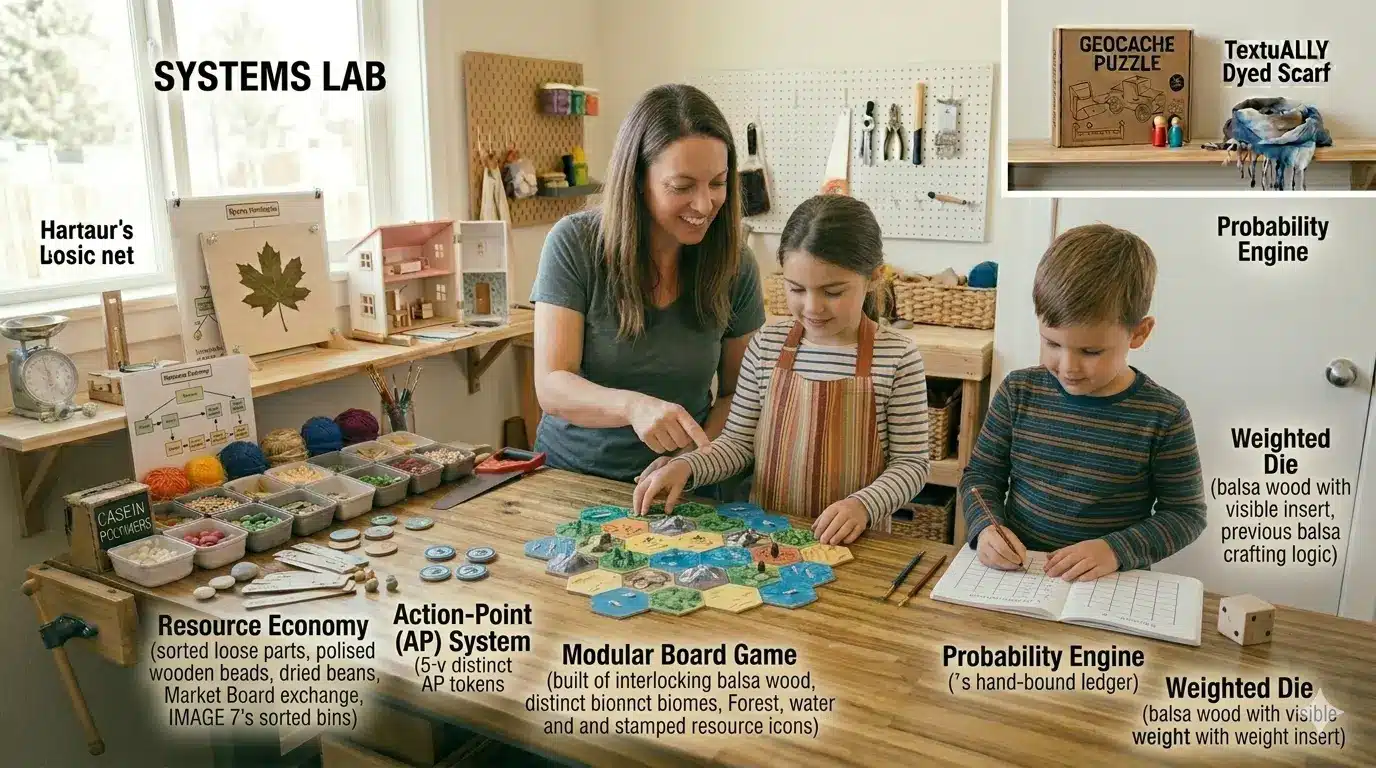
We have mastered the physical, the biological, and the digital. In this final capstone of our high-quality DIY journey, we explore Systems Design. Every game, from a simple board game to a complex mobile 4X strategy title, is a “system of rules” that governs interaction. By building their own games, children transition from being players to being Architects of Experience.
This guide focuses on “Tabletop Engineering”—building durable, balanced, and engaging games that teach probability, resource management, and social dynamics.
1. The “Modular” Board Game: Level Design 101
A fixed game board offers one experience. A Modular Board allows the child to “procedurally generate” a new world every time they play.
The Build:
- The Tiles: Hexagonal or square pieces cut from heavy book board or plywood.
- The Biomes: Use your “Taxonomy” skills to create distinct zones (Forest, Desert, Mountain, Water) with different movement costs.
- The High-Quality Touch: Use the “Symmetrical Block Prints” technique to stamp consistent icons for resources on each tile.
- The Science: This teaches spatial balancing. If all the resources are in one corner, the “game system” breaks. The child must learn to distribute value across the map.
2. The “Probability” Engine: DIY Dice and Spinners
In any system, there must be an element of “Chance.” High-quality DIY dice teach children the difference between Uniform and Weighted Probability.
Engineering the Odds:
- The Fair Die: Carve a perfect cube from balsa wood. Sand it until it rolls smoothly.
- The Weighted Die: Drill a tiny hole in one face and insert a small lead weight or a heavy screw, then seal it.
- The Spinner: A high-precision needle pivot.
- The Experiment: Roll the fair die 50 times and record the “Data” in the Accession Ledger. Then roll the weighted die. This teaches the child how bias affects a system’s outcome.
3. The “Resource Economy”: Token Engineering
Strategic games require a “Currency.” Instead of paper money, engineer a Tactile Resource System.
The Setup:
- Primary Resources: Use the “Loose Parts” from your collector’s lab—polished stones (Ore), wooden beads (Lumber), and dried beans (Food).
- The Exchange Rate: Create a “Market Board.” 3 Beans = 1 Stone. 2 Stones = 1 Tool.
- The Logic: This is a physical representation of an In-Game Economy. The child learns about inflation (what happens if we add 100 more beans to the game?) and scarcity.
4. The “Action-Point” System: Mechanical Turn Logic
How do we prevent one player from doing “everything” at once? We engineer an Action-Point (AP) System.
The Mechanism:
- The Pool: Each player gets 5 wooden tokens at the start of their turn.
- The Cost: Moving 1 tile = 1 AP. Attacking = 3 AP. Building = 5 AP.
- The Strategy: The child must decide: “Do I move five times, or do I stay still and build once?”
Technical Insight: This is the foundation of Resource Allocation in software engineering. You have a finite amount of “CPU/Memory” (AP) and must decide which “Processes” (Actions) are most important.
5. The “Feedback Loop”: Game Testing and Iteration
The most important part of high-quality DIY game design isn’t building the board; it’s Debugging the Rules.
The Protocol:
- The Alpha Test: The child plays the game against themselves.
- The Beta Test: The family plays the game together.
- The Patch Notes: After the game, ask: “What was too easy? What was frustrating?”
- The Update: Change one rule (e.g., “Moving now costs 2 AP instead of 1”) and see how it changes the “Player Experience.”
Game Engineering Standards
- Rule Clarity: A high-quality game must have a written “Instruction Manual.” If a rule isn’t written down, it doesn’t exist in the system.
- Durability: Game pieces should be built to last. Use the “Casein Polymer” or wood-sealing techniques from previous articles to protect the tokens.
- The “Fun” Factor: Remind the child that a system can be mathematically perfect but boring to play. Balance the “Math” with “Narrative.”
Summary of Systems Design
| Project | System Concept | Physical Analog | Skill Developed |
| Modular Board | Level Design | Hex Tiles | Spatial Balancing |
| Weighted Dice | Probability | Balsa Cubes | Statistical Analysis |
| Resource Market | Macro-Economics | Stones / Beans | Value Trade-offs |
| Action-Point Pool | Resource Management | AP Tokens | Strategic Priority |
| Beta Testing | Iteration / QA | Player Feedback | Debugging / Empathy |
Final Thoughts: The Infinite Workshop
You have now traveled from the very first cardboard box to the creation of entire worlds and systems. By building a game, your child has synthesized everything: the physics of motion, the logic of math, the beauty of art, and the social dynamics of community.