
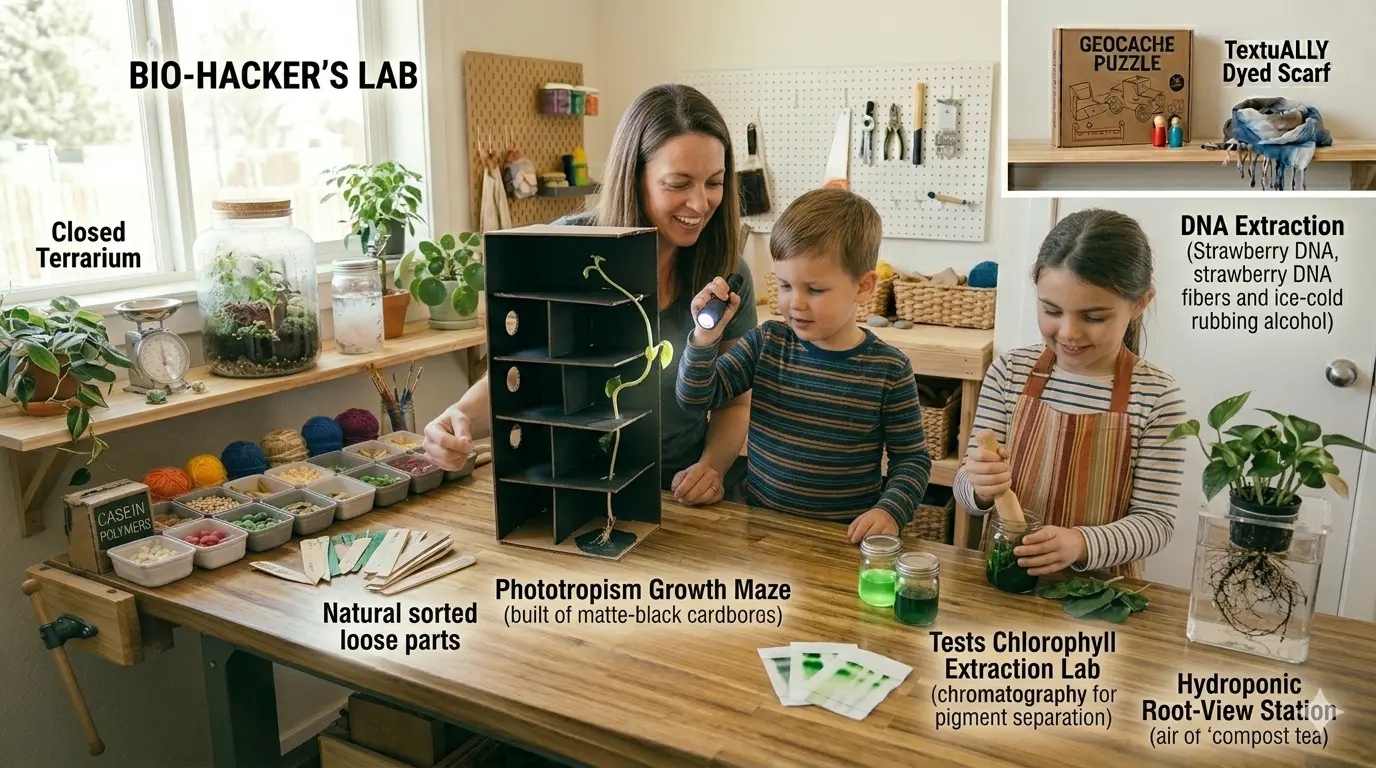
In this installment of our high-quality DIY series, we move from the mechanical and fluid worlds into the living world. High-quality “Bio-Hacking” isn’t about complex labs; it’s about understanding the code of life—DNA, photosynthesis, and cellular structures—using the garden as our motherboard.
By engineering “Living Playthings,” children learn that biology is a system of inputs and outputs that can be observed, tested, and optimized.
1. The “Chlorophyll” Extraction Lab
Plants are solar-powered factories. To understand how they work, we must see the “ink” they use to capture sunlight.
The Build:
- The Solvent: Isopropyl alcohol (hand sanitizer or rubbing alcohol).
- The Source: Dark green leaves (spinach or kale work best).
- The Process: Tear the leaves into tiny bits and soak them in the alcohol in a glass jar. Use a DIY wooden pestle to crush them.
- The Result: After an hour, the liquid turns a deep, glowing green. This is raw chlorophyll.
- The Test: Place a coffee filter strip into the liquid. Through chromatography, the different pigments (greens, yellows, and oranges) will separate, showing the hidden colors of the leaf.
2. The “Phototropism” Maze
Plants aren’t static; they “hunt” for light. You can engineer a growth maze that forces a plant to solve a spatial puzzle to survive.
Engineering the Challenge:
- The Box: A tall cardboard box with the inside painted matte black.
- The Baffles: Horizontal cardboard “shelves” staggered with holes in alternating corners.
- The Goal: A single hole at the very top to let in one beam of light.
- The Organism: A fast-growing bean sprout.
Scientific Observation: Over two weeks, the child watches the bean stalk bend in 90-degree angles to find the light—a biological response known as phototropism.
3. The “DNA” Kitchen Extraction
DNA is the “source code” for all living things. Surprisingly, it is large enough to be seen with the naked eye when extracted correctly from a strawberry.
The Extraction Protocol:
- Step 1: Mash a strawberry in a bag with a “lysis buffer” (water, salt, and dish soap). The soap breaks open the cell membranes.
- Step 2: Filter the liquid into a jar.
- Step 3: Layer ice-cold rubbing alcohol on top.
- The Reveal: White, cloudy, stringy fibers will rise into the alcohol layer. That is the strawberry’s DNA.
Technical Insight: Strawberries are “octoploid,” meaning they have eight sets of chromosomes. This high density makes them the perfect candidate for DIY genetic visualization.
4. The “Root-View” Hydroponic Station
Soil is often a “black box” that hides the most interesting engineering: the root system. A high-quality hydroponic station makes the invisible visible.
The Setup:
- The Vessel: A clear glass or plastic jar.
- The Support: A piece of mesh or a sponge to hold the seed above the water.
- The Nutrient: A DIY “compost tea” (water soaked with aged compost).
- The Observation: Because there is no soil, the child can watch the radicle (first root) emerge and branch out into a complex, fractal network.
5. The “Terrarium” Ecosystem: Closed-Loop Logic
A closed terrarium is a self-sustaining miniature planet. It teaches children about the carbon cycle and the water cycle in a sealed environment.
The Build:
- The Layers: 1. Pebbles (drainage), 2. Charcoal (filtration), 3. Moss/Soil, 4. Small plants.
- The Seal: A glass jar with a gasket lid.
- The Play: Once sealed, the water evaporates from the leaves, condenses on the glass, and “rains” back down. It is a circular economy of resources that can survive for years without being opened.
Bio-Engineering Standards and Ethics
- Sanitation: When working with DNA or plant extracts, “cross-contamination” is the enemy. Wash all tools between experiments to keep the “data” clean.
- Resource Respect: Only harvest what you need. Teach the child that plants are living systems, not just materials.
- The “Release” Protocol: Once a maze or hydroponic experiment is finished, transplant the plant into the earth to complete its lifecycle.
Summary of Bio-Hacking Concepts
| Project | Concept | System Component | Skill Developed |
| Chlorophyll Lab | Photosynthesis | Pigments / Solvents | Chemical Extraction |
| Growth Maze | Phototropism | Sensory Input | Observation |
| DNA Extraction | Genetics | Molecular “Code” | Lab Technique |
| Root-View Station | Hydroponics | Resource Delivery | Structural Analysis |
| Closed Terrarium | Ecology | Closed-Loop Cycles | Systems Thinking |
Final Thoughts: The Code of Life
Bio-hacking reminds us that we are part of a larger, living engine. By extracting DNA and engineering mazes, children realize that life isn’t magic—it’s a sophisticated, beautiful series of chemical and physical interactions. They stop being just observers of nature and become its stewards.