In this chapter of our high-quality DIY journey, we move from the visible mechanics of gears and pulleys to the invisible force of fluid power. Pneumatics (using air) and hydraulics (using liquids) are the hidden muscles behind everything from construction cranes to dental chairs. Building these systems allows children to master the concept of pressure, volume, and force multiplication.
By creating “Fluid Engines,” children learn that air and water aren’t just things we breathe or drink—they are tools for doing work.
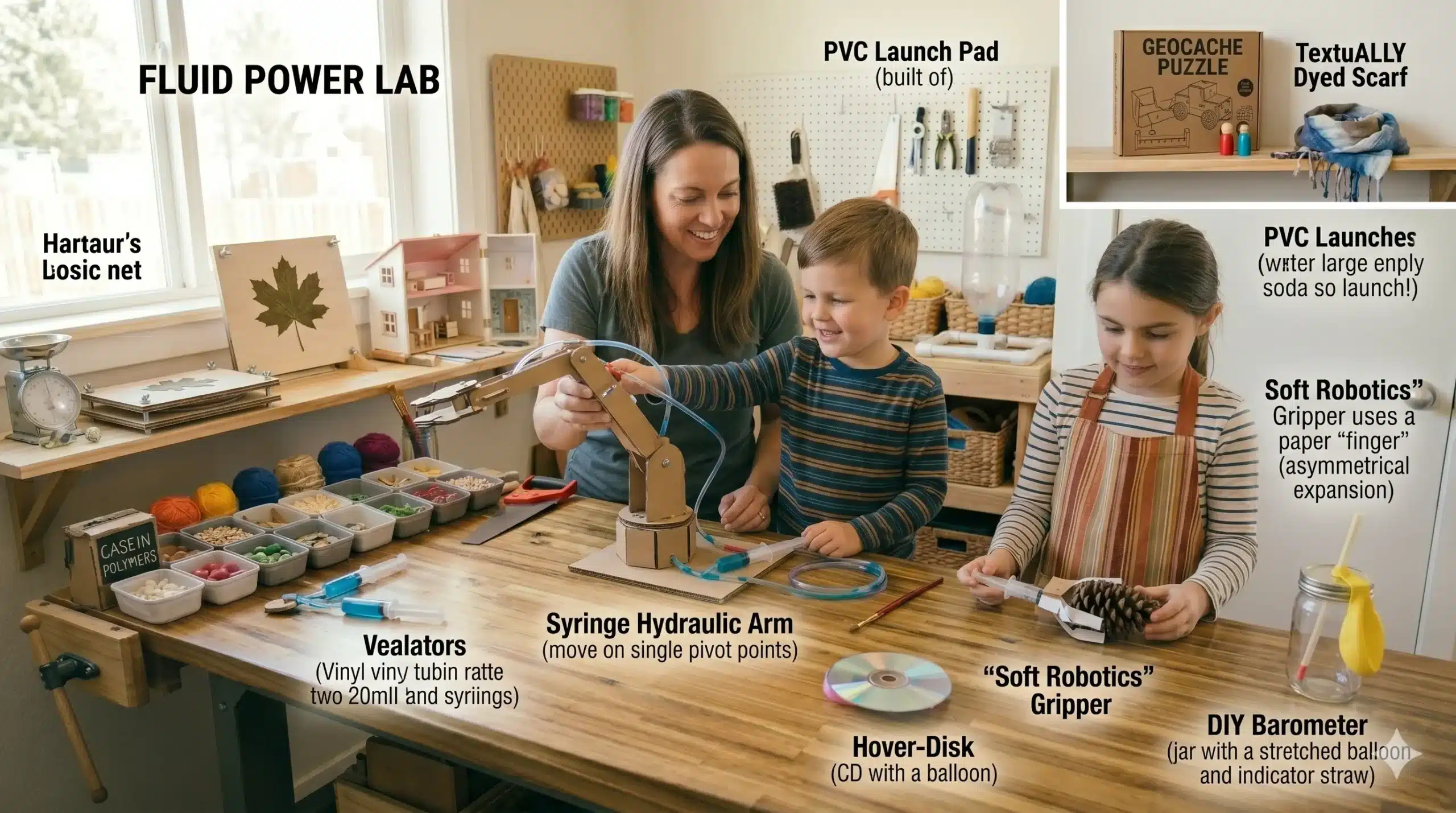
1. The Syringe Hydraulic Arm
This is the “Gold Standard” of fluid engineering. By connecting two medical-grade syringes (without needles) with a clear vinyl tube, you create a closed-loop system that can move objects across a distance.
The Build:
- The “Actuators”: Two 20ml syringes.
- The “Veins”: 2 feet of clear vinyl tubing (ensure a tight fit on the syringe tips).
- The Fluid: Water (add a drop of food coloring to make the “energy” visible).
- The Mechanical Joint: A simple cardboard arm with a single pivot point (a brass fastener or a bolt).
Scientific Insight: This demonstrates Pascal’s Principle: pressure applied to an enclosed fluid is transmitted undiminished to every part of the fluid and to the walls of the container.
2. The “Soft Robotics” Gripper
Modern robotics is shifting away from hard metal toward “soft” materials. You can engineer a pneumatic gripper that uses air pressure to bend paper or cardboard “fingers.”
Engineering the Bend:
- The Finger: A strip of corrugated cardboard with one side of the paper skin removed to expose the “ribs.”
- The Muscle: A long, skinny balloon taped along the ribbed side.
- The Action: When you blow air into the balloon (using a syringe or your breath), the balloon expands and forces the cardboard strip to curve.
This introduces the concept of asymmetrical expansion, the foundation of high-tech soft-body robotics used in delicate surgery or fruit harvesting.
3. The Atmospheric “Stomp” Rocket Launcher
While we previously built a water rocket, the “Stomp Rocket” is a pure pneumatic system that uses a large-volume air pulse to achieve lift.
The High-Quality Difference:
- The Bladder: A clean, empty 2-liter soda bottle or a heavy-duty laundry detergent jug.
- The Launch Tube: 1/2-inch PVC pipe.
- The Rocket: A custom-rolled paper tube that fits snugly (but not tightly) over the PVC.
- The Physics: By stomping on the bottle, the child converts a large volume of low-pressure air into a high-velocity stream.
4. The DIY Barometer: Measuring the Weight of Air
To understand high-pressure systems, we must first understand atmospheric pressure. A DIY barometer allows children to see the invisible weight of the weather.
The Build:
- The Chamber: A glass jar with a balloon stretched tightly over the top and secured with a rubber band.
- The Indicator: A thin straw taped to the center of the balloon skin, pointing to a scale on the wall.
- The Logic: When the outside air pressure is high, it pushes down on the balloon, making the straw point up. When the pressure is low (stormy weather), the air inside the jar pushes out, making the straw point down.
5. The “Hover-Disk” (Air Bearing)
Friction is the enemy of motion. You can build a high-quality “Air Bearing” or hover-disk to demonstrate how a thin film of air can eliminate friction entirely.
The Setup:
- The Disk: An old CD or a smooth plastic plate.
- The Valve: A bottle-cap with a small hole, glued over the center of the disk.
- The Power: A large balloon inflated and stretched over the cap.
- The Result: The air escaping the balloon creates a microscopic cushion between the disk and the table, allowing it to glide with zero-friction.
Fluid Power Standards and Safety
- Compression Differences: Teach the child the core difference: Air is compressible (like a spring), but Water is incompressible. This is why hydraulics are used for heavy lifting and pneumatics for fast, light movements.
- Leak Integrity: In fluid power, a tiny leak equals a total system failure. This teaches the importance of seals and tolerances.
- Pressure Limits: Always use flexible tubing that will pop off before a rigid container (like a bottle) explodes.
Summary of Fluid Concepts
| Project | Medium | Concept | Engineering Skill |
| Hydraulic Arm | Water | Force Transfer | Closed-Loop Systems |
| Soft Gripper | Air | Asymmetrical Expansion | Biomimicry |
| Stomp Rocket | Air | Velocity / Volume | Pneumatic Thrust |
| Barometer | Atmosphere | Pressure Differentials | Meteorological Tools |
| Hover-Disk | Air | Fluid Film / Friction | Surface Engineering |
Final Thoughts: The Power of the Invisible
Fluid power teaches children that the most powerful forces are often those we cannot see. By manipulating the air and water around them, they realize that engineering isn’t just about what you can touch—it’s about how you manage the energy within the space.
As a digital entrepreneur, you deal with “flow” and “traffic” in a virtual sense. How would you explain to your child that a syringe pushing water is exactly like “data” moving through a network?