
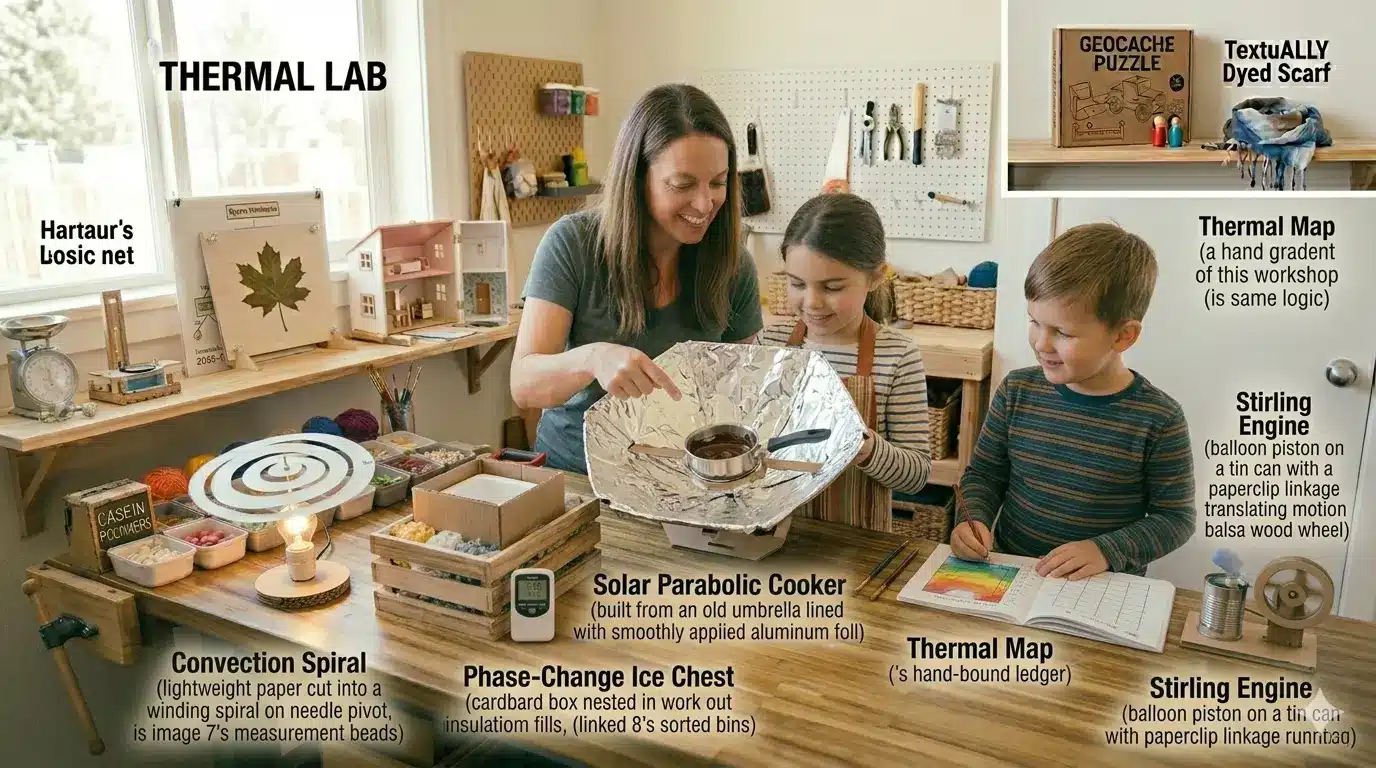
As we wrap up our intensive study of systems, we tackle the most fundamental driver of all physics: Energy. High-quality DIY play in thermodynamics isn’t just about “making things hot or cold”; it’s about understanding how energy moves, transforms, and is captured. By building “Thermal Engines,” children learn the vital concepts of conduction, convection, and radiation.
This guide explores how to build tools that harness the sun, the wind, and the molecular motion of heat.
1. The “Solar” Parabolic Cooker: Concentrating Radiation
The sun delivers a massive amount of energy to Earth every second. A high-quality Parabolic Reflector teaches children how to focus that diffuse energy into a single, high-intensity point.
The Build:
- The Frame: An old umbrella or a deep satellite dish.
- The Reflector: High-quality aluminum foil or Mylar sheets glued smoothly to the interior.
- The Focus: A wooden dowel positioned at the “Focal Point.”
- The Science: By aligning the dish with the sun, the child uses Geometric Optics to bounce light waves into a central spot, generating enough heat to melt chocolate or boil water.
2. The “Convection” Spiral: Visualizing Air Currents
Heat is invisible, but its effects are structural. You can engineer a Thermal Spiral to show how heat reduces the density of air, creating lift.
Engineering the Motion:
- The Rotor: A circle of lightweight paper cut into a continuous spiral.
- The Pivot: A needle balanced on a vertical dowel.
- The Heat Source: A warm radiator or a safely shielded incandescent bulb.
- The Result: As the air heats up, it expands and rises (Convection), pushing against the paper blades and causing the spiral to spin.
3. The “Phase-Change” Ice Chest: Insulation Science
Building a “cooler” is a masterclass in Heat Transfer. This project challenges the child to prevent energy from moving.
The Experiment:
- The Chamber: A cardboard box nested inside a larger wooden crate.
- The Variable (Insulation): Test different “fills”—wool, crumpled newspaper, air pockets, or sand.
- The Metric: Place a 100g ice block inside. The “winning” build is the one that preserves the most mass after one hour.
- The Logic: This teaches Thermal Resistance ($R$-value). The child learns that certain materials slow down molecular vibration better than others.
4. The “Stirling” Engine (Simplified): Mechanical Heat
The Stirling engine is a fascinating device that converts a temperature difference into physical motion.
The Setup:
- The Piston: A balloon stretched over a tin can.
- The Displacer: A piece of steel wool inside the can.
- The Cycle: When the bottom of the can is heated and the top is cooled, the air inside expands and contracts rapidly, pushing the balloon up and down.
- The Translation: Attach a paperclip linkage to a wheel to see the heat turn into Rotational Kinetic Energy.
Getty Images
5. The “Thermal” Map: Documenting Energy
Using the skills from our “Cartography” article, the child can create a Thermal Survey of their home or workshop.
The Data Collection:
- The Tool: A simple infrared thermometer or even “tactile sensing” (carefully feeling surfaces).
- The Map: Draw the floor plan of the workshop.
- The Coding: Use a color gradient—Blue for “Heat Sinks” (windows, metal legs) and Red for “Heat Sources” (electronics, sunlit spots).
Thermal Standards and Safety
- Heat Management: Always use “Hot Pads” or gloves when handling solar reflectors or engine cans.
- Fire Safety: Solar cookers can ignite dry leaves in seconds. Never leave a parabolic reflector unattended in the sun.
- Accuracy: Use a digital thermometer to record exact temperatures. High-quality play relies on empirical data, not just “feeling warm.”
Summary of Thermal Concepts
| Project | Concept | System Energy | Skill Developed |
| Solar Cooker | Radiation | Radiant to Thermal | Geometric Focus |
| Thermal Spiral | Convection | Fluid Dynamics | Observation |
| Ice Chest | Conduction | Thermal Resistance | Material Science |
| Stirling Engine | Work | Heat Expansion | Mechanical Engineering |
| Thermal Map | Energy Gradient | Spatial Data | Systems Analysis |
Final Thoughts: The Engine of Everything
Energy is the currency of the universe. By building these projects, your child learns that they are not just consumers of power—they are Energy Managers. They learn to see the world as a flow of heat and motion, preparing them for a future where sustainable engineering is the most critical skill of all.