
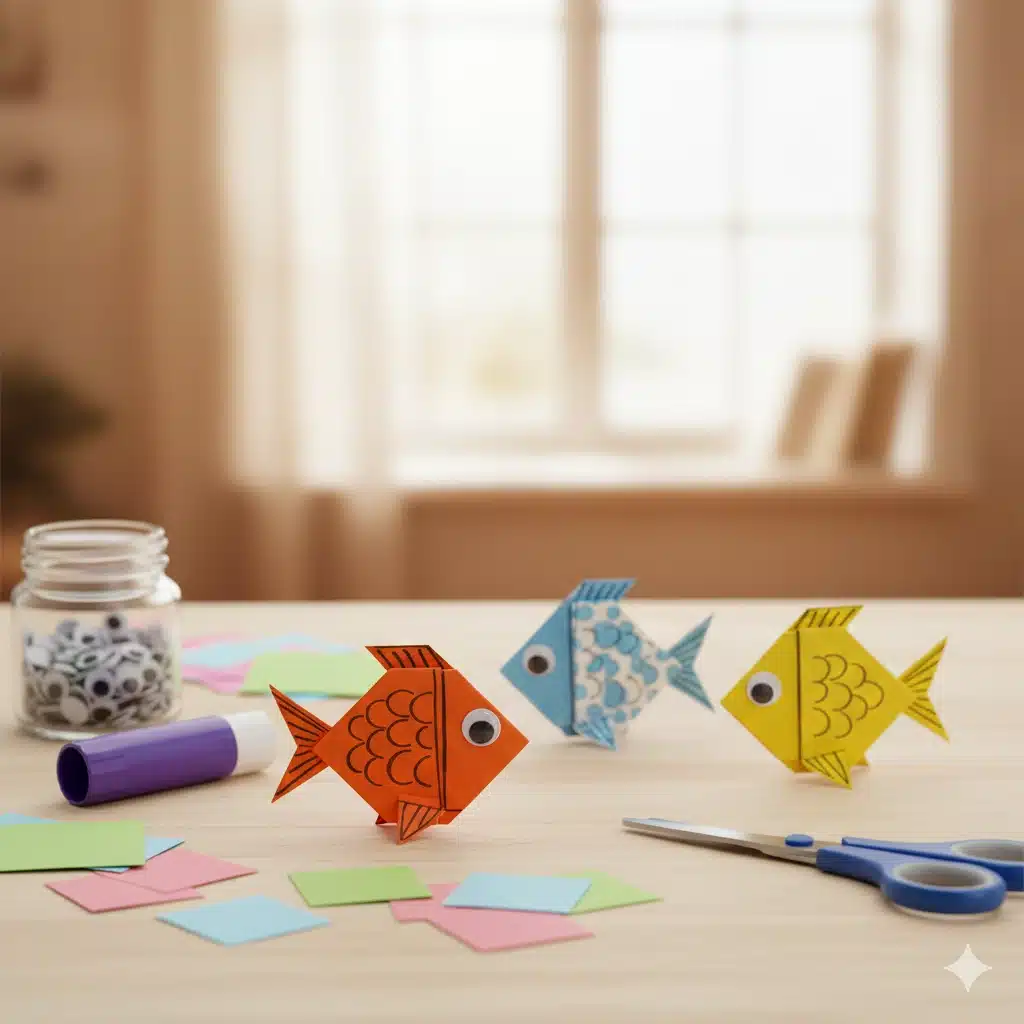
The world of paper crafting is vast, but few techniques are as rewarding or as globally recognized as Origami. For many, the word “Origami” conjures images of incredibly complex, museum-grade sculptures made from a single sheet of paper. However, the heart of this Japanese tradition is much more accessible. In fact, if you’ve ever folded a paper airplane or a “cootie catcher” during a school break, you have already practiced the ancient art of Origami.
In Japanese, the word is derived from two roots: “Oru” (to fold) and “Kami” (paper). Together, they represent a philosophy of transformation—taking a simple, two-dimensional square and turning it into a three-dimensional work of art. Today, we are going to dive into the refreshing world of aquatic life with an Easy Origami Fish Craft. This project is designed specifically for beginners and children, making it the perfect introduction to a lifelong hobby.
The Benefits of Origami for Growing Minds
Origami is more than just a fun pastime; it is a powerful educational tool. When children sit down to fold a paper fish, they are engaging in several critical developmental areas:
- Spatial Reasoning: Understanding how a flat surface becomes a 3D object helps children visualize geometric concepts.
- Fine Motor Skills: Precise folding requires a high level of hand-eye coordination and finger dexterity.
- Patience and Focus: Following step-by-step instructions encourages children to slow down and pay attention to detail.
- Mathematical Foundations: Many Origami folds are based on symmetry, fractions, and angles, providing a tactile way to experience math.
Exploring Popular Origami Shapes
While our focus today is on the fish, the world of Origami is filled with iconic shapes that have captured imaginations for centuries. Here are some of the most popular projects for beginners to explore after they master the fish:
- Fortune Tellers (Cootie Catchers): A playground classic used for games and storytelling.
- Paper Boats: A simple fold that actually floats on water.
- Hats: A large-scale fold often made from newspapers.
- Cranes: Perhaps the most famous shape, symbolizing peace and longevity.
- Swans: Known for their elegant necks and graceful aesthetic.
- Jumping Frogs: An interactive fold that uses the tension of the paper to “hop.”
- Hearts: A popular choice for cards and Valentine’s Day decorations.
Essential Supplies for Your Origami Fish
One of the best things about Origami is that it requires very few tools. You don’t need expensive equipment to get started. For this fish craft, gather the following:
- Colored Craft Papers: You can use specialized Origami paper or any lightweight craft paper. A 4″ x 4″ square is the perfect size for little hands.
- Pencil: Helpful for marking folds or adding details later.
- A Pair of Scissors: While traditional Origami doesn’t always use cutting, we’ll use them here to prep our perfect squares.
- Craft Glue: To secure the googly eyes and any extra fins.
- Googly Eyes: To give your fish a playful, animated personality.
- Markers or Sharpies: For adding scales, stripes, or bubbles!
Step-by-Step Instructions: Folding Your Origami Fish
Follow these steps carefully. Remember, the secret to great Origami is making your creases as sharp as possible!
1. The Perfect Square
Start with a square piece of paper, 4 inches on all sides. If you are using paper that is colored on only one side, start with the colored side facing down.
2. Creating the Grid
Fold the paper in half vertically and crease it well. Unfold it. Now, fold it in half horizontally and crease it. When you unfold it this time, you should see a cross-shaped “grid” in the center of your square. These lines will act as your roadmap for the rest of the craft.
3. The Triangular Base
Fold the paper diagonally, bringing one corner to the opposite corner. Crease and unfold. Repeat this with the other two corners. You should now have lines running through the center in four directions. Using these creases, push the sides inward to collapse the paper into a “Waterbomb Base”—a classic Origami shape that looks like a small, four-pointed triangle.
4. Shaping the Tail
Take the top flap of the right side of your triangle and fold it toward the center, slightly past the middle line. Take the left flap and fold it over the right one. This creates the overlapping “X” shape that forms the fish’s tail.
5. Bringing the Fish to Life
Flip the paper over. You will see the smooth body of your fish with the tail pointing out the back. Now it’s time for the finishing touches! Glue a googly eye near the front point of the fish. Use your markers to draw a curved line for the gills and add some colorful scales along the body.
Creative Ways to Display Your Origami Fish
Once you’ve made one fish, you’ll likely want to make a whole school of them! Here are some fun ways to use your finished crafts:
- Underwater Diorama: Use a shoebox painted blue to create a miniature ocean. Hang your Origami fish from the top using clear fishing line so they look like they are swimming.
- Greeting Cards: Glue a flat Origami fish onto the front of a blue card. Draw some bubbles and seaweed for a personalized “Thank You” or “Happy Birthday” note.
- Mobile Art: Attach several fish to a wooden hoop or a hanger to create a beautiful, moving mobile for a child’s bedroom.
- Bookmarks: These fish are flat enough to be tucked into a book, making them a great companion for a trip to the library.
Pro Tips for Origami Success
- Work on a Hard Surface: Avoid folding in your lap. A flat table will give you much sharper, more accurate creases.
- Use Your Fingernail: After making a fold, run your fingernail along the crease to “lock” it in place.
- Don’t Be Afraid of Patterns: Using patterned paper (like polka dots or florals) can give your fish a “tropical” or “exotic” look.
- Check Your Symmetry: Origami is all about balance. If one side looks different than the other, unfold a step and try to realign the edges.
Conclusion: The Joy of Paper Transformation
Origami is a journey that begins with a single fold. By making this easy fish craft, you are participating in a tradition that spans centuries and continents. It is a reminder that with a little patience and imagination, something as simple as a square of paper can become a symbol of life and creativity.
Whether you are crafting in a classroom or at the kitchen table, we hope this Origami fish brings a splash of color and joy to your day. Happy folding