
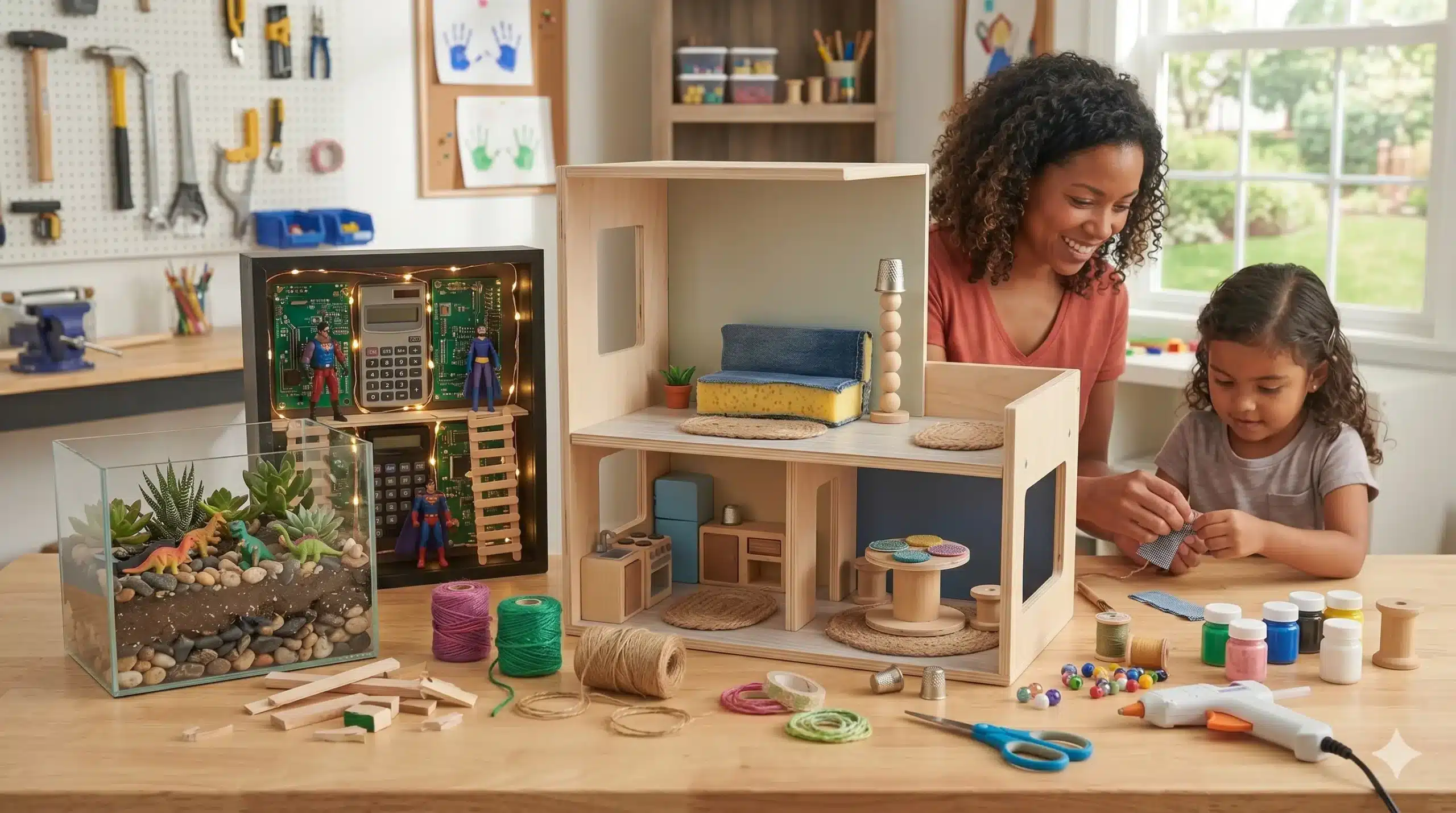
While the previous guides explored grand physical movements and sensory exploration, this article focuses on the intricate, the internal, and the imaginative. Crafting miniature worlds—whether a traditional dollhouse, a superhero base, or a dinosaur terrarium—is an exercise in meticulous planning and narrative-building.
For a child, a miniature world is a space where they have total control. They aren’t just playing; they are practicing social dynamics, interior design, and structural organization. When you move away from pre-fabricated plastic kits and toward DIY miniatures, you open up a world of “creative scavenging” where a bottle cap becomes a stool and a scrap of fabric becomes a Persian rug.
1. Project: The Modernist Plywood Dollhouse
Target Skills: Scale measurement, interior architecture, and spatial awareness.
A “Modernist” house isn’t just a style choice—it’s a design philosophy that favors clean lines and open spaces, making it much easier for small hands to navigate and play.
Materials You’ll Need:
- Frame: 1/2-inch birch plywood (sanded to a high finish).
- Joinery: Wood glue and a brad nailer (or small finishing nails).
- Flooring: Self-adhesive vinyl floor tiles or thin cork sheets.
- Paint: Low-VOC interior sample pots.
The Build:
- The 1:12 Rule: In the world of miniatures, the standard scale is 1:12 (one inch equals one foot). This makes math easy for children. If a real ceiling is 8 feet high, your dollhouse ceiling should be 8 inches high.
- Open Concept: Avoid adding a front wall. A three-sided structure allows for maximum “playability” and allows multiple children to engage at once.
- The Modular Roof: Instead of a fixed pitched roof, create a flat, removable roof terrace. This adds an extra “room” for play without increasing the footprint of the toy.
2. Project: The “Scrap-to-Studio” Furniture Kit
Target Skills: Material repurposing, fine motor skills, and “Upcycling” logic.
High-quality dollhouse furniture can be expensive. The DIY approach teaches children to look at “trash” as potential treasure.
The Transformation List:
- The Sofa: A kitchen sponge wrapped in a scrap of old denim or linen, secured with hot glue.
- The Lighting: Large wooden beads stacked with a gold thimble on top to create a “mid-century” floor lamp.
- The Dining Table: A circular wooden craft coaster glued onto a discarded thread spool.
- The Rugs: Samples of carpet from a flooring store or braided colorful twine.
The Lesson:
Encourage your child to use prototyping. If the sponge sofa is too “springy,” how can we weight it down? This introduces the concept of structural integrity on a micro-scale.
3. Project: The Jurassic Terrarium (Live Miniature World)
Target Skills: Botany, ecosystem management, and geology.
Not every miniature world is about domestic life. A “dino-scape” or a “fairy garden” introduces a living element to play, requiring the child to care for the toy to keep it “alive.”
Materials You’ll Need:
- The Vessel: A large galvanized tub or a wide-mouth glass jar (for a closed ecosystem).
- Drainage: A layer of river pebbles and activated charcoal (to prevent root rot).
- Soil: High-quality potting mix.
- Plants: Slow-growing succulents or mosses.
The Build:
- The Strata: Layer the pebbles, then charcoal, then soil. Explain to the child how this mimics the earth’s natural filtration system.
- The Hardscape: Add large jagged rocks to represent “mountains” and a small mirror or blue glass gems to represent a “lake.”
- The Narrative: Add DIY-painted wooden dinosaurs or small figures. The child must “mist” the plants weekly, turning a plaything into a lesson in responsibility.
4. Project: The Superhero “Command Center” (Shadow Box Style)
Target Skills: Electrical circuitry (basic) and thematic storytelling.
For children interested in action and technology, a command center built into a deep shadow box or an old suitcase provides a portable, high-action miniature world.
Materials You’ll Need:
- The Case: An old hard-shell briefcase or a wooden “crates” box.
- The Tech: Old computer motherboards (unscrewed and cleaned), calculator buttons, and LED copper wire lights.
- The Grid: Silver metallic spray paint for a “high-tech” look.
The Build:
- The Wall of Tech: Glue old circuit boards to the back wall. These provide incredible visual texture that looks like a futuristic city or a spaceship interior.
- Lighting the Lab: Use the LED wire lights to outline “portals” or “computer screens.”
- Verticality: Use popsicle sticks painted silver to create ladders and catwalks, allowing figures to move between different “levels” of the base.
5. The Science of Scale and Perspective
Working in miniature forces a child to engage with Geometry. When they are building a staircase for a 4-inch action figure, they are inherently calculating rise and run:
$$Slope = \frac{Rise}{Run}$$
If the “Rise” is too steep, the figure falls over. If the “Run” is too long, the stairs won’t fit in the house. This is “stealth learning”—math applied to a problem they actually want to solve.
6. Curating the Miniature Collection
To keep a DIY miniature world high-quality, you must avoid “clutter creep.”
- Quality over Quantity: It is better to have three beautifully crafted pieces of furniture than a box full of plastic scraps.
- The “Box” Rule: Everything for the miniature world must fit back into its “vessel” (the dollhouse or the suitcase) at the end of the day.
- The Repair Shop: Set aside a small tin for “broken” miniatures. Once a month, have a “Repair Clinic” where you and the child use wood glue or a needle and thread to fix the items. This teaches the value of maintenance.
Conclusion: Why the Small Things Matter
In a giant world designed for adults, miniature play allows children to be the giants. It gives them a sense of omnipotence and order. By building these worlds yourself, you provide a canvas that is far more flexible than anything found in a toy aisle. You are telling the child: “Your imagination is the only blueprint we need.”