
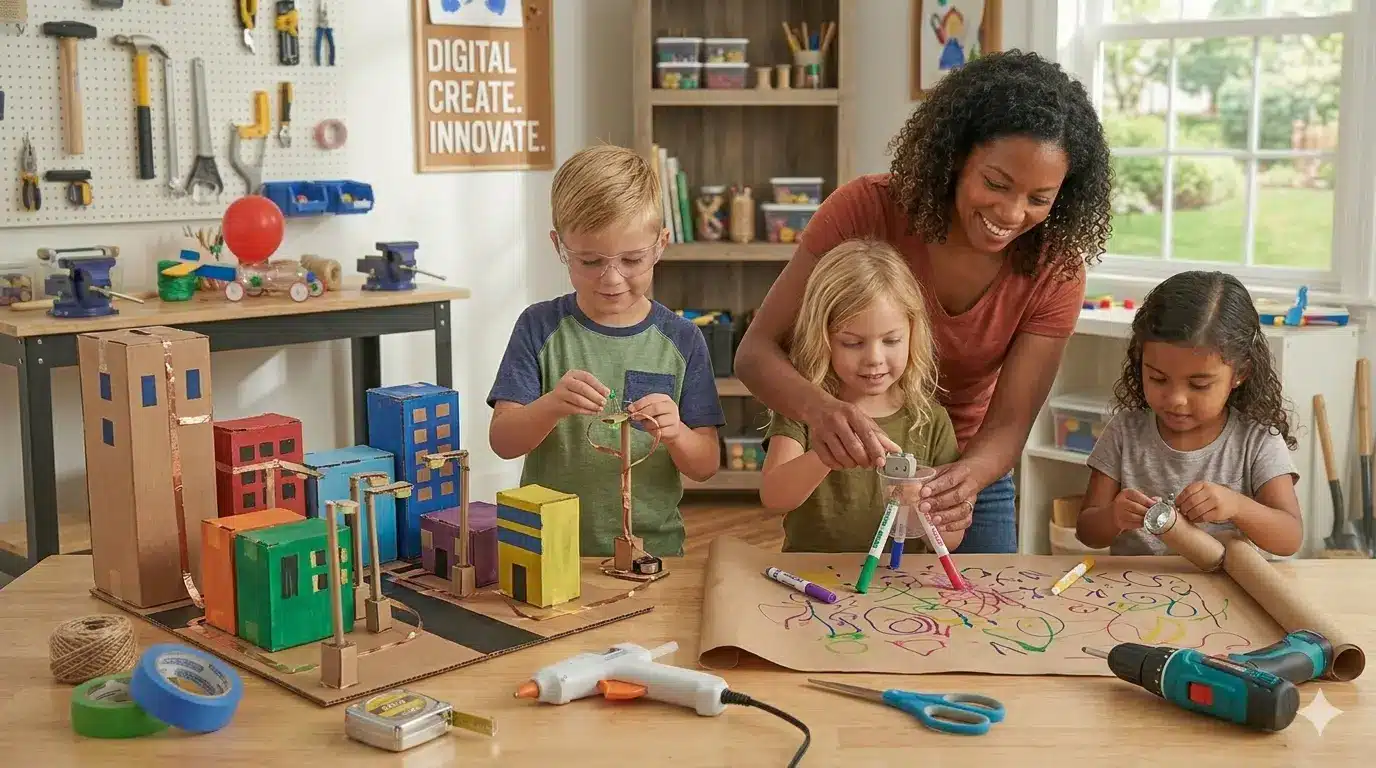
In our final transition from purely mechanical toys to the “smart” DIY era, we explore the intersection of traditional crafting and basic electronics. For a child, there is a distinct magic in seeing a creation literally “come to life” through light, sound, or movement.
This isn’t about complex coding or expensive microprocessors. It is about Circuit Literacy—understanding that electricity is a flow that can be harnessed. By integrating low-tech electronics into cardboard and wood projects, you teach children that technology isn’t a “black box” of mystery, but a tool they can manipulate.
1. Project: The Cardboard “Circuit” City
Target Skills: Parallel circuits, conductivity, and urban planning.
Instead of drawing a city on a piece of paper, we build a 3D environment where the streetlights actually turn on and the buildings have internal “power grids.”
Materials You’ll Need:
- The Infrastructure: Cardboard boxes of various sizes.
- The “Wiring”: Copper adhesive tape (highly conductive and easy for kids to peel).
- The Power: 3V coin cell batteries (CR2032).
- The Output: 5mm LED bulbs in various colors.
The Build:
- Lay the Roads: Use copper tape to create “bus lines” across your city board. Remember, a circuit must be a loop.
- The Light Post: Poke the two legs (anode and cathode) of an LED through a cardboard tube. Connect one leg to the positive copper strip and the other to the negative.
- The Switch: Use a simple clothes-pin or a folded piece of cardboard with copper tape to “bridge the gap” and turn the lights on.
- The Lesson: This is the perfect time to explain the difference between a Series Circuit and a Parallel Circuit. In a parallel circuit, if one building “burns out,” the rest of the city stays lit!
Target Skills: Kinetic energy, offset weights, and abstract art.
An Art-Bot is a jittering robot that “walks” across a piece of paper, leaving a trail of colorful doodles in its wake.
Materials You’ll Need:
- The Body: A plastic cup or a small cardboard box.
- The Motor: A small 3V DC motor (available for pennies at hobby shops).
- The Weight: A glue stick or a small piece of cork.
- The Legs: Three or four felt-tip markers.
The Build:
- Assembly: Tape the markers to the sides of the cup so it stands like a tripod.
- The Vibration Engine: Attach the cork or glue stick to the spindle of the motor off-center. When the motor spins, the uneven weight creates centrifugal force that makes the robot shake.
- Power Up: Tape the battery to the top of the cup and connect the motor wires.
- The Result: Place the robot on a large sheet of butcher paper, take the caps off the markers, and watch it create “robotic” masterpieces.
3. Project: The DIY Flashlight (The “Prop” Project)
Target Skills: Troubleshooting and the anatomy of everyday objects.
Building a flashlight from scratch demystifies one of the most common tools in a child’s life.
Materials You’ll Need:
- Housing: A PVC pipe off-cut or a sturdy cardboard tube.
- Reflector: An old yogurt lid covered in aluminum foil.
- The “Guts”: A battery holder (2 AA), a toggle switch, and an LED.
The Build:
- Reflectivity: Explain how a curved, shiny surface focuses light into a beam. Shape the foil-covered lid into a cone around the LED.
- Wiring: The switch is the “gatekeeper.” If the gate is open, the light stays off.
- Customization: Let the child add “filters” (colored cellophane) to turn their flashlight into a “ghost hunter” light or a “deep-sea” explorer lamp.
4. The Rules of Electronic DIY Safety
While low-voltage (3V–9V) projects are generally safe, they require their own set of workshop habits:
- The Heat Check: If a battery or wire feels hot to the touch, there is a “short circuit.” Disconnect the battery immediately and find where the positive and negative lines are touching.
- Coin Battery Caution: Coin cell batteries are a severe ingestion hazard. Ensure they are always secured inside a taped battery holder or a project casing.
- Polarity Awareness: LEDs only work in one direction. Teach the child that the “Long Leg” is the “Long Way” to the positive side of the battery.
5. Why “Low-Tech” is Better than “High-Tech”
In an age of AI and high-end robotics kits, why bother with copper tape and bottle caps?
- Visibility: In a DIY robot, the wires are visible. The child can see exactly where the power goes. High-end kits often hide the “how” inside a plastic shell.
- Resilience: When a copper tape circuit fails, the child has to physically trace the line with their finger to find the break. This builds debugging skills that are applicable to coding, engineering, and life.
- Creative Freedom: A kit allows you to build the robot on the box. DIY electronics allow you to turn anything into a robot.
Conclusion: The Final Frontier of Play
By adding a simple LED or a vibrating motor to a DIY toy, you are validating the child’s role as a Technologist. They are no longer just building with wood and string; they are harnessing energy.