
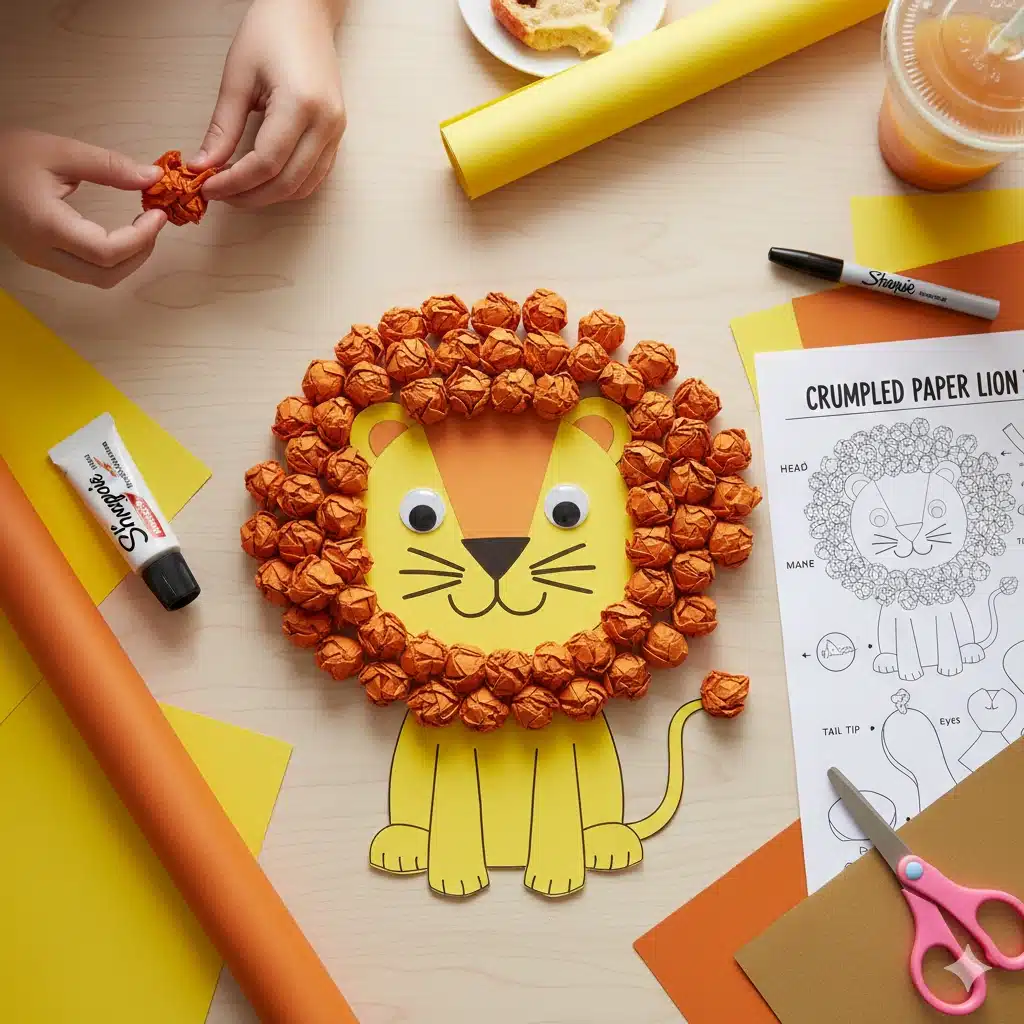
Why is crumpling paper such a powerhouse for child development? It all comes down to hand strength and dexterity.
- Muscle Strengthening: Squeezing a piece of tissue paper into a tight ball requires the use of all the small muscles in the palm and fingers. This builds the “grip strength” necessary for holding a pencil properly.
- Bilateral Coordination: Using both hands together—one to hold the paper and the other to crush it—helps the left and right sides of the brain communicate more effectively.
- Sensory Integration: The sound of the paper crunching and the change in texture from smooth to ridged provide immediate sensory feedback, which is particularly beneficial for toddlers and preschoolers.
Essential Supplies for Your Lion Craft
To create your crumpled masterpiece, you will need a few basic supplies. Most of these are likely already in your craft bin!
- Craft Paper: Yellow for the body/head and dark orange for the mane base.
- Tissue Paper: Several sheets of dark orange or gold. This is the material that will be crumpled to create the 3D texture of the mane.
- Pencil & Scissors: For tracing and cutting out your shapes.
- Craft Glue: A strong liquid glue works best for securing crumpled paper.
- Black Sharpie: To add those final, bold facial details.
- The Lion Template: A simple outline of the lion’s head, mane, and body.
Step-by-Step Tutorial: Making the Crumpled Paper Lion
Step 1: Preparing Your Base Shapes
Start by downloading a lion template or drawing the basic shapes yourself. You will need:
- A large circle for the mane (Dark Orange).
- A medium circle for the head (Yellow).
- A triangular piece for the forehead (Light Orange).
- The body, tail, and tail tip shapes.
Trace these onto your craft paper and carefully cut them out. For younger children, you may want to pre-cut these shapes so they can focus entirely on the assembly and crumpling phases.
Step 2: The Art of the Crumple
This is the part the kids have been waiting for! Take your orange tissue paper and tear it into small squares (roughly 2×2 inches). Show the child how to roll and squeeze each square into a small, tight ball.
Pro Tip: Don’t make them too perfect! Part of the lion’s charm is the wild, uneven texture of his mane.
Step 3: Building the Mane
Apply a generous layer of craft glue around the outer edge of your large dark orange circle. Have the child press the tissue paper balls into the glue, side-by-side, until the entire outer ring is covered. This creates a thick, bushy mane that literally pops off the page.
Step 4: Assembling the Face
Now, take your yellow head circle. Glue the light orange forehead triangle at the top-center. Position your googly eyes (or draw them with your Sharpie) just below the triangle. Using your black Sharpie, draw a large, rounded nose and a wide, friendly smile. Don’t forget to add a few dots for whisker spots and some long, bold whiskers! Glue the finished head onto the center of the crumpled mane.
Step 5: Attaching the Body
Finally, glue the head and mane assembly to the top of the lion’s body. Attach the tail to the back, and glue a few extra pieces of crumpled tissue paper to the very tip of the tail to match the mane.
Educational Extensions: Jungle Learning
While you craft, you can turn this into a mini-lesson about the natural world. Lions are fascinating creatures with unique social structures.
- The Pride: Explain that lions are the most social of all big cats and live in groups called “prides.”
- The Mane Event: Did you know that only male lions have manes? The mane protects their neck during fights and makes them look bigger and more intimidating to rivals.
- The Roar: A lion’s roar is so loud it can be heard from up to five miles away! Ask the kids to give their best “lion roar” once their craft is finished.
Tips for Success with Young Crafters
- Glue Management: Young children tend to use too much or too little glue. You can put a small puddle of glue in a recycled lid and give them a cotton swab or a small brush to apply it more precisely.
- Color Variations: While yellow and orange are traditional, who says you can’t have a rainbow lion? Using multi-colored tissue paper for the mane is a great way to talk about colors and patterns.
- Displaying the Art: Because of the tissue paper balls, these crafts have some “loft.” They look great when mounted on a piece of blue cardstock to represent the African savannah sky.
Why This Craft is an “AdSense-Friendly” Activity
If you are a teacher or a blogger sharing this project, this craft is a winner because it uses low-cost, accessible materials. It appeals to parents looking for “screen-free” time and teachers looking for “fine motor” curriculum support. By focusing on the physical benefits of crumpling paper, you are providing value that goes beyond just “making a cute picture.”
Final Thoughts
The Crumpled Paper Lion is more than just an art project—it’s a workout for small hands and a celebration of one of nature’s most iconic animals. The texture of the crumpled mane makes the lion feel “real” to a child, and the pride they feel in completing such a 3D project is immense.